There is something exquisitely voyeuristic about Mary Cassatt (1844-1926). The Pennsylvania-born artist was a professional working woman whose primary subject was the airless life of the leisured haute bourgeoisie. She did not marry or have children yet dedicated much of her career to observing and restaging the most intimate moments of tenderness between mothers and their offspring.
The literature on Cassatt laments all that she did not have access to as a single woman in late 19th-century Paris—the bars, cafés and nightclubs fetishised by her fellow Impressionists as emblematic locales of the modern. Less is made of what she did have access to—women’s dressing rooms, dressmaker’s salons, bedrooms and boudoirs—the private feminine realm in which modern life of a different kind played out. Cassatt documents these spaces with benign espionage. Painting women in private boxes at the theatre we share her view from a darkened world beyond, watching them watching, watching them being looked at. In At the Theatre (around 1879) a woman in a pistachio gown gazes forward, gloved arms crossed artfully at the wrist, her mouth obscured by a painted fan as though she were imparting a secret that must be kept from us. Cassatt leans in close.
The grand homecoming Mary Cassatt at Work at the Philadelphia Museum of Art opens 180 years after the artist’s birth, almost to the day. Founded in years of close study of the museum’s substantial holdings, bolstered with starry loans from public and private collections across the US, the show addresses the serious light in which Cassatt regarded her endeavour. From a newly wealthy Europhile family that valued diligent enterprise, Cassatt’s financial wherewithal unquestionably placed her at an advantage—she had a studio and money for models and material—though her father made it clear that if she chose to be a professional artist then she was expected to support herself.
She grants the women and children who sit for her the same gravity with which she hoped to be considered
No record remains of Cassatt’s studio practice as a painter, but we have preparatory sketches and progress states of her prints. The magnificent set of ten drypoint and aquatint prints that she created in 1890-91 are explored in depth, showing how she refined compositions to focus on a core dynamic. Her subjects are the intimate lives of wealthy women—dress fittings, childcare, bathing and dressing—as well as the workers who pinned their hems and tended their children. The influence of Japanese prints exhibited at the École des
Beaux Arts in Paris was significant, inspiring Cassatt to use isolated zones of bold colour and a strong and sinuous line. A small gallery exploring the genesis of this “Set of Ten” is an understated highlight.
A world of comfort
This deep technical investigation of printmaking is an approach shared with a concurrent Käthe Kollwitz exhibition at the Museum of Modern Art in New York (until 20 July), which likewise presents preparatory drawings and prints in all of their surviving states. The comparison with Kollwitz, a German artist some 20 years Cassatt’s junior and fiercely driven by a sense of social justice, is a sharp reminder of why Cassatt was so easily dismissed as lightweight. Hers is a world of comfort, prettiness, visual seduction. The Peasant War this show is not.
Cassatt documented the world available to her gaze and greeted it with seriousness—she grants the women and children who sit for her the same gravity with which she hoped to be considered herself. The deft pastel Woman Arranging Her Veil (around 1890) catches a sharp and quizzical expression that seems to have flashed across her sitter’s face as she is captured mid gesture. Whether holding the reins of a horse carriage (Driving, 1881), working at her embroidery (Lydia at a Tapestry Frame, around 1881) or wielding a crochet hook (Lydia Crocheting in the Garden at Marly, 1880), Cassatt portrays her sister Lydia grave and focused, intent on the task at hand.
All this is of a part with Cassatt’s conviction that women should engage in professional work, and with her vocal support for women’s suffrage. Whether portrayed reading, absorbed in domestic work, or lost in thought, Cassatt’s women are permitted skill and intellect. Her Little Girl in a Blue Armchair (1877-78) has become one of the best loved paintings in the US precisely because Cassatt paints her young sitter on her own terms—bored, and no longer prepared to play pretty in her fussy white dress.
Cassatt’s work with pastels as well as her printmaking informed the way she set about working in oils. Her admiration for Japanese prints taught her to simplify and refine compositions, often approaching subjects from dynamic angles. In the painting Maternal Caress (1896) the young mother is seen in profil perdu, her cheek grabbed forcefully by the auburn-haired infant she carries. The figures are isolated against a backdrop of softly modulating greens suggesting a shady May garden. Work with pastels trained Cassatt’s focus on soft modelling of the face, often leaving the rest of the figure a gestural suggestion. In one of the boldest pastel works here, The Long Gloves (1886), the blue of a young woman’s garb is suggested by the loosest possible strokes of ultramarine, a colour then carried upwards to emphasise the brightness of her hair. (Like her mentor Edgar Degas, Cassatt could not resist the visual excitement of red hair.)
This pulling on of long gloves is a rite of passage into the buttoned-up world of female adulthood. The curators distinguish the contained and claustrophobic public realm, in which women were tightly robed from chin to fingertip, and the looser private world of parlour and garden. The nakedness of children is particularly striking in this context, as is the sensuality with which women embrace young infants—rare moments of touch and closeness.
Sugary sentiment
One gallery unites her studies of women and children (a subject pointedly described here as “care work”—many of the models were servants). It is in her mother-and-child paintings that Cassatt is most liable to slip into the realm of sugary colour and sentiment that might test modern fans much as it did some of her male contemporaries.
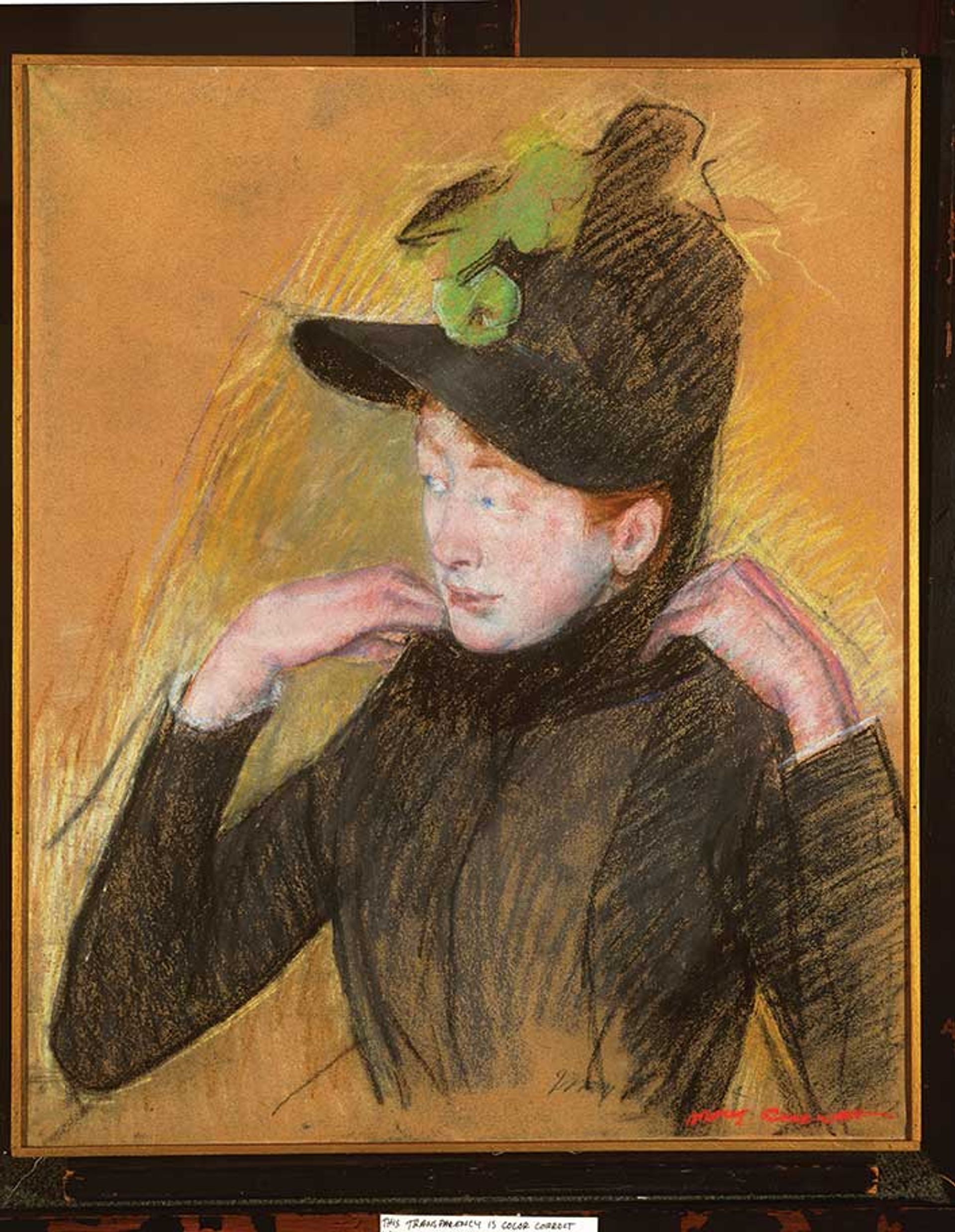
A sharp and quizzical expression: Woman Arranging her Veil (around 1890) is one of several pastel sketches in the show
Philadelphia Museum of Art
The inclusion of some less successful works—The Barefooted Child (1896-97), Pattycake (Mother and Child) (1897), Woman and Child (1908)—offer insight into the challenge of creating vivacious and convincing infant portraits. Over long study of her subject, Cassatt developed a distinctive composition, revisited in a number of works, in which adult and child appear in tight embrace, crushed cheek to cheek. It is a pose that seems more eloquent of a female desire for affection than an infant’s search for comfort.
Travelling on to the Legion of Honor in San Francisco (5 October-26 January 2025), this is a scholarly survey offering fresh insight into Cassatt’s world and working methods. Outfitted in rich colours lifted from key paintings in the show, Mary Cassatt at Work approaches its subject with a seriousness of purpose and lightness of execution that might have been borrowed from the artist herself.
• Mary Cassatt at Work, Philadelphia Museum of Art, until 8 September
• Curators: Jennifer A. Thompson and Laurel Garber