

Bitcoin is struggling to hold above the $90,000 level as uncertainty continues to dominate market sentiment. After weeks of consolidation and failed recovery attempts, price action reflects a fragile balance between cautious buyers and persistent selling pressure. While traders focus on technical levels and macro signals, an often-overlooked component of the Bitcoin ecosystem is quietly sending important warnings: miner behavior.
Top analyst Darkfost explains that mining activity comes with variable and rising costs, including energy, hardware, and operational expenses. When miners begin operating at a loss, they are typically left with two main options, which are often used in combination. The first is to sell BTC to cover expenses and remain operational. The second is to reduce or shut down activity by turning off machines, effectively lowering their exposure to unprofitable conditions.
At its core, Bitcoin mining consists of solving cryptographic problems using computational power. The network is engineered so that one block is mined roughly every 10 minutes. When block times drift higher or lower, the protocol automatically adjusts mining difficulty every 2,016 blocks to restore equilibrium. These adjustments, combined with miner profitability, are directly reflected in the network’s hashrate.
Currently, the hashrate is declining, signaling mounting stress across the mining sector. This suggests miners are scaling back operations, a dynamic that often coincides with heightened market fragility and elevated sell-side risk for Bitcoin.
Today, Bitcoin’s mining difficulty is beginning to adjust, offering early signs of relief for a sector that has been under sustained pressure. The latest adjustment shows a decline of approximately 2.6%, and current projections suggest the next difficulty change could also move lower by around 1.88%. While these figures may appear modest, they carry meaningful implications for miner behavior and broader market dynamics.

A downward difficulty adjustment reduces the computational effort required to mine new blocks, effectively lowering operational stress for miners. As a result, profitability conditions improve at the margin, even if Bitcoin’s price remains range-bound.
This easing of pressure helps stabilize mining activity and, critically, reduces the urgency for miners to sell BTC simply to cover operating costs. Historically, periods when miner stress begins to unwind have often coincided with declining sell-side pressure from this cohort.
These dynamics are implicitly captured by the Hash Ribbons indicator, which tracks short- and long-term moving averages of the network hashrate to identify miner capitulation and recovery phases. Darkfost notes that Hash Ribbons is still flashing a buy signal, indicating that the market remains in a post-capitulation environment where miner selling pressure has largely been absorbed.
However, this signal is now starting to fade. As difficulty adjusts downward and conditions normalize, miners are likely to gradually return to full operational capacity. As machines come back online, the hashrate should trend higher, marking the transition out of the stress phase and signaling that the window of miner-driven relief may be narrowing.
Price Action Remains Range-Bound Below Key Averages
Bitcoin continues to trade in a broad consolidation range after the sharp sell-off from the October highs, with price currently hovering around the $90,000–$92,000 zone. The chart shows BTC attempting to stabilize after reclaiming the red long-term moving average, but upside momentum remains limited as price is still capped below the blue and green mid-term moving averages, which are now acting as dynamic resistance.
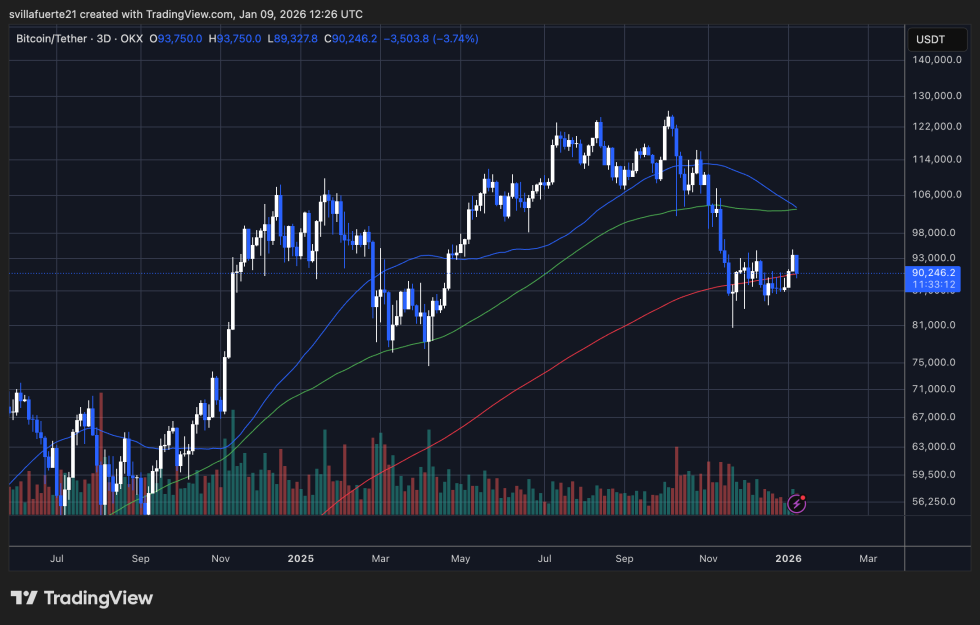
The recent bounce from the $85,000–$87,000 area suggests that buyers are defending this demand zone, which has repeatedly attracted bids since late November. However, the structure remains corrective rather than impulsive. Each recovery attempt has produced lower highs, signaling that sellers continue to distribute into strength. Volume also remains relatively muted compared to the sell-off phase, reinforcing the idea that this move is a consolidation rather than a trend reversal.
From a structural perspective, Bitcoin remains trapped between strong resistance near $95,000–$98,000 and key support around $85,000. A decisive reclaim of the 100-day and 200-day moving averages would be required to confirm a bullish regime shift. Until that happens, price action favors continued sideways movement or another test of lower support.
Overall, the chart reflects a market in balance: sellers are no longer in full control, but buyers lack the conviction needed to push Bitcoin back into a sustained uptrend.
Featured image from ChatGPT, chart from TradingView.com
Editorial Process for bitcoinist is centered on delivering thoroughly researched, accurate, and unbiased content. We uphold strict sourcing standards, and each page undergoes diligent review by our team of top technology experts and seasoned editors. This process ensures the integrity, relevance, and value of our content for our readers.