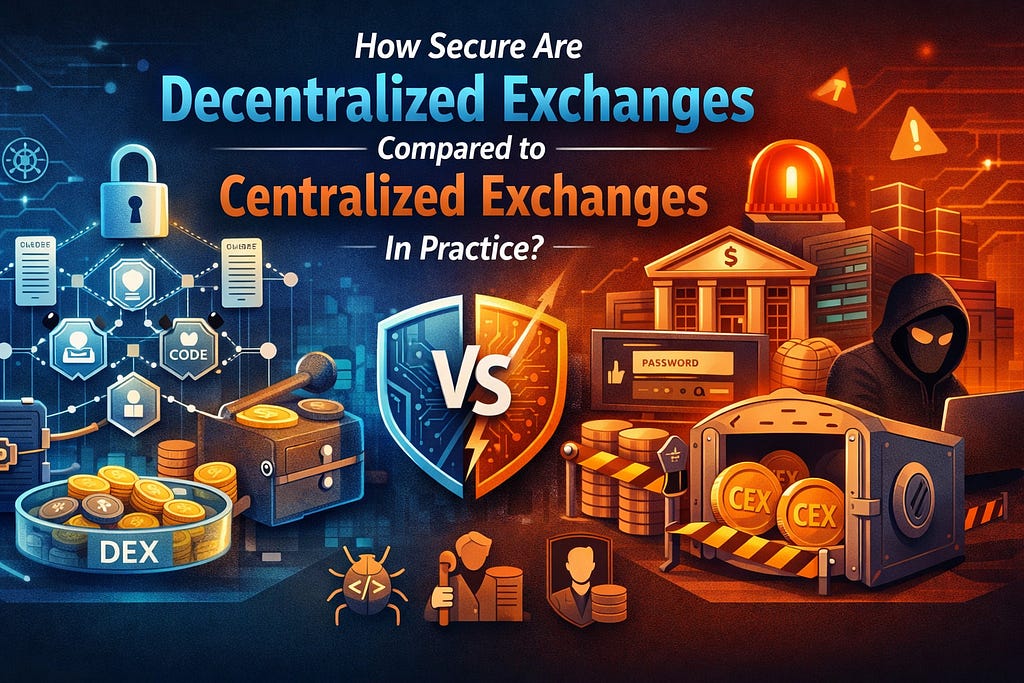
Decentralized exchanges (DEXs) provide robust security features through their non-custodial frameworks, which do not rely on a centralized system, as well as smart contracts that cannot be changed, unlike centralized exchanges (CEXs) which contain centralized honeypots which can be a target for hackers. However, in practice, DEXs do face issues with vulnerabilities in coding, as do CEXs with threats coming from insiders along with overreaching rules and regulations. Developers and traders need to analyze the security of both CEXs and DEXs. This paper uses Dexlyn and similar DEXrs to highlight the fundamental strengths and weaknesses of DEXs in the real world.
Fundamental DEX Security
Dexlyn, like other DEXs, uses the automated market maker (AMM) protocol, which allows users to keep their private keys and interact directly with the on-chain smart contracts. With this non-custodial architecture, funds cannot be frozen, and individual accounts cannot be accessed, which is a key advantage over CEXs whose wallets are custodial. Dexlyn’s structure includes liquidity pools that are audited and mechanically enforced with atomic swaps from Solidity contracts. This means that trades can reverse if they are not completed and do not expose any reserves.
Other DEXs, including PancakeSwap on BNB Chain, use the same constant product algorithm which is configured as x * y = k, in which balances of a pool are kept in equilibrium without any off-chain interference. Dexlyn, however, enhances this with cross-chain bridges using Supra and EVM ecosystems and employs timelock validators to improve security for asset transfers and reduce dependency on oracles, which are frequently found on platforms like THORChain.
CEX Security Limitations
When a CEX centralizes assets, it stores them in both hot and cold wallets which are managed by internal teams. These centralized teams create a new loss potential due to the privilege access and server-side breach risks. While some wallets utilize multi-signature schemes and hardware security modules, API endpoints remain vulnerable to data leaks. Platforms like Binance, while relying on enterprise monitoring, suffer outages due to DDoS attacks or regulatory compliance. These outages impact millions of users, while decentralized exchanges (DEX) are open 24/7 due to the permanence of the blockchain.
User authentication via 2FA and biometric checks are helpful, but KYC (Know Your Customer) data collection leaves a user’s identity vulnerable to theft. Dexlyn circumvents this, offering users pseudonymity and avoiding account freezes, which increases users’ rights, allows users to control their own data, and complies with Web3 regulatory frameworks.
Dexlyn’s Audit-Driven Protections
Dexlyn sets the standard for DEX security by obtaining independent, and public, audits from Hacken Club and CDSecurity, which evaluate audits for core contract attacks. These attacks include reentrancy, overflow, and access control attacks. Dexlyn has chosen to self-impose the integrity of their audits with the non-upgradable feature of their DEX, which prevents runtime modifications that other DEXs may expose. Dexlyn’s protections against sandwich attacks include anti-MEV oracles and liquidity services which add to the dynamic slippage controls.
Dexlyn utilizes Merkle proofs for cross-chain functionality and bridge validation, ensuring that data from the Supra-EVM transfers to Dexlyn’s and other EVMs with no private data exposed. Dexlyn’s EVM focus is a noticeable improvement over Raydium on Solana because of the broad range of compatible developer tools, such as Etherscan verification. This promotes an enterprise developer trust to facilitate development and integration.
Comparative Technical Models
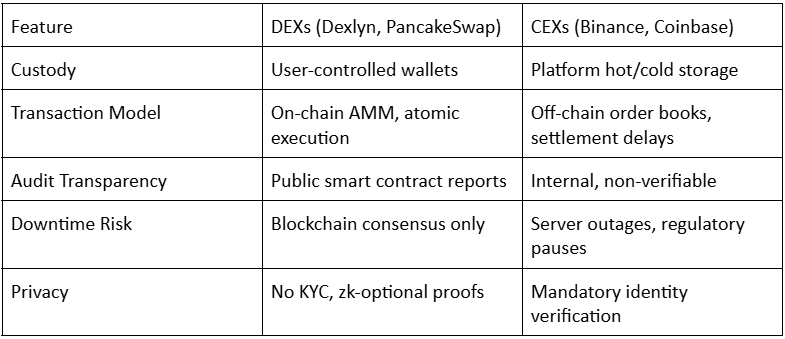
Risk distribution in code and users in DEXs, against infrastructure centralized in CEXs. Dual-audit model in Dexlyn reduces the risk in external calls DEXs distribute risk across code and users, while CEXs concentrate it in infrastructure
Safeguards in Leading DEXs
For governance, PancakeSwap deploys multi-party computation (MPC), therefore, reducing the surfaces of attacks of 51% on the emissions of the tokens. Dexlyn mirrors this with immutable farms, where the logic of yield is programmed to prevent integer underflows of the reward calculations using checked arithmetic. Both include pause proxies, which act as circuit breakers in the last resort, to be used only by multisig oracles.
These practices emphasize the use of certain tools, such as Slither, to scan for weaknesses (SWC) in the code to verify it formally pre-deployment.
Strategies for Mitigating Risks at CEX
To mitigate risks, CEX employs real-time SIEM systems along with Chainalysis for on-chain tracing, allowing them to quickly freeze funds. More than 90% of their assets are kept in cold storage, which is secured with air-gapped HSMsand Shamir’s Secret Sharing. However, the employee key rotations and SOC 2 compliance do not fully address social engineering and phishing, which bypass hardware tokens.
Their recovery mechanisms are useful to central exchanges, as support teams are able to restore lost accounts. In contrast, decentralized exchanges (DEXs) centralize accounts. However, this presents the risk of governmental seizures, which is not present in Dexlyn’s bearer-asset model.
User Recommendations for Each Platform
- When using DEXs, such as when trading on Dexlyn, users should review the documentation and the available audits before making swaps. Users should also utilize hardware wallets (e.g. Trezor) for transaction approvals.
- In terms of slippage, users should manually set their slippage to 1–2% for more volatile pairs. Users may also utilize the simulate option on tender.ly.
- When using CEXs, ensure that two-factor authentication (2FA) is set up with a hardware key (e.g. YubiKey). After making a fiat on-ramp, withdraw assets to a DEX.
- When using both CEXs and DEXs, use the CEX for exploration and use Dexlyn for the trading. You can use APIs to bridge portfolios.
- When used separately, Dune Analytics offers pool health, and DeFiLlama shows audits of Total Value Locked (TVL).
- As Dexlyn has done, developers must prioritize bugs that may be present in systems, as white-hat hackers can bring valuable scrutiny.
Constructing Balanced Trade-Offs
Dexlyn DEXs are sovereign, yet require a degree of DEX technical discipline, contract verification through the Remix IDE. CEXs are a trade-off in scaling convenience for structural cross risk. At the same time, DEXs benefit from straightforward user experience layered on Dexlyn’s solid code.
DeFi’s evolution sees hybrid models dominate; CEXs feeding DEXs. Dexlyn’s immutable and auditable design proves that DEXs can surpass CEXs.
Transforming Security Landscape
DEXs like Dexlyn are reshaping how secure trading can be. By focusing on code immutability and user empowerment instead of centralized conveniences, they show how trading can be done in a truly secure manner, especially in DeFi’s high stakes world. As blockchains integrate with ZK-rollups and AI based audits , the architecture of DEXs will continue to be ahead of the vulnerabilities of CEXs. This will empower both developers and traders to create the financial future they want.
How Secure Are Decentralized Exchanges Compared to Centralized Exchanges in Practice? was originally published in The Capital on Medium, where people are continuing the conversation by highlighting and responding to this story.