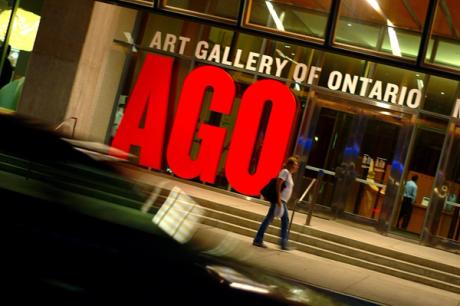
Since it was revealed last month that a committee at the Art Gallery of Ontario (AGO) in Toronto decided to nix the acquisition of a work by Nan Goldin over charges that the Jewish American photographer is “antisemitic”, there have been growing calls for the resignation of the trustee who instigated the decision, Judy Schulich.
Schulich is a significant donor to the AGO and an executive with the Schulich Foundation, one of Canada’s largest private foundations—started by her father, the billionaire businessman Seymour Schulich. Representatives for Schulich have not replied to The Art Newspaper’s requests for comment.
The fact that it was Schulich who instigated the decision not to acquire Goldin’s work—first revealed by Toronto-based independent journalist Samira Mohyeddin on X—was later reported by the Globe & Mail. The newspaper reviewed further documentation indicating that an unnamed person in a decisive meeting of the gallery’s Modern and contemporary curatorial working committee likened Goldin to Leni Riefenstahl, the Second World War-era German film-maker and Nazi propagandist, and called Goldin a “liar” based on her outspoken advocacy for Palestinians.
Although the AGO had planned to jointly purchase Goldin’s moving-image work Stendhal Syndrome (2024) with the Vancouver Art Gallery (VAG) and Minneapolis’s Walker Art Center, it pulled out in mid-2025 after its Modern and contemporary curatorial working committee voted 11-to-9 against it. The move was unexpected, especially as the AGO already had three Goldin works in its collection. In the vote’s aftermath John Zeppetelli, the AGO’s curator of modern and contemporary art, who had lobbied for the acquisition, resigned last year; two volunteer members of the committee also resigned over the decision. (The VAG and Walker Art Center proceeded with the joint acquisition.)
“That the supporters of the AGO have a range of opinions should not surprise anyone who has spent any time in Toronto recently,” Stephan Jost, the gallery’s director and chief executive, said in a statement to The Art Newspaper. “We are a public museum and pluralism is a reality. Today’s geopolitical climate has created challenges around the world for cultural organisations like ours as we are being asked to mediate conflicts beyond our control. As director and CEO of the AGO, I can assure you we are focused on our mission and working to take the necessary actions to ensure our processes are about art and respectful dialogue.”
After the revelation about Schulich’s advocacy against the Goldin acquisition, the AGO announced last week it will split the relevant committee in two. Jost added: “In response to the recommendations from an independent governance review, the AGO will shift the Modern and contemporary curatorial working committee into separate committees: one focusing on 20th-century art; and one focusing on 21st-century art. This will happen later in 2026.””
The response outside the institution has been more strident. A widely circulated open letter calling for more transparency and curatorial independence at the AGO and for Schulich to step down had garnered 540 signatures as of 1 February, including from Goldin herself. The letter was organised by a coalition of Jewish organisations including Jews Say No To Genocide, Independent Jewish Voices Toronto and United Jewish Peoples Order Canada.
“Judy Schulich, a trustee of the Art Gallery of Ontario, intervened to block the acquisition of a new work by Jewish American artist Nan Goldin, reportedly citing a speech Goldin delivered in Berlin in 2024, in which she condemned the actions of the Israeli government against Palestinians as genocidal,” the letter begins. “According to accounts of the meeting, Goldin was labelled antisemitic and her speech dismissed as ‘full of lies’. We are Jewish groups, allies, and artists who vociferously reject this framing and who unequivocally denounce Israel’s ongoing genocide in Palestine.”
The letter’s authors write that “the use of wealth and institutional power by donors to intimidate curators, override professional decision-making and censor artists” is “antithetical to artistic freedom and to the responsibilities of public cultural institutions”.
Expressing concern about the “intervention” to block the Goldin acquisition, the letter also takes issue with “the broader pattern of governance failures at the AGO”, including “other instances in which false or bad-faith accusations of antisemitism have led to serious professional and reputational consequences”. The Art Newspaper reported in 2024 that the curator Wanda Nanibush was ousted by the AGO, allegedly because of her stance on Palestine.
“I signed the petition because it reflects badly on the museum to keep Schulich on the board,” Goldin tells The Art Newspaper. “It indicates that money and power guarantee immunity, even when there’s a clear-cut case of censorship of an artist.” She adds: “It throws into question the priorities of this museum. Does that committee (that was dissolved) have the same influence as the board?”
A spokesperson for Independent Jewish Voices, one of the organisers of the letter, told The Art Newspaper in a statement: “It’s important not to let decisions like this stay behind closed doors. Too many people are being silenced and vilified [for] standing up for Palestinian human rights. There is nothing antisemitic about holding Israel to account for its actions. Art should not be inhibited by people seeking to protect the Israeli state from criticism at any time but especially not when it is committing genocide.”
While the AGO did not jointly acquire Goldin’s Stendhal Syndrome, it has three of her photographs in its permanent collection: Brian in hotel room with three beds, Mérida, Mexico (1982), Cody in the Dressing Room at the Boy Bar, NYC (1991) and My bed, Hotel la Louisiane, Paris (1996).