

DOT Is Bleeding — and the Market Knows Why

I’ve been watching Polkadot bleed slowly for weeks now. Not the kind of crash that wipes out leverage in a single violent move — but the worse kind. A quiet, grinding downtrend. Lower highs. Lower lows. No panic. No urgency. Just sellers doing their job, day after day.
Right now, DOT is trading around $1.72, sitting uncomfortably close to a local liquidity pocket between $1.63 and $1.70. That zone isn’t random. It’s where bids have repeatedly appeared, and where buyers want to believe the downside ends. Whether they’re right is something the market hasn’t confirmed yet.
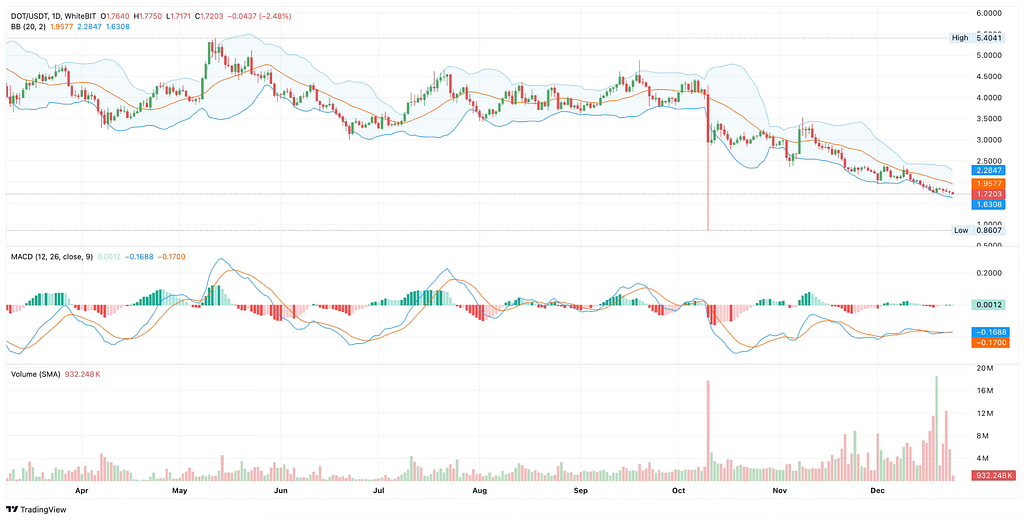
From a pure market structure perspective, nothing here suggests a reversal. Price remains capped below $1.95, a level that has quietly flipped from support into resistance. Until DOT can reclaim it with real volume — not a wick, not a short-lived bounce — the broader structure stays bearish.
The Bollinger Bands remain tight, volatility is compressed, and momentum indicators like MACD continue to flatline below zero. This isn’t fear-driven selling. It’s something more uncomfortable: disinterest. And markets rarely reward assets that fall out of focus.
The On-Chain Story Behind the Slow Fade
What’s dragging DOT lower isn’t a single headline or sudden shock — it’s a quiet accumulation of negative signals that the market has been pricing in over time.
- Capital rotation away from DOT: Over the past week, Polkadot has underperformed the broader crypto market. While BTC and select large-cap alts managed to hold ground, DOT continued to bleed — a clear sign that capital is rotating elsewhere rather than reacting to systemic risk.
- No fresh fundamental catalysts: Recent news flow around Polkadot has been largely neutral. No major ecosystem launches, no institutional announcements, no regulatory tailwinds. In a market driven by narratives, DOT is currently story-less — and story-less assets are usually the first to be sold.
- Ecosystem fatigue priced in: Parachain auctions and long-term lockups no longer function as speculative drivers. The mechanism is understood, absorbed, and largely ignored by capital looking for faster rotation and clearer upside.
- Weak organic network growth: On-chain activity hasn’t shown meaningful expansion. Address growth and transactional demand remain flat, reinforcing the perception that Polkadot lacks short-term momentum despite its long-term architecture.
- Volume without follow-through: Recent volume spikes suggest increased attention around key liquidity zones — but so far, that interest hasn’t translated into sustained buying pressure. That typically signals distribution or cautious positioning, not aggressive accumulation.
- Derivatives reflect hesitation: Funding rates remain muted, and open interest shows no signs of leverage buildup. There’s no squeeze narrative forming — just a market unwilling to bet on upside without proof.
The result is a slow fade rather than a violent move. DOT isn’t being abandoned — it’s being deprioritized. And in this environment, that’s often enough to push the price lower.
What Needs to Happen Next
If DOT manages to reclaim $1.95 with strong volume, a short-term relief move toward $2.28 becomes plausible. That level aligns with prior value and the upper Bollinger Band — a classic mean-reversion target in compressed conditions.
But if $1.63 fails, downside opens quickly. Below that zone, structural support thins out fast, leaving the $1.00 psychological level as the next area where buyers might step in. It’s not a popular scenario — but it’s one the chart clearly allows.
Derivatives positioning supports this caution. Funding remains soft, open interest is restrained, and there’s no sign that traders are positioning for aggressive upside. This is a market waiting to be convinced — or stepping aside.
Bottom Line
Polkadot isn’t selling off because something broke. It’s selling off because nothing new has stepped in to save it.
Until DOT proves it can reclaim structure and attract fresh demand — not belief, not loyalty, not long-term narratives — the bears remain in control.
Trade the levels. Respect the trend. And don’t confuse silence with safety.
DOT Is Bleeding — and the Market Knows Why was originally published in The Capital on Medium, where people are continuing the conversation by highlighting and responding to this story.