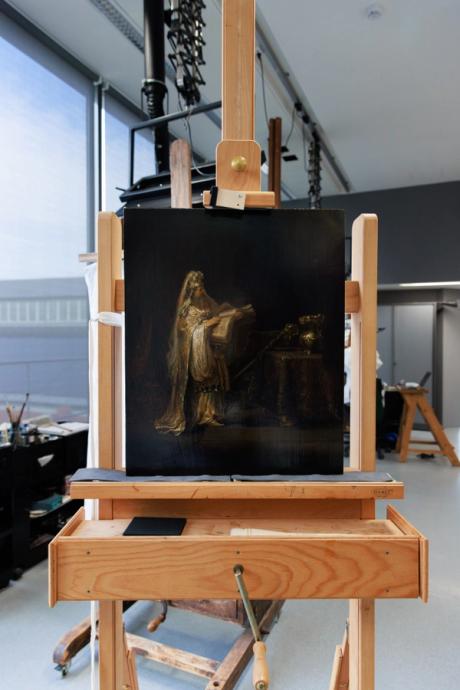
An early biblical painting by Rembrandt van Rijn that was long thought to have been lost has been rediscovered by the Rijksmuseum, according to an announcement today (2 March).
Vision of Zacharias in the Temple (1633)—which depicts the story of the high priest Zacharias being told by the angel Gabriel that he and his aged wife will have a son, John the Baptist—has re-emerged from a private collection.
It is, according to the Rijksmuseum’s director, Taco Dibbits, a “beautiful example” of the young Rembrandt’s capacity for storytelling and illustrates the development of his sketch-like style.
The 1633 painting was de-attributed in 1960, with significant doubts about the work’s authenticity expressed by the scholar Horst Gerson in 1969 and the Rembrandt Research Project in 1986. However, modern scanning techniques have convinced the Rijksmuseum that the painting is by Rembrandt’s hand.
In an article in The Burlington Magazine, the Rijksmuseum’s curator of 17th-century art Jonathan Bikker and paintings researcher Petria Noble—who have examined the work over the past two years—argue that it has been “mistakenly excluded from Rembrandt’s oeuvre since the mid-20th century on the basis of evaluation using photographic reproductions rather than first-hand examination”.
The painting disappeared from public view in 1961, sold by the Amsterdam art dealer P. de Boer to a private collector. After it was inherited by the owner’s two children, they decided to conserve the darkened painting. They approached the Rijksmuseum for advice on whether it was by a painter such as Jan Lievens or Salomon Koninck, Bikker tells The Art Newspaper.
A similar work in the Staatliches Museum Schwerin in eastern Germany—often attributed to Koninck, according to the Burlington article—is thought to be a copy of an original Rembrandt, which the Rembrandt Research Project had surmised was lost.
Using techniques also employed in The Night Watch (1642) restoration, the Rijksmuseum established that the paint pigments in the privately held work matched those in Rembrandt’s works from the same period; that the technique and build-up of layers was similar; and macro-XRF scans showed characteristic compositional changes, according to a museum statement. Analysis of the wooden panel confirmed the date of 1633, inscribed on the work.
“Before, you only had black-and-white photos and all of the comparisons had to be done from memory,” Bikker said. “We are hugely privileged to have been able to see this painting in the original and let loose all of our techniques on it… It is a very emotional moment to find another Rembrandt.”
Dibbits says that the painting illustrates how the young artist could already portray movement and golden highlights, with segments using a looser brushstroke. “He had been in Amsterdam for three years and mostly painted portraits, but this gives a beautiful insight into his development,” he says.
Although the owners wish to remain anonymous, their painting will go on long-term loan at the Rijksmuseum from Wednesday (4 March).