

If you’ve been following the headlines lately, you could easily be forgiven for thinking that the fight over stablecoin yields is the only sticking point holding the United States back from the crypto industry’s long awaited comprehensive market structure legislation. But sadly, you’d be wrong.
For months now, the headlines have fixated on a genuine but ultimately tractable disagreement: whether crypto platforms should be allowed to share yield from their Treasury bill reserves with stablecoin holders, or whether that practice should be restricted to protect traditional banks from competition for consumer deposits. It’s a real fight. The American Bankers Association has mobilized their entire lobbying arsenal against it. Coinbase has made it a red line. Senate negotiators have spent months trying to thread the needle. And they’ll probably figure it out eventually.
But while bank lobbyists and the media obsess over who exactly will get the privilege of pocketing stablecoin interest, Congress is getting dangerously close to gutting the single provision that will determine whether market structure actually delivers on its promise — or ends up crippling the very industry it claims to support. That provision – Section 604 of the current Senate draft – has to do with developer protections and whether those who write non-custodial software can be held liable by the USG as bona-fide money transmitters. Whether this section survives the Senate negotiation process intact will determine the fate of the entire bill.
This provision isn’t a technical footnote. It’s not some abstract philosophical debate. It is the load-bearing wall that supports the entire policy objective of this bill. And right now, it’s cracking.
The BRCA Is the Whole Ballgame
The Blockchain Regulatory Certainty Act, or BRCA, is a narrowly tailored provision with bipartisan origins. Introduced by Senators Cynthia Lummis (R-Wyoming) and Ron Wyden (D-Oregon), it does one essential thing: it clarifies that software developers and infrastructure providers who do not custody or control user funds are not money transmitters under federal law. That’s it. It doesn’t weaken anti-money laundering statutes. It doesn’t shield bad actors. It simply draws a line that should have been obvious from the start — that writing code is not the same as transmitting money.
Without the BRCA, developers of non-custodial software — the people who build the wallets, the protocols, and the decentralized applications that millions of Americans already use — face potential criminal liability under Section 1960 of the federal criminal code. Not civil penalties. Not regulatory fines. Criminal prosecution for the mere act of publishing software.
This is not a hypothetical. We’ve already seen what “regulation by prosecution” looks like. In 2025, the developers behind Tornado Cash and Samourai Wallet were criminally prosecuted — not for personally laundering money, not for actively conspiring with criminals, but for simply writing and publishing code that other people used in ways the government didn’t like. Keonne Rodriguez and William Lonergan Hill are now locked up serving federal sentences following their respective convictions in what often looked like a show trial. Roman Storm is being re-prosecuted and faces over a century in prison. And all this despite standing DOJ guidance to the contrary, a Treasury department which acknowledges the valid need for privacy/mixers, and an administration that claims to be “the most crypto-friendly” in history. No matter what shade of lipstick you want to put on it, the message from federal prosecutors is unmistakable: if you build non-custodial software in the United States, you do so at your own peril.
If the Senate CLARITY Act passes without robust BRCA protections, that message becomes the law of the land. And the rational response from every developer, every startup, and every venture-backed crypto firm in America will be the same: leave.
This is not an exaggeration. It is an economic certainty. No founder with competent legal counsel will accept a regulatory framework where writing open-source code can land you in a federal penitentiary based on which way the wind is blowing in Washington D.C. Instead they will incorporate in Singapore, in Switzerland, in the UAE — in any jurisdiction that doesn’t treat software engineers like unlicensed money transmitters. A CLARITY Act without strong BRCA developer protections, won’t just fail to bring clarity. It will accelerate the very capital flight that Congress claims to be trying to prevent.
Congress Could Kill the Agentic Economy in Its Crib
The developer exodus would be catastrophic enough on its own. But the timing here couldn’t be worse because Congress could very well end up strangling a nascent technological revolution that has the potential to generate material GDP growth for decades to come: the agentic economy.
Autonomous AI agents — software systems that can negotiate, transact, and execute tasks on behalf of users without the need for human intervention — are emerging as the next great computing paradigm. NVIDIA CEO Jensen Huang projected a $1 trillion agentic AI opportunity at GTC 2026. OpenAI is building models purpose-designed for multi-agent architectures. Institutional capital is flooding in. And the infrastructure these agents need to operate at scale — micropayments, 24/7 settlement, programmable wallets, cryptographic verification — is all built using blockchains.
This is not a crypto-native fever dream. It is the consensus view of the world’s largest technology companies and investors. AI agents need permissionless, always-on financial rails. Traditional payment systems, with their batch settlements, minimum transaction fees, and business-hour limitations, cannot support an economy where machines transact with machines thousands of times per second. Blockchains can. And the developers building that nascent infrastructure are the same developers the CLARITY Act threatens to criminalize and drive offshore.
We’ve been here before. In the late 1990s, Congress faced a similar inflection point with the early internet. Lawmakers could have imposed heavy-handed regulations on the nascent web — requiring licenses for website operators, imposing liability on platform developers for user-generated content, taxing digital transactions before the market had a chance to mature. They chose restraint. That decision — deliberate, bipartisan, and far-sighted — enabled the creation of the most extraordinary engine of economic value in modern history. Google, Amazon, Apple, Meta, Microsoft, NVIDIA, Tesla — trillions of dollars in publicly traded equity, millions of American jobs, and an entire generation of global technological leadership — all trace their origins to a Congress that understood that overzealous regulation kills innovation.
The agentic economy is the internet boom of the 2020s. The question is whether this Congress will show the same wisdom — or whether it will over-legislate a transformative technology in its infancy, ceding what should be a new generation of American economic dominance to competing jurisdictions that won’t make the same mistake.
An Affront to the Toolmaker Principle
Even if we set aside the economic catastrophe sure to follow in the wake of any official criminalization of crypto/AI software development, the government’s current approach to developer liability – which would become permanently anchored by a CLARITY Act without strong BRCA protections – represents something more fundamental: a violation of the basic principles of American law.
We do not prosecute automobile executives as accessories to bank robberies because the getaway driver used a Ford. We do not charge Google engineers with conspiracy because criminals coordinated an attack over Gmail. We do not indict Microsoft engineers for money laundering because a cartel tracked its finances using Excel. In every other domain of American commerce, we recognize a foundational legal principle: the maker of a tool is not liable for its misuse.
Crypto developers are the only class of toolmakers in the American economy being singled out for this retributive treatment. And the tool they are building — non-custodial, open-source software that empowers individuals to transact without intermediaries — is arguably more aligned with American values of individual liberty, financial privacy, and free enterprise than any technology since the printing press.
This is not a partisan observation. The BRCA was co-introduced by a Republican and a Democrat. It passed in the House of Representatives with a 70% margin. The principle it embodies — that publishing code is not a crime — should be as uncontroversial as the principle that publishing a newspaper is not a crime. Yet here we are, watching a Congress that promised to make America the crypto capital of the world negotiate away the one provision that would actually make that possible.
What Congress Needs to Hear
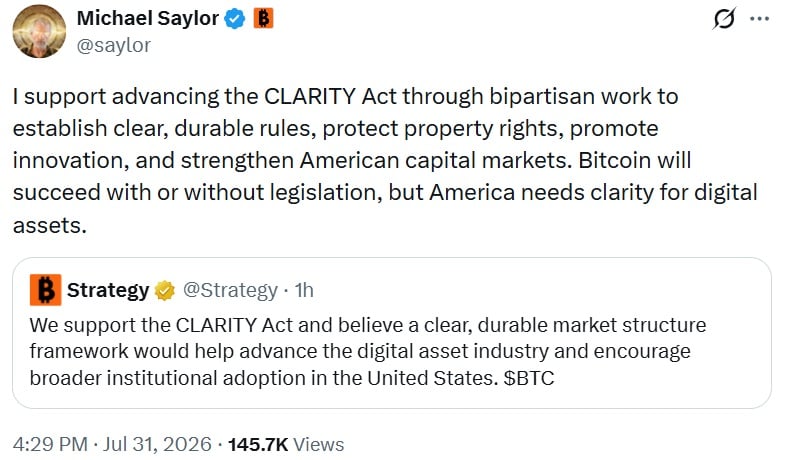
Making America the crypto capital of the world was a central promise of the current administration and the congressional majority that rode into office alongside it. Voters heard that promise. The industry heard it. The world heard it. The CLARITY Act, without bulletproof developer protections, would fall catastrophically short of delivering on that promise.
The fight over stablecoin yields will get resolved. Nobody wants to see the digital yuan win because bank lobbyists needed the gravy train to keep running through Wall Street. The regulatory competition between the SEC and the CFTC will get resolved. A new Howey framework will be developed. These are all important details, but ultimately they are just that – implementation details. The existential question — the one that determines whether there will even be an American crypto industry left to regulate by 2030 — is whether Congress will protect the developers who build this technology from criminal prosecution for the act of writing code.
The BRCA must be included in any market structure bill. It must be included with teeth. And it must not be diluted, carved out, or traded away in backroom negotiations over provisions that, however important, are not the difference between an industry that thrives in America and one that packs its bags for Hong Kong or Singapore.
Congress has a very narrow window of opportunity left. The midterm elections in November look poised to be a political earthquake. The legislative timer in Washington D.C. is rapidly running out of sand. A generational opportunity for the United States to assert its continued leadership in the new multi-polar world order is disappearing. The time to get this right is now — not because the crypto lobby is demanding it, but because the principles of American innovation, equal treatment under the law, and our continued economic and technological leadership of the world demand it.
The question is not whether the United States will have a market structure bill. The question is whether that bill will be worth the paper it’s printed on.
This is a guest post by Kyle Olney. Opinions expressed are entirely their own and do not necessarily reflect those of BTC Inc or Bitcoin Magazine.