The hardware conversation around smart meeting rooms is well established. From video bars to beamforming microphones and AI cameras,most IT buyers have a reasonable sense of what those cost and what they get for the money. What tends to catch organisations off guard is what sits above the hardware, and how quickly it adds up.
In 2026, smart meeting rooms are no longer just a room with a video bar and a platform licence. AI features now sit in the camera, the audio system, the platform, and increasingly the workflow tools that connect what happens in the meeting to what happens after it. Every one of those layers carries a cost, and for most organisations the software and licensing stack now costs more to run annually than the hardware cost to buy.
As Vivek Kar, Head of Employee Interaction Suite at Tata Communications, told UC Today: “Each switch disrupts workflow continuity and adds cognitive load. This fragmentation erodes employee efficiency and contributes to collaboration burnout.”
The cost of getting the room environment wrong, he argues, is not just the hardware outlay. It is everything that breaks down around it.
The Hardware Baseline
Hardware cost varies by room size, but the ballpark figures are consistent across vendors. A small room, typically four to six people, requires a video bar in the $1,500 to $2,500 range. The Logitech Rally Bar Mini sits at the lower end of the medium-room tier at around $2,999. The Rally Bar itself, which covers medium to large rooms, is priced at $3,999 MSRP. A full boardroom deployment with a premium video bar, ceiling microphone array, and dedicated compute unit will run $10,000 to $25,000 depending on the specification.
These are one-time capital costs amortised over a hardware lifecycle that most organisations model at four to five years. At that rate, a $4,000 video bar costs roughly $65 to $80 per month in real terms. That number matters when you start adding the recurring costs on top.
For organisations considering AI-native hardware, Logitech’s Rally AI Camera is priced at $2,499 for the standard model and $2,999 for the Pro, shipping this summer. It adds automated video analytics, space utilisation data, and Presenter View for training environments. As Henry Levak, VP of Product at Logitech for Business, explained ahead of InfoComm 2026: “Rally AI Cameras are designed to power the hybrid-first office, where the tech fades into the background to let the digital and physical worlds blend.” The question is whether the AI tier is worth the premium over the standard Rally Bar, and that depends almost entirely on whether you have the IT resource and governance processes to actually use the analytics it generates.
The Platform Licence
This is where the cost picture starts to diverge by platform.
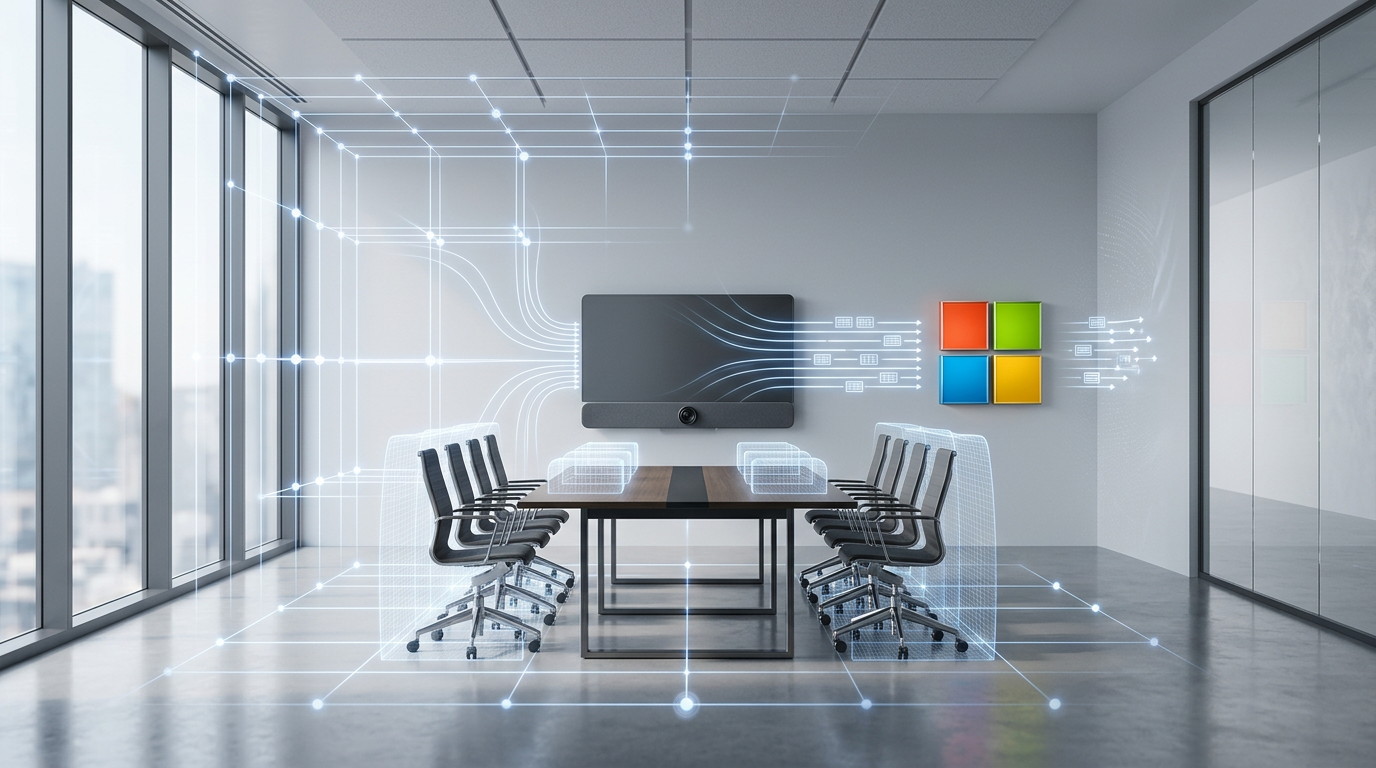
Microsoft Teams Rooms Basic is free for up to 25 rooms. Beyond that, Teams Rooms Pro is $40 per room per month. Pro unlocks the features most enterprise IT teams need at scale: the Pro Management Portal with real-time device health monitoring, remote restart, detailed room analytics, conditional access policies, and AI features including IntelliFrame intelligent camera framing. For a 50-room estate, that is $24,000 per year before a single user licence is counted.
Zoom Rooms has a single tier at $49 per room per month, with AI Companion included at no extra charge. That covers meeting summaries, smart recording, and speaker attribution. At 50 rooms, Zoom comes to $29,400 per year. Over a five-year hardware lifecycle, the licensing difference between Teams Rooms Pro and Zoom Rooms on a 100-room estate is around $54,000 in Zoom’s favour.
Webex Rooms pricing varies by device and deployment tier. Organisations already on Webex Suite typically get room device management included. That makes the per-room incremental cost lower than either Microsoft or Zoom for an existing Cisco customer.
The AI Assistant Layer
This is the number many budgets miss entirely.
Microsoft 365 Copilot unlocks meeting summaries, action item capture, and the intelligent meeting recap in Teams. It costs $30 per user per month as an enterprise add-on, on top of the base M365 licence. For a 500-person organisation with half the workforce on Copilot, that is $90,000 per year in AI assistant licensing alone, before room hardware or room platform licences are counted.
Teams Premium, the lighter alternative, is $10 per user per month and includes intelligent meeting recap without the full Copilot suite. For organisations that only need the meeting intelligence features and not the broader Copilot functionality across Word, Excel, and Outlook, Teams Premium is the cheaper route. But it is still an additional line item.
Zoom includes AI Companion in every paid Workplace plan at no extra charge. That is a meaningful differentiator in the total cost calculation. An organisation on Zoom Business at roughly $20 per user per month gets meeting summaries, transcription, and action items included. The equivalent on Microsoft requires either a $10 Teams Premium add-on or a $30 Copilot licence on top of the base M365 plan.
Cisco bundles Webex AI features into the Webex Suite, with higher-tier capabilities available at the enterprise tier. Organisations already paying for the Webex Suite pay nothing extra for the AI meeting assistant.
The Emerging Layer: Workflow AI
The workflow AI layer is the cost most 2026 budgets have missed entirely. These are tools that connect what happens in a meeting to what gets recorded and actioned in other business systems.
Zoom launched ZoomMate on 1 June at $20 per user per month. It connects meeting conversations to Salesforce, Jira, ServiceNow, and Slack, automatically creating follow-up tasks, updating records, and generating deliverables from meeting context. Slackbot’s meeting intelligence feature is available to Slack Business Plus and Enterprise Plus customers. It listens to meetings running on Zoom, Google Meet, or Slack Huddles via desktop audio and logs action items directly into Salesforce CRM. Monday.com’s Vibe AI Notetaker, part of the platform’s June 2026 update, attends calls and fills boards with action items automatically.
None of these are expensive on a per-user basis in isolation. But organisations deploying multiple AI workflow tools alongside a platform licence and a Copilot add-on will find the monthly per-user cost stacking up faster than the original hardware budget anticipated.
What It Actually Costs: A Working Example
A mid-market organisation with 20 meeting rooms and 200 users on Microsoft Teams, deploying a genuinely AI-capable smart room environment in 2026, faces roughly the following annual spend:
- Hardware (20 rooms, mixed small and medium, amortised over five years): approximately $18,000 per year.
- Teams Rooms Pro licensing (20 rooms at $40 per month): $9,600 per year.
- Teams Premium for meeting intelligence (200 users at $10 per month): $24,000 per year.
- Total annual recurring cost: $33,600, not including the hardware amortisation. The licensing cost alone is 87% higher than the annualised hardware cost.
If the same organisation opts for Microsoft 365 Copilot rather than Teams Premium, and licenses it for the 200 users who attend meetings regularly, the AI licensing line rises to $72,000 per year. At that point the software stack costs four times the annualised hardware investment.
The Question Worth Asking Before the Next Budget Cycle
The point of this exercise is not that smart meeting rooms are not worth the investment. For most organisations they are. A Forrester Total Economic Impact study of Microsoft Teams Rooms reported a 342% ROI over three years when meeting experiences are properly integrated. Barco’s meeting barometer found 71% of employees still struggle with hybrid meetings. Both put real numbers behind the case for investment.
But the hardware cost tends to dominate the procurement conversation. It is increasingly the smaller half of what a smart room actually costs to run. As Neat CEO Javed Khan told UC Today in May, the market is heading toward rooms that go beyond capturing meetings to understanding them. That capability comes at a price, and it sits mostly in the software stack above the device.
Before the next room deployment or renewal cycle, three questions are worth asking. Which AI features will we actually use? What does our existing platform already include? Is the workflow AI layer something we need or something that looked good in a demo? The M365 price rises landing on 1 July make this month a reasonable moment to work through all three.