

Bitcoin may be flashing one of its most closely watched contrarian signals. With more than 10 million BTC now held below their acquisition cost, a growing portion of the market is underwater. According to recent on-chain observations highlighted by analyst Ali Martinez, this development places Bitcoin in a zone that has historically coincided with major market turning points, raising fresh debate over whether the latest decline is nearing a bottom.
Bitcoin’s Underwater Supply Reaches A Historic Threshold
The latest data points to a remarkable shift in market positioning. According to Glassnode, BTC’s Total Supply in Loss metric shows that approximately 10.46 million BTC are currently being held at a loss. Given Bitcoin’s circulating supply of just under 21 million coins, that figure represents roughly half of all coins in existence.
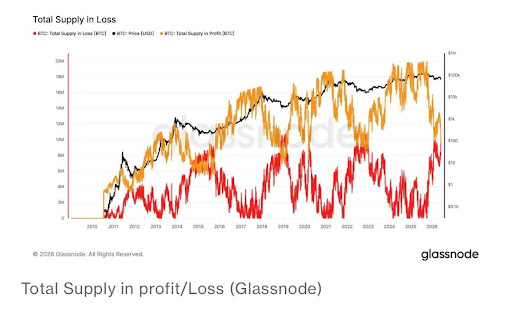
The significance of this threshold becomes clearer when viewed against Bitcoin’s historical market cycles. Previous major bottoms have frequently developed when the amount of BTC held at a loss climbed beyond 10 million coins. Similar conditions emerged during some of the market’s deepest corrections, many of which later gave way to prolonged recoveries.
The latest on-chain data also highlights the shifting balance between profitable and unprofitable holdings. As Bitcoin’s price retreated from its highs, the number of coins held in profit contracted while the amount of supply sitting at a loss expanded considerably. By June 2026, the latter had risen to roughly 10.46 million BTC, pushing the market into a zone that has historically been associated with severe downturns and heightened investor stress.
At the same time, Bitcoin’s price has fallen substantially from its cycle highs. Recent market data shows BTC trading around $63,242, with losses extending across multiple timeframes, including a decline of more than 40% over the previous year. Those figures help explain why such a large share of the network has slipped into unrealized losses.
Bottom Signal Or Just Another Stage Of A Correction?
This is where the discussion becomes particularly interesting. Martinez argues that elevated loss holdings can reduce the intensity of selling activity. When large numbers of investors are already deeply underwater, the incentive to liquidate positions often diminishes. Rather than locking in losses, many holders choose to wait, causing selling pressure to gradually weaken.
Recent Glassnode data appears to support the idea that sentiment has deteriorated significantly. Bitcoin’s Net Unrealized Profit/Loss (NUPL) indicator has fallen into the “Hope–Fear” zone after spending much of the previous year in more optimistic territory. Historically, these lower NUPL ranges have reflected periods when confidence has been shaken, but widespread capitulation has not necessarily intensified further.
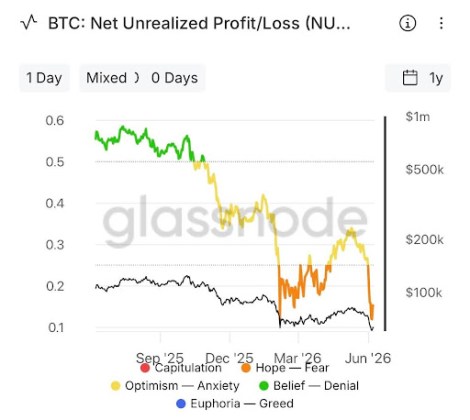
The combination of more than 10 million BTC in loss, weak sentiment, and a steep decline from previous highs has historically appeared near major market bottoms. While a definitive bottom remains unconfirmed, the scale of unrealized losses across the network indicates that Bitcoin is once again trading in a zone often associated with accumulation and recovery.
Featured image created with Dall.E, chart from Tradingview.com
Editorial Process for bitcoinist is centered on delivering thoroughly researched, accurate, and unbiased content. We uphold strict sourcing standards, and each page undergoes diligent review by our team of top technology experts and seasoned editors. This process ensures the integrity, relevance, and value of our content for our readers.