

The Musée des beaux-arts de La Chaux-de-Fonds in western Switzerland has had “a pleasant surprise” after a recent donation by the Swiss collector Philippe Bodenmann, initially thought to comprise 150 works, was found to contain 218, says David Lemaire, the museum’s director. “When we first announced the donation project to the political authorities [in 2025], not all of the portfolios had yet been opened and the inventory was not fully completed,” he adds. “The 150 works initially announced were those that were visible at the collector’s premises.”
Bodenmann’s collection is being shown in its entirety for the first time in the museum’s exhibition Voyages en zigzag: La collection de Philippe Bodenmann (until 3 January 2027), which brings together works spanning Anglo-American conceptual art, Zurich Concrete art and the Swiss Neo-Geo scene.
The collection includes several works by Joseph Kosuth, Lawrence Weiner and Royden Rabinowitch, as well as works by Olivier Mosset, Marcia Hafif and Günther Förg. It is particularly strong in British conceptual artists associated with walking as an artistic practice, notably Hamish Fulton and Richard Long. The gift also strengthens the museum’s holdings of Zurich Concrete art, a historically important part of its identity, with several major paintings by Max Bill.
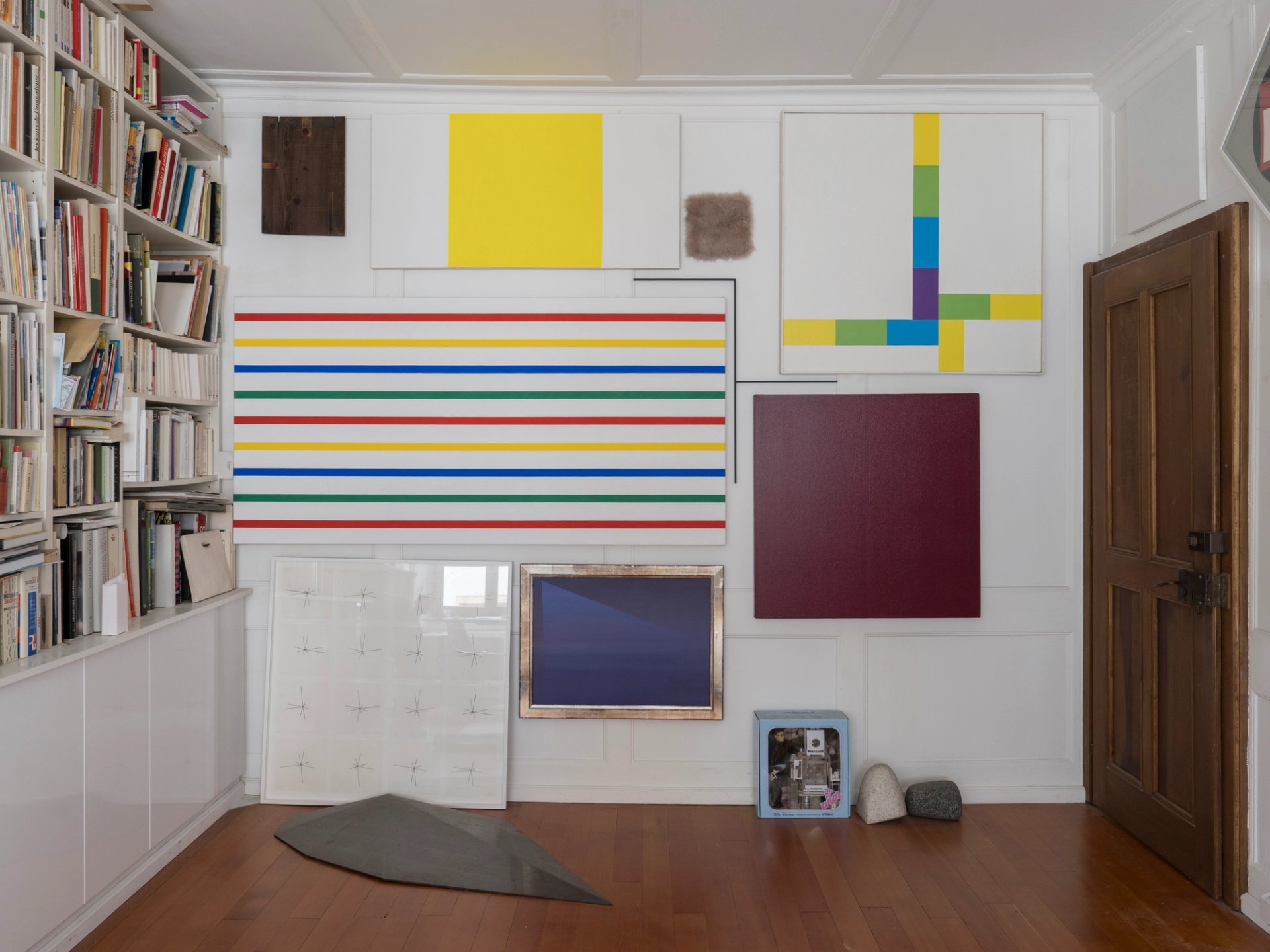
Philippe Bodenmann’s collection hung in his home office Courtesy of Musée des beaux-arts de La Chaux-de-Fonds
Lemaire singles out Kosuth’s 1985 Intentio (project) and Andreas Christen’s untitled monochrome relief from 1998 as the two most important works for the museum. Both artists previously had solo exhibitions there, in 1985 and 1994 respectively, but until the donation the museum owned no works by Kosuth and only one by Christen.
Lemaire describes Intentio (project) as “a pivotal work in the artist’s career”, introducing “a change in scale, the use of colour, and a much more complex engagement with text” than Kosuth’s earlier “tautological” works and Art as Idea as Idea series.
Christen’s 1998 work is “particularly spectacular”, Lemaire says, adding that “thanks to its relief, the human eye is unable to perceive that it is a monochrome. Moreover, the areas shaded by shadows change with the moving light.”
Bodenmann has placed no conditions on the gift. Lemaire describes it as “an act of great trust in our institution, which he has known for more than 40 years”. Given the collection’s coherence, he says, it is important to Bodenmann that it be offered as a whole.