

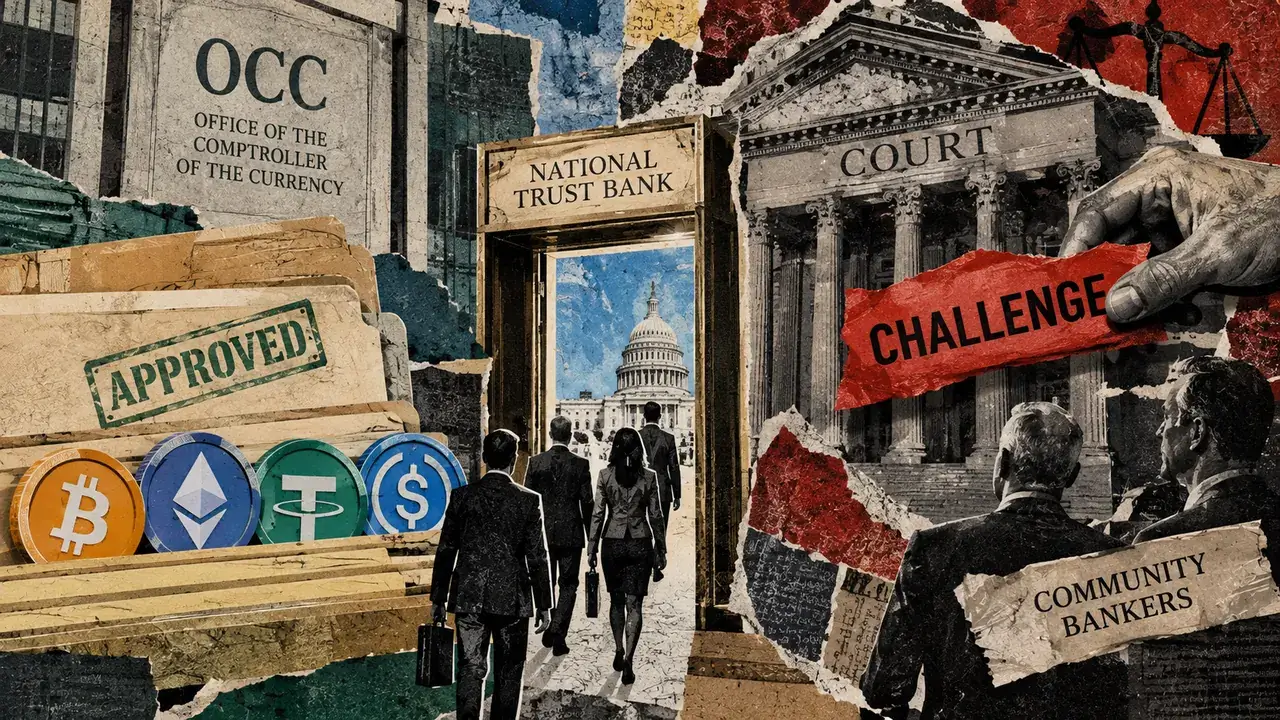
The Independent Community Bankers of America sued the OCC in federal court in Washington on Oct. 2, two weeks after the agency approved Agora National Trust Bank, Catena Trust Bank and Bastion Platforms.
American Banker reported that the complaint asked the court to vacate the OCC’s national trust bank rule and Interpretive Letter 1176. It argued the agency exceeded its authority by widening limited-purpose trust charters for fintech and crypto firms.
ICBA says the OCC has approved or conditionally approved 21 trust banks, 13 of them tied to crypto.
Banks lost the applicant-by-applicant fight against crypto firms
Banking groups objected company by company, and the OCC kept approving. Five crypto-linked national trust applications, including BitGo, Fidelity Digital Assets, First National Digital Currency Bank, Paxos and Ripple-linked applicants, won decisions in December 2025.
Bridge, National Digital Trust and Foris DAX, the parent of Crypto.com, followed in February, Coinbase in April and Laser Digital in May. Agora, Catena and Bastion arrived Sept. 18, and several of these approvals are conditional or preliminary.
The OCC finalized its national trust bank rule in February, effective April 1. It replaced the phrase “fiduciary activities” with the statute’s broader wording, “the operations of a trust company and activities related thereto.”
The OCC says the language leaves its chartering authority intact and that national trust banks have long performed some nonfiduciary work, including custody. It points to 12 U.S.C. 24(Seventh) as authority for nonfiduciary custody and related activities.
ICBA’s complaint reads the same rule as stretching a limited-purpose trust charter to cover non-depository, non-fiduciary crypto businesses under a lighter framework than insured banks face.
An objection to Coinbase or Ripple asks the agency to deny one applicant. A suit over the rule asks a judge to decide the scope of authority behind every charter that relies on it.
The OCC said a court would decide
In the February rule, the OCC cited the Supreme Court’s Loper Bright decision. It said that when a party with standing disputes whether the National Bank Act authorizes a national trust bank charter, courts must exercise independent judgment on the statutory question.
That is the review ICBA now requests. The OCC spent 2026 approving crypto trust charters while on record that a court would settle their legal basis.
Exposure varies with business plan, with plain fiduciary custody furthest from the dispute and nonfiduciary custody, stablecoin issuance and reserves, payments, settlement, conversion, and execution nearest to it.
Coinbase’s approved plan covers digital asset custody as a fiduciary plus transactional services tied to custodied assets, and the OCC defended it as trust-company operations or related activities under fiduciary authority and 24(Seventh).
Agora plans dollar-backed stablecoin issuance, reserve maintenance, nonfiduciary custody, and payment and settlement services. Catena combines custody, investment management, and trust services with conversion, clearing, and execution, and Bastion offers white-label stablecoin issuance, custodial wallets, conversion, and issuer services.
Foris DAX’s plan couples custody with trade settlement and staking, and Bridge’s initial approval covers custody, stablecoin issuance and orchestration, and reserve management.
ICBA seeks vacatur plus declaratory and injunctive relief. What happens to existing charters depends on the order a judge writes, including how it treats final approvals, conditional approvals and activities with independent statutory support.
The OCC said in August that it had received 40 de novo charter applications over about 18 months, and Comptroller Jonathan Gould said 23 of them involved digital assets.
The agency’s digital-asset licensing page lists pending applicants, including zerohash, Dakota National Trust Bank, Payward (Kraken), Lorum National Trust Bank, EDX Trust and PAYO Digital Bank.
Whether the OCC keeps processing those applications on the same terms while the court weighs the rule is the open question for each of them.
Where the court crypto test leads
If the court sides with the OCC, the national trust bank becomes a firmer federal route for crypto custody and stablecoin infrastructure.
JPMorgan sees $500 billion by 2028, Coinbase’s model centers on $1.2 trillion by the end of 2028, and Standard Chartered expects $2 trillion by then. Citi’s 2030 cases run from $1.9 trillion in its base scenario to $4 trillion in its most optimistic one.
FDIC-insured banks held about $20.7 trillion in deposits in the second quarter, so $500 billion to $2 trillion equals roughly 2.4% to 9.7% of that base. For Bitcoin, a win would deepen bank-supervised custody and settlement-linked services for institutions.
If the court vacates or narrows the rule or the letter, the effect lands hardest on plans built around stablecoin issuance, reserves, nonfiduciary custody, conversion, payments and settlement.
Those firms might restructure activities into affiliates, state trust companies or partner-bank arrangements, and pending charters could face tougher review. Bitcoin custody itself could stay available, with the federal wrapper less flexible around adjacent services such as conversion, execution, settlement, staking-like services and collateral movement.
The San Francisco Fed estimates stablecoin issuers’ Treasury demand could roughly double to about $400 billion by 2030, which gives the answer weight beyond crypto.
How much nonfiduciary market infrastructure can sit inside a national trust bank is now a question for a federal judge, which is where the OCC said it would land.