

In a few weeks, the Frieze juggernaut moves to the next edition in its eight-fair portfolio: Frieze Abu Dhabi. The first edition of the fair is set to open in the United Arab Emirates on 19 November.
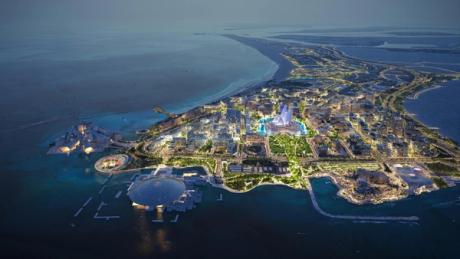
Abu Dhabi has already been a visible presence at Frieze London this week. On Thursday, Aldar, the leading Abu Dhabi real-estate development company and the official fair partner of Frieze Abu Dhabi, announced its new “creative neighbourhood” called Noma. Its gold logo also adorned the place settings on Thursday night’s Collectors’ Dinner in the Frieze London tent.
Concrete plans on Noma have yet to be released, but Abu Dhabi has been making a concerted push to attract creative talent to the city over the past few years. In an interview with The Art Newspaper in 2021, the Department of Culture and Tourism’s (DCT) chairman Mohamed Khalifa Al Mubarak spoke about plans for developing artist-friendly cultural districts. “In Abu Dhabi there has been a very clear and conscious decision to invest in culture, and investing in culture does not just mean buildings,” he said then. “We’re investing in infrastructure, both soft and hard—whether it’s institutions, music programmes, or school curricula.” (Al Mubarak is also chairman of Aldar.)
Districts that support exhibition and studio spaces have been successful means of anchoring artistic communities across the Gulf region. Alserkal Avenue in Dubai is the most notable example, with most of the UAE’s major galleries now long-term residents in the pedestrianised district. Riyadh has invested in own post-industrial zone, Jax, which hosts artist studios as well as the Diriyah Biennale spaces, and Abu Dhabi’s cherished Salama bint Hamdan Al Nahyan Foundation has also recently launched Miza, a creative district centred around its Warehouse421 arts space, in the port area of the city.
The name Noma is derived, New York-style, from its location: North of Manarat Al Saadiyat. Manara is the multi-purpose exhibition site that has hosted Abu Dhabi Art since 2011. When Frieze Abu Dhabi sets up shop there next month, it will bring 88 galleries, with a focus on the Swana region (South-west Asia and North Africa).
Familiar elements
There will be elements familiar to Frieze aficionados: Frieze Sculpture installs public works along the beach at Mamsha, on Saadiyat’s northern edge; a Focus section; and Frieze Masters, curated by Marika Sardar. The fair is also drawing on decades of artistic activity in the UAE, with the Abu Dhabi-based collective Dirwaza Curatorial Lab putting the work of two Emirati artists into cross-generational dialogue (Mohammed Kazem and Alia Zaal), and by using the Global Futures section to show artists with well-established profiles in the country, such as Abdullah Al Saadi and Ala Younis.
It is unclear whether the current geopolitical unrest will affect the fair. US President Donald Trump continues to make incendiary claims about a resumption of the war with Iran, though it is impossible to know how seriously to take these. And the closure of Saudi Arabia’s airspace this week—due to a conflict that the UAE is currently not a part of—has also made some gallerists nervous. But Frieze has underlined that the organisation and DCT are “fully committed to Frieze Abu Dhabi, and preparations are well advanced for the opening on 19 November”.
“We are in close and regular contact with our exhibitors, and will be as flexible as we sensibly can be for any gallery affected by travel advisories outside their control,” says a spokesperson for Frieze. “As with every Frieze fair, the safety of participants is the primary consideration in all our planning, and we are working closely with DCT and the relevant authorities.”
• Frieze Abu Dhabi, Manarat Al Saadiyat, 19-22 November