

One Ether fund has been quietly swimming against the current. Since October 1, Fidelity’s FETH has taken in a net $32.2 million, while BlackRock’s much larger ETHA has seen $1.89 billion leave. For anyone tracking FETH stock, that split is the most interesting detail in a month that has otherwise been rough for US spot Ether ETFs.
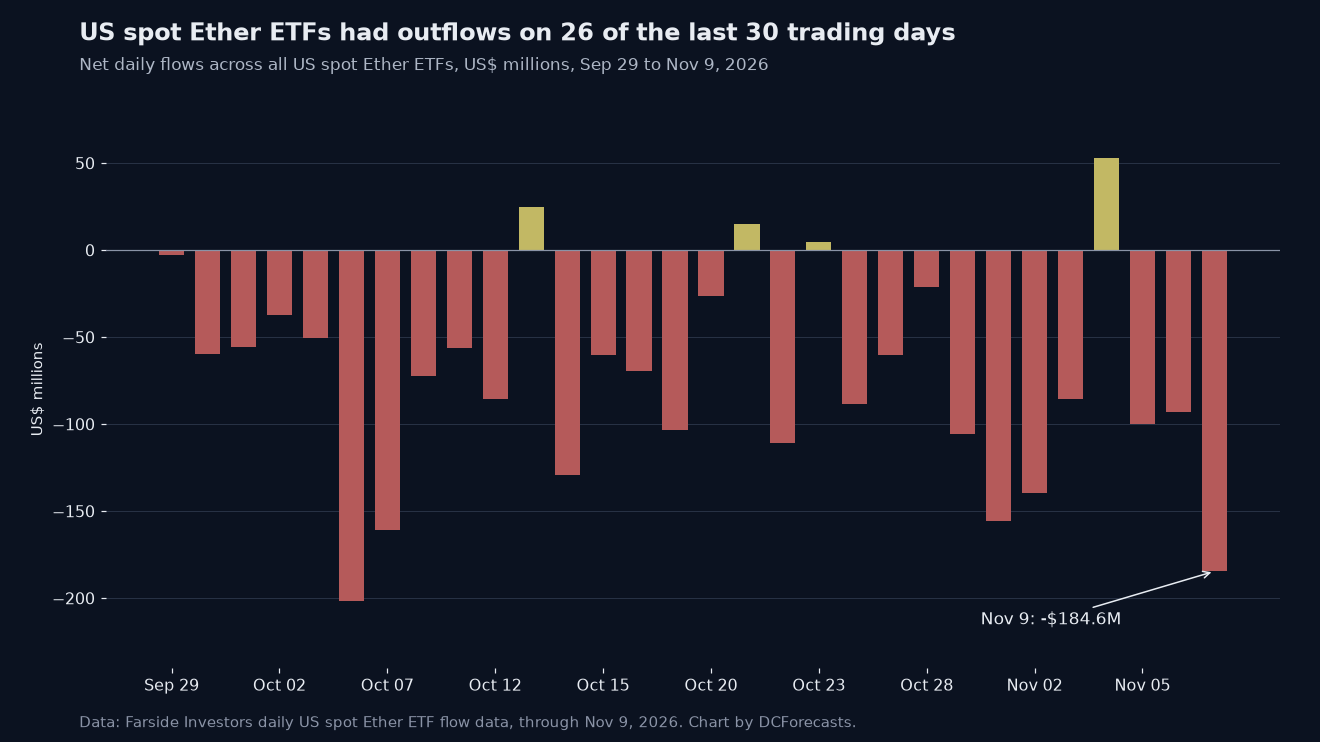
The group as a whole recorded net outflows on 26 of the last 30 trading days, according to daily flow data compiled by Farside Investors. Monday, November 9, brought the largest single-day withdrawal since October 6: $184.6 million.
A month of steady redemptions
The pattern is not one dramatic exit. It is a long run of moderate daily outflows, mostly between $20 million and $160 million, broken by only four positive sessions: October 13 (+$24.8 million), October 21 (+$14.9 million), October 23 (+$4.4 million) and November 4 (+$53.0 million).
Added together, US spot Ether ETFs have lost a net $2.16 billion since October 1. October alone accounted for $1.61 billion of that, and the first six trading days of November added another $549.8 million.
That is a sharp turn from late summer. The same funds pulled in a net $1.85 billion in August and $831.3 million in September, so the selling has erased those two months of buying and then some.
Ether itself was trading near $2,094 on Tuesday, according to CoinGecko, down about 1.5% over 24 hours.
Monday’s $184.6 million exit, fund by fund
ETHA once again did most of the damage on Monday, with $119.3 million in outflows. The Grayscale Ethereum Mini Trust (ETH) lost $25.0 million, ETHB lost $20.8 million and FETH gave back $19.1 million.
The only fund that took in money that day was MSSE, the Morgan Stanley Ethereum Trust, with a $1.6 million inflow. MSSE launched on NYSE Arca in late July with a 0.14% fee and a policy of staking part of its ether. Morgan Stanley’s bitcoin product has been drawing its own attention, as we covered in our look at MSBT’s run of inflows.
Why the FETH stock split stands out
ETHA is the largest fund in the category, so it is natural for it to carry the biggest absolute moves. Still, the gap since October is wide. ETHA’s $1.89 billion in net outflows makes up about 87% of the entire category’s loss over that period.

ADVERTISEMENT
FETH, by contrast, finished the stretch with a small net gain of $32.2 million. It had several solid inflow days in late October that offset its weaker sessions, including Monday’s outflow. MSSE also stayed positive at $8.5 million.
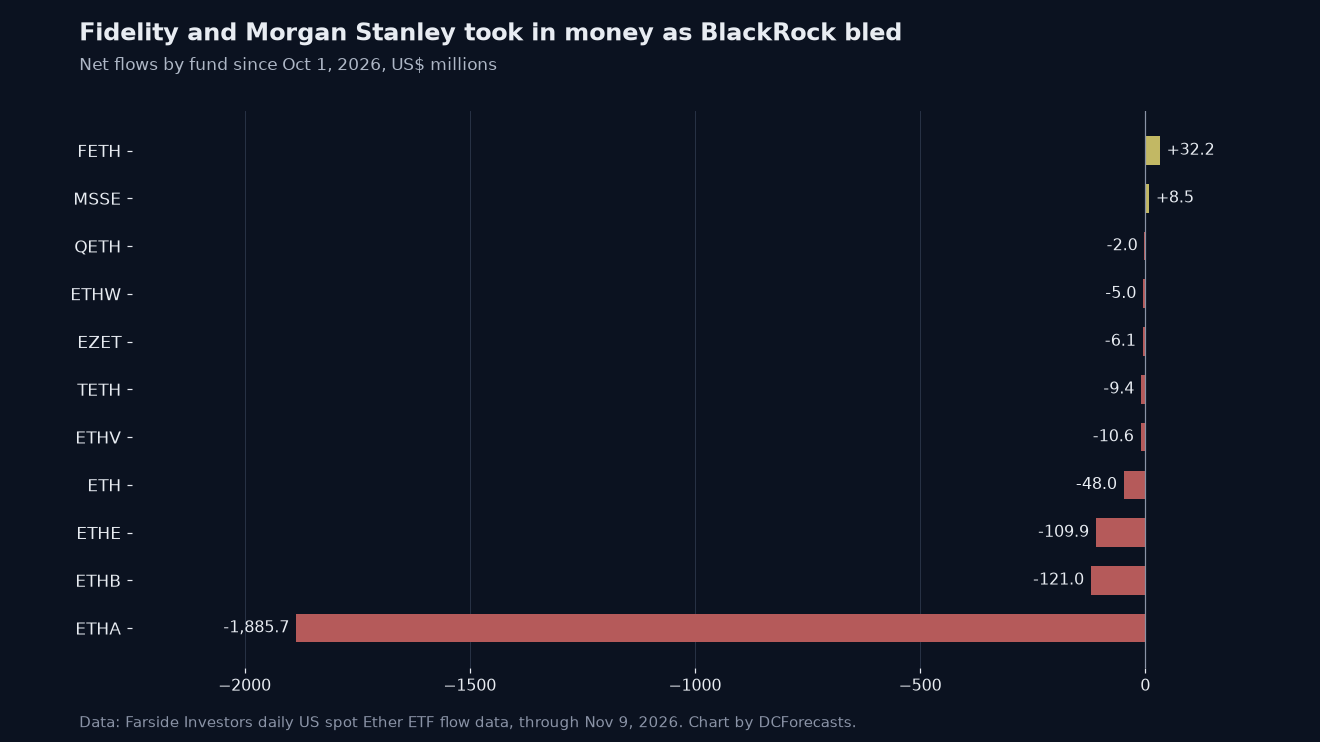
Every other fund was negative over the period. ETHB lost $121.0 million, the original Grayscale Ethereum Trust (ETHE) lost $109.9 million and the Grayscale mini fund lost $48.0 million. The remaining products, including Bitwise’s ETHW, 21Shares’ TETH, VanEck’s ETHV, Invesco’s QETH and Franklin’s EZET, each saw single-digit or low double-digit million outflows.
Flow data cannot tell us exactly who is selling. Large funds such as ETHA tend to be used by institutions and model portfolios that rebalance in size, while smaller funds can be driven by a few advisers or platforms. One plausible reading is that FETH is benefiting from Fidelity’s own brokerage distribution, but the data alone does not prove that.
Cumulative inflows are still large
The outflows look heavy on a chart, but they need context. Since launch, US spot Ether ETFs have still taken in a cumulative net $11.77 billion. That total peaked at $15.11 billion on October 8, 2025, so roughly $3.34 billion, or about 22%, of the peak has since flowed back out.
At the fund level, ETHA remains far ahead, with a net $11.40 billion since launch even after the recent redemptions. FETH has a cumulative $2.43 billion, while the original Grayscale trust is still the outlier at a net $5.53 billion in outflows since it converted to an ETF.
In other words, the long-term holders who built these positions over the past two years have mostly stayed. What has changed is the marginal buyer, who has been absent for most of the past six weeks.
Bitcoin funds have held up better
The contrast with spot Bitcoin ETFs is worth noting. Since September 1, Bitcoin ETFs have taken in a net $649.1 million, while Ether ETFs have lost $1.33 billion over the same stretch. Bitcoin funds had a strong September, adding $2.65 billion, which cushioned the selling that followed.
Both groups have seen outflows in November, so this is not a story of one asset booming while the other fades. But Bitcoin’s deeper pool of ETF demand has given it more room to absorb redemptions. We looked at the liquidity side of that picture in our analysis of the stablecoin supply ratio.
Corporate treasuries offer a different channel of ether demand that does not show up in ETF flows. Bitmine, for one, has been pursuing a large ether holding target, as we reported in our story on Bitmine’s ETH goal.
What would signal a turn
A single inflow day has not been enough to break the trend. November 4’s $53.0 million gain was followed by three straight outflow days. A more convincing signal would be several consecutive positive sessions led by ETHA, since the largest fund has been the main source of redemptions.
Until that happens, FETH and MSSE are the funds to watch. Their small but positive flows show that some investors are still adding ether exposure, even as the category’s biggest product sheds assets.
Daily flows can swing quickly and are often revised as late data from issuers arrives. They gauge sentiment, not where ether’s price goes next.
DC Forecasts is a leader in many crypto news categories, striving for the highest journalistic standards and abiding by a strict set of editorial policies. If you are interested to offer your expertise or contribute to our news website, feel free to contact us at [email protected]