

Scholars, curators and collectors of historical paintings are breathing a little easier today. A looming crisis in the conservation field caused by the discontinuation of two key ingredients needed to produce a popular adhesive used to line historical canvases has been averted.
Researchers at the Conservation Center of the Institute of Fine Arts at New York University (NYU) and the School of Polymer Science and Polymer Engineering at the University of Akron (UA) in Ohio, with the support of a grant from the Getty Foundation, have developed a new version of the popular conservation adhesive Berger’s Ethylene Vinyl Acetate (Beva) 371. The new adhesive’s formula presents fewer health risks, is more adaptable to future supply-chain changes and can take a range of forms including as a more durable, solvent-free “spaghetti-like” extrusion. But before delving into its features, some historical context may be helpful.
As its name suggests, Beva 371 was developed by Gustav Berger (1920-2006), an Austrian American painting conservator, in 1972. It proved to be especially well adapted to affixing new canvas to the backs of ageing canvases to stabilise them (a process commonly referred to as lining) because of the strength of its adhesiveness and because it did not penetrate the original canvas and affect the paint layers as old adhesives had, darkening the composition and seeming to stain the image. Marc Chagall’s Paris Through a Window (1913) at the Solomon R. Guggenheim Museum was the first painting from an institutional collection to be treated with Beva 371, and in the five decades since thousands of works around the world have been conserved using the adhesive, including paintings and pieces in other media, from textiles to works on paper.
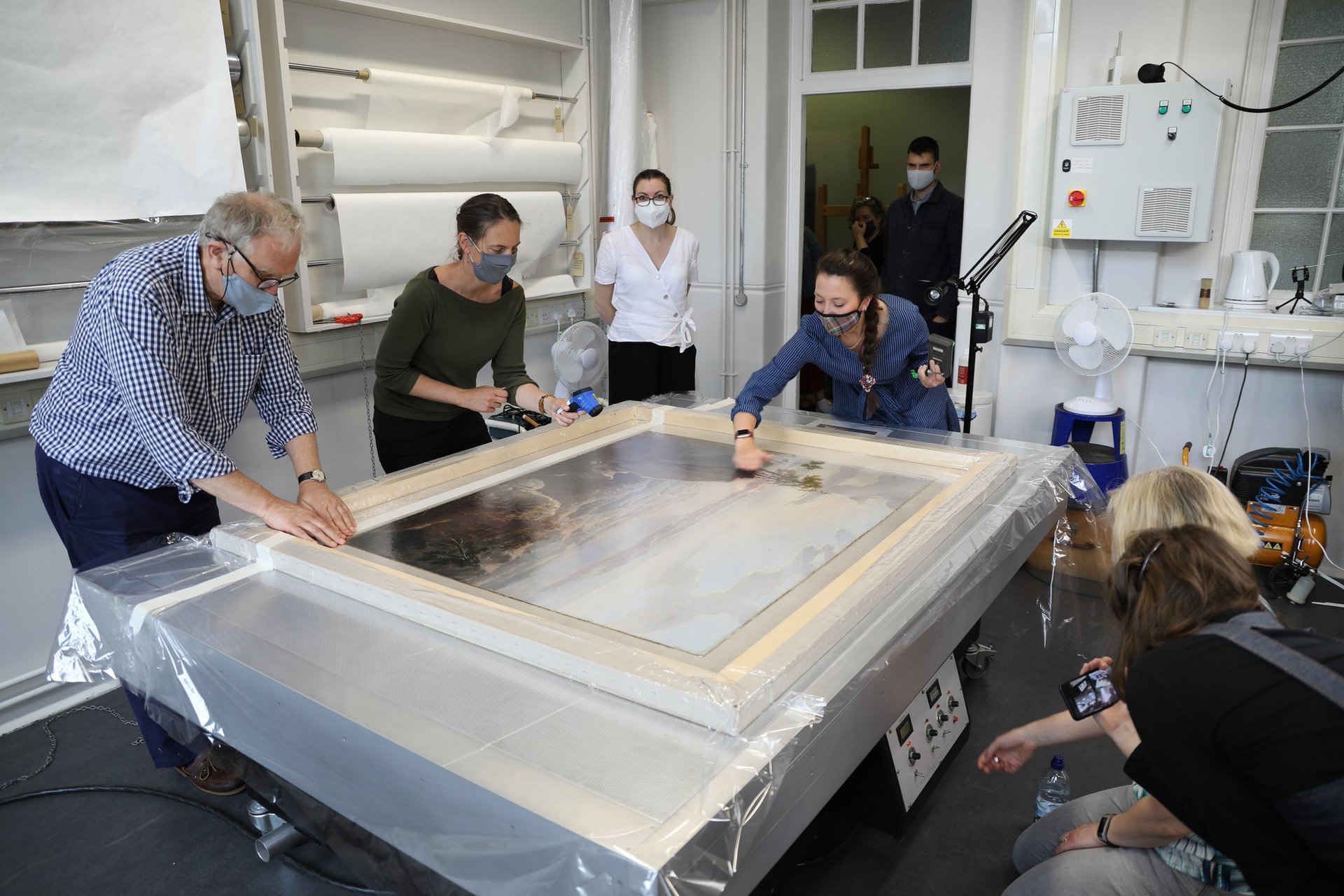
Conservators using an earlier formulation of Beva 371 in 2021 to line the 19th-century painting View of Cape Townshend taken from Mount Westall, March 1802, by William Westall at the Royal Museums Greenwich in London National Maritime Museum, Greenwich, London
However, over the past 20 years two critical ingredients in Beva 371 have been discontinued: the resin Laropal K-80, in 2005; and the tackifier Cellolyn 21E, in 2020. The following year, through its Conserving Canvas initiative, the Getty awarded NYU a research grant to develop a new adhesive, and NYU in turn partnered with the UA’s industry-leading polymer science and plastics engineering programme.
“Without these key resins, a major resource for the field of art conservation was lost,” Ali Dhinojwala, the chair of and a professor in the College of Engineering and Polymer Science at UA, said in a statement. “Finding a satisfactory substitute that matched the original adhesive’s favourable thermal performance was critical to optimising the material options available to conservators.”
The resulting adhesive, dubbed Beva 371 Akron, incorporates resins that were not available at the time Berger was first developing his formula. It also does away with any phthalates, a class of chemicals that affect the durability and flexibility of plastics but are now being phased out due to their links to a range of possible human health risks. The teams developing the new adhesive also studied its various components in hopes of future-proofing the chemical formula in case other components are phased out.
“We’ve conducted rigorous performance testing of the recipe with leading experts, and we are thrilled with the new, conservation-optimised formulation that will provide conservators more ways to work,” Chris McGlinchey, the project director at NYU and the former senior conservation scientists at the Museum of Modern Art, said in a statement. “It’s a big win anytime you enable a conservator to do their work more safely and effectively.”
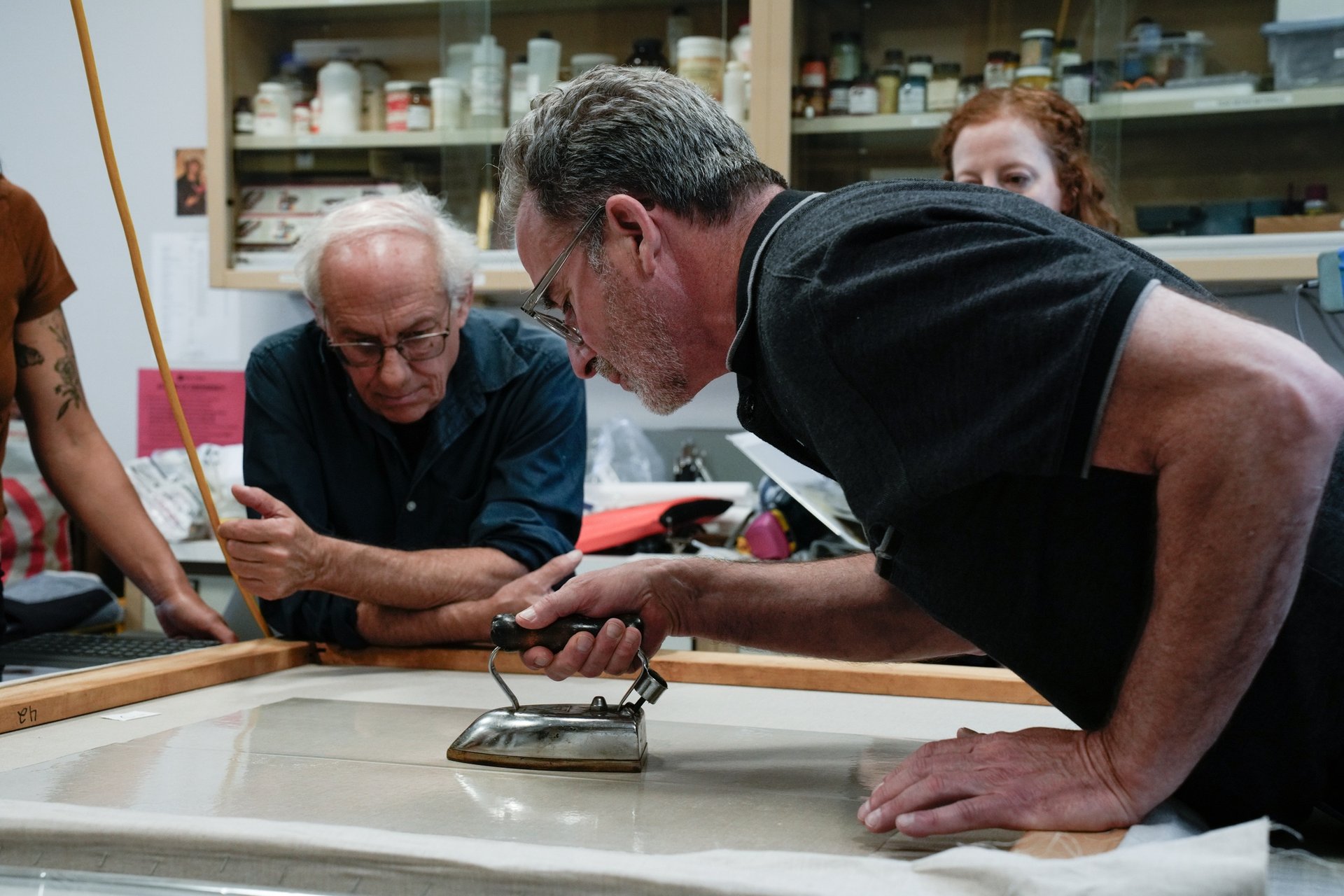
The conservators Dean Yoder and Matteo Rossi Doria demonstrate canvas lining using the new Beva 371 Akron formulation at the Conservation Center at NYU’s Institute of Fine Arts Photo: Nita L. Roberts
Another innovation in the development of Beva 371 Akron is that it can be produced in three different forms: a pre-mixed, heat-seal form similar to the original formula; a solid form extruded into noodle-like bands that have a longer shelf life and, once broken into pellets, are much easier to transport; and a forthcoming solvent-free form whose structure is pure adhesive.
“This project has been a long time coming, and we are so glad the new formula is going into production in multiple forms, making it a strong option for conservations across the globe,” said Matteo Rossi Doria, a Rome-based painting conservator who assisted the researchers in testing their formulations.
The project also had a professional-development component, with graduate students from NYU’s Institute of Fine Arts working alongside early and mid-career conservators from Europe and leaders in the field to study the original Beva 371 adhesive and test the new formulations. Paul Ackroyd, a conservator at the National Gallery in London, added in a statement: “With its advances in materials innovation and sustainability, the project is a shining example of how successful collaboration can be in a niche industry like ours.”
The findings of the team that developed Beva 371 Akron are being presented this week at the American Institute of Conservation’s annual meeting in Minneapolis.