A privacy coin is headed for Wall Street, and the wrapper says everything about what happens when a technology built for discretion tries to move through the most surveilled pipes in global finance.
Grayscale’s bid to list a Zcash ETF on NYSE Arca (ticker ZCSH) marks the first serious attempt to wrap a privacy coin in the fully documented world of ETF filings, approved custodians, sanctions screening, and brokerage compliance. The entire project is set up like a stress test for a simple idea: can regulated privacy exist, or does the regulation part smother the privacy part on contact? The mechanics described in the S-3 are straightforward, with cash creations at launch, and potential in-kind redemptions down the line, but the cultural and technical baggage Zcash carries is anything but.
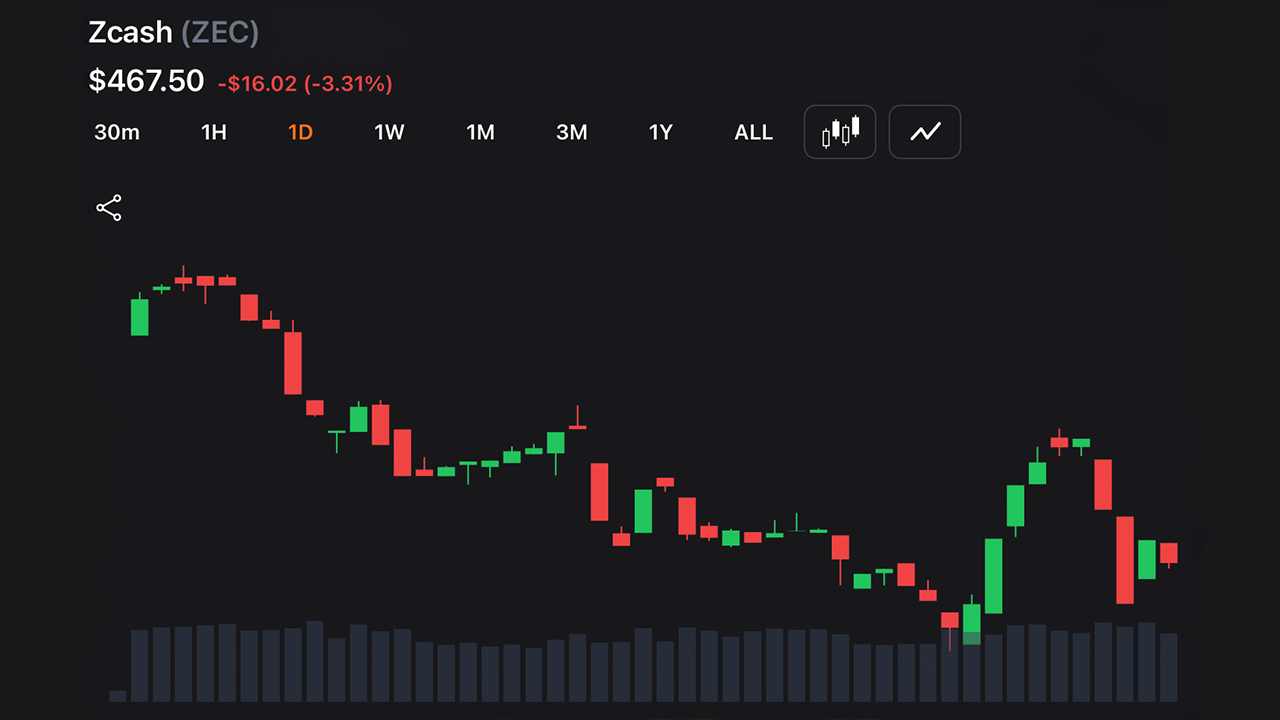
After starting 2025 near $30 following a long period of dormancy, ZEC spent the first half of the year grinding between $40 and $55, barely noticed outside its core community. Then the market snapped, and by November, ZEC had erupted to $699, marking one of the most dramatic rallies of any major crypto asset this year. Such a dramatic spike (+730% YTD) put privacy coins to the forefront of institutional interest and is what’s pushing investors to chase it with size.
Zcash was built to give users a choice between transparent addresses and shielded ones, using zk-SNARKs to prove validity without disclosing details. An ETF has no such spectrum. It has administrators, custodians, AP desks, and regulated venues. And because nothing in the ETF world moves without a verified identity attached, the first Zcash ETF could operate in a universe where everything is compliant, everything is screened, and none of that tells you much about the privacy that originally made ZEC matter.
The tension comes from how the ETF is designed to function. Grayscale proposes cash creations from day one. That means authorized participants send dollars, not ZEC, into the fund; the sponsor goes to market, buys ZEC, and holds it in Coinbase Custody. This setup bypasses the immediate problem of moving shielded coins through compliance desks, because cash creations don’t touch the privacy features at all. It’s a price-exposure instrument wearing a privacy-themed label. And with ZEC’s price now hundreds of dollars higher than it was when the year began, the convenience of letting someone else deal with custody, key management, and exchange risk becomes even more appealing.
The filing leaves the door open for in-kind creations later, but only if NYSE Arca’s rule-change request succeeds. Even then, APs would still face a practical hurdle: if they want to deliver or redeem ZEC, they would almost certainly need to use transparent addresses, because shielded transactions introduce audit and sanctions-screening issues that traditional financial institutions have no infrastructure to handle.
In other words, “in-kind privacy” only exists as a technical possibility, not a regulatory one. You can route the coins through the shielded pool, but no ETF administrator in the US is going to accept a batch of assets that can’t be traced and certified.
The irony lands harder when you look at how ZEC is actually used. Most on-exchange activity relies on transparent addresses. Shielded adoption is real, but concentrated among a minority of users who value private payments, identity separation, or institutional-grade confidentiality.
The ETF will never interact with that world. Coinbase Custody, as the appointed custodian, already enforces strict address-whitelisting and risk screens. It will likely hold ZEC in its more transparent form for operational clarity, maintain logs and attestations for auditors, and routinely disclose holdings the way it does for other crypto ETFs. And because ZEC at $400-plus attracts a different class of speculator than ZEC at $40, the product’s transparency bias may deepen over time rather than shrink.
The biggest mystery of ZCSH is who this product is meant to serve. “Privacy coin ETF” sounds like a contradiction until you remember that most ETF buyers don’t want to be privacy users, and just want exposure to the theme. They want the narrative potential of privacy becoming a mainstream investment category without the hassle of direct custody, view keys, or technical footguns.
Hedge funds looking for asymmetric bets can justify an allocation because privacy rails are back in fashion. Retail investors get a clean way to own ZEC without touching exchanges that flag withdrawals into shielded pools. And institutions get something even simpler: compliance-safe exposure to a crypto asset from the “privacy” family, without adopting the operational posture of an actual privacy user.
This creates a strange inversion. Privacy becomes a popular investment theme, instead of the inherent property of the coin. A ZEC ETF on NYSE Arca doesn’t help anyone transact privately; it just allows them to speculate on the future importance of transacting privately. If privacy coins become infrastructural building blocks for on-chain finance, ZEC’s value could grow. If regulators take a harder line on confidentiality layers, the ETF could sit in limbo. The buyer of this ETF isn’t voting for privacy with their transactions, but their brokerage account, which is a very different gesture. And given how ZEC went from $29 in March to over $700 in November, plenty of people are willing to vote.
That’s why Grayscale’s ETF filing matters. It tests whether privacy, as a narrative, can attract regulated capital even when the underlying technology is effectively neutered by the ETF wrapper it sits in. It also probes the boundary between what a sponsor can register and what regulators will tolerate. Zcash works because it can offer optional privacy. An ETF works because it removes optionality and enforces standardization. Those two worlds do not naturally align.
And yet, there’s a reason this filing wasn’t laughed out of the room: ZEC is one of the few privacy coins that can plausibly exist in a regulated ecosystem because its architecture allows transparency. Monero’s default privacy means it won’t pass this test; ZEC at least has the flexibility to run in transparent mode and let institutions treat shielded pools as someone else’s problem.
Regulated privacy meets real compliance
The compliance stack in the filing looks like a warning label. Coinbase Custody will hold the keys, Coinbase, acting as prime broker, will handle trading, and BNY Mellon will administer the product.
Each of these institutions operates with stringent KYC, OFAC screening, and transaction-monitoring requirements. Even if shielded transactions are technically possible, nothing in this pipeline accommodates them. If the ETF ever attempts in-kind creations, APs must demonstrate provenance, risk profile, and legitimacy of the assets they deliver. Shielded transactions obscure those details, which means the practical path is transparent ZEC end-to-end.
This is the whole point from the point of view of regulators. They object to opacity in financial products, not to privacy in the abstract. As long as ZEC behaves like any other crypto asset within the ETF machine, they can sign off.
What they can’t accept is a product that leaks unverified assets into the US financial market. This means the Zcash ETF becomes a compliance-first instrument even though the underlying coin is privacy-first technology. That inversion will define how critics talk about it. Privacy advocates will say it defeats the purpose. Institutional allocators will say it’s exactly the point.
Who buys the Zcash paradox
A ZEC ETF is not for hardcore privacy maximalists. It’s for institutional or advanced investors who want to track the price of a coin associated with privacy, without engaging in private behavior. It’s for funds that don’t want operational exposure to shielded pools. It’s for traders who want liquidity, tight spreads, and a clean instrument tied to a complicated underlying idea. It’s also for the growing crowd that believes privacy infrastructure, not meme mania, is the next frontier in crypto adoption. And it’s for allocators hedging the possibility that blockchains with privacy layers end up powering enterprise use cases.
That last group may be the quiet catalyst. If institutions are expected to onboard real value onto blockchains, privacy becomes a prerequisite, not a luxury. An ETF lets them express that theme without picking winners across the entire privacy-tech landscape. ZEC becomes a stand-in for a future where discreet on-chain activity is normal.
ZCSH won’t turn Wall Street into a privacy sanctuary. It won’t move shielded pools into the center of ETF mechanics. And it certainly won’t make Zcash’s most powerful features mainstream. What it will do is normalize the idea that privacy technologies deserve a seat at the regulated table, even if that seat comes with guardrails. The product may never interact with privacy as a function, but it interacts with privacy as an investment thesis. And that alone tells you where the conversation is heading: toward a future where confidentiality becomes an institutionally priced asset class, not just a cypherpunk conviction.
A Zcash ETF won’t teach Wall Street how to use privacy. But with ZEC’s rally pulling it from penny-stock territory into one of the year’s best-performing large-caps, it may teach Wall Street that privacy isn’t going away, and that is how regulated privacy begins, paradox and all.