


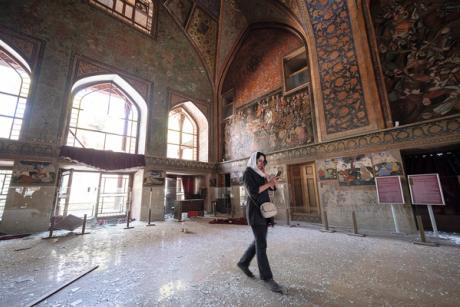
Since the war began, Iran has sustained immeasurably life-altering damage to its urban fabric, infrastructure and environment. Most criminally consequential is the loss of life: for example, a strike on the girls’ school in Minab, southern Iran, killed at least 168 people. But reports of damage to cultural sites should keep everyone who cares for world heritage in a state of alarm.
An early assessment of the damage lays bare a heartbreaking mutilation. At Tehran’s Golestan Palace, where Iran’s ruling Qajar dynasty (1789-1925) held court, the damage was concentrated in the most ceremonial, sumptuously decorated part of the palace: the Ayvan-e Takht-e Marmar (the Hall of the Marble Throne). The space was set up to afford an elevated view towards a garden with a long pool in front. The Qajar monarch’s parade of dignitaries, ambassadors and visitors would march along the pool to approach the enthroned king. Extensive mirror-mosaic wall decorations, known in Persian as ayeneh-kari, and a rich array of materials in gold and pigments made this a glittering royal space for the highest functions of the court, not unlike the Hall of Mirrors in Versailles.
Palaces severely damaged
The ayeneh-kari technique has a long history, going back to the royal precinct of Isfahan, built in the late 16th to early 18th century by the Safavid dynasty (1501-1722), where the earliest fully realised examples of mirror-mosaic work were installed in the 17th century. They were also bombed in March.
The Chehel Sotoun Palace sustained perhaps the worst damage of any Iranian heritage site so far. The force of a nearby blast dislodged parts of the ayaneh-kari surface of the ayvan (porch) where the Safavid king would host royal feasts and ceremonial gatherings. Parts of the painted and gilded wooden coffered ceiling of the 40-columned hall have fallen to the ground. The wooden latticework window frames and glass window-panes of the grand audience hall have been shattered and scattered across the floor. Photos of the large murals depicting scenes of royal receptions of ambassadors, dating to the middle of the 17th century, show serious gashes and cracks.
Damage, yet to be fully recorded, has also affected the Ali Qapu Palace, a five-storey building across the vast rectangular open area known as Maydan-e Naqsh-e Jahan (The Image of the World Square), in the heart of Safavid Isfahan. This was the formal entrance into the palace precinct; it housed the Safavid judiciary and offered vistas from its elevated porch onto the square where polo was played, markets were held and ambassadors paraded into royal receptions on the palace grounds. Today, families stroll and picnic in the square, surrounded by horse-drawn carts and street-vendors.
While the world must reckon with the moral implications of destroying cultural sites for years to come, their recovery and restoration already require planning. Who will restore the cultural heritage of Iran? What resources can be mustered?
Iran has a significant history of heritage recognition and preservation. Already early in the 20th century, a group of nationalist thinkers and politicians founded the Society for the National Heritage of Iran, to record and protect heritage sites. Despite two world wars and successive political upheavals, the preservation of cultural heritage remained constant. Modern systems were put in place to register, restore and consolidate the country’s historical monuments. In those early efforts, some Europeans were called in to assist, and the organisational structures, names and titles changed with the political winds, but the core ideals and vision to sustain the machinery of heritage conservation have been kept alive.
A long history of preservation
Archaeologists and architects have always collaborated with highly skilled traditional craftspeople who have deep knowledge of building materials and decorative techniques—mirrorwork, mural-painting, stucco carving, woodworking, tiling and other skills. This work has been documented by the modern institution now known as the Iranian Cultural Heritage Organisation. Between 1964 and 1978, an important campaign of assessing the state of preservation work of Isfahan and Persepolis, the ceremonial palace-city of the Achaemenid period (around 550BC-330BC) in Fars, were carried out through a collaboration between the Iranian Archaeological Services and the Italian Institute for the Middle and Far East (IsMEO). The fruits of those labours are an incomparable archive shared between Rome and Tehran, and a highly capable generation of conservators who continued to work well after the 1979 revolution. Those Iranian scholar-conservators in turn trained a new generation that has continued their work. And they were the ones who, together with local craftspeople and builders, restored sections of the 12th-century Great Mosque of Isfahan (a Unesco World Heritage site).
In the heat of the revolution, some fanatics who considered symbols of Iranian kingship and images of humans to be incompatible with an Islamic state aimed to destroy the wall paintings in the Chehel Sotoun and to bulldoze Persepolis. But the professional restorers and custodians of the monuments stood before the onslaught—literally with their bodies. They managed to save most of the monuments. Once more the defence of Iran’s heritage—tangible and intangible—will fall to the young people of Iran.
• Sussan Babaie is a professor in the Arts of Iran and Islam at the Courtauld Institute, London, and the author of Isfahan and its Palaces: Statecraft, Shi’ism and the Architecture of Conviviality in Early Modern Iran (2008)