

In Kevin Costner’s 1995 sci-fi blockbuster Waterworld, melting polar ice caps and rising sea levels have forced humanity to live on improvised makeshift floating junk islands in the ocean. The movie’s key themes have found an eerie echo in Austrian artist and choreographer Florentina Holzinger’s Seaworld Venice installation for her country’s pavilion at this year’s Biennale, a dizzying, immersive, confrontational and shocking rumination on climate change, technology and a flooded, dystopian future. Not that either Holzinger or the pavilion’s curator have seen it.
“I’m not aware of any direct references to sci-fi in the show,” says Nora-Swantje Almes, the curator. You haven’t seen Waterworld? It was huge in the 1990s, a genuine cultural phenomenon. “I have not seen it, no,” Almes says. “Should we have a watch party this evening?”
They probably should, if only to help them steer clear of any copyright infringement issues. Costner’s aquatic warning—that we are irreparably and irreversibly damaging the world, and will soon be literally up to our necks in the consequences—is the same as Holzinger’s. They just present them in different ways.
Turning stomachs
Long before she was accidentally mining 1990s Hollywood flops, Holzinger was making a name for herself with works of performance art so visceral and in-your-face that audience members were fainting with shock. Her 2019 body horror ballet Tanz premiered in Vienna with content warnings for nudity, blood, needles, strobes and graphic violence. People walked out, some even passed out. Eighteen people were treated for severe nausea after attending 2024 performances of her opera Sancta in Stuttgart. By combining nudity, real sex, live piercing, bodily fluids and heavy machinery (including motorbikes and, in 2022’s Ophelia’s Got Talent, an actual helicopter), Holzinger has managed not only to turn stomachs and gain notoriety, but to leave behind the shackles of choreography and theatre and find acceptance in the world of contemporary performance art.
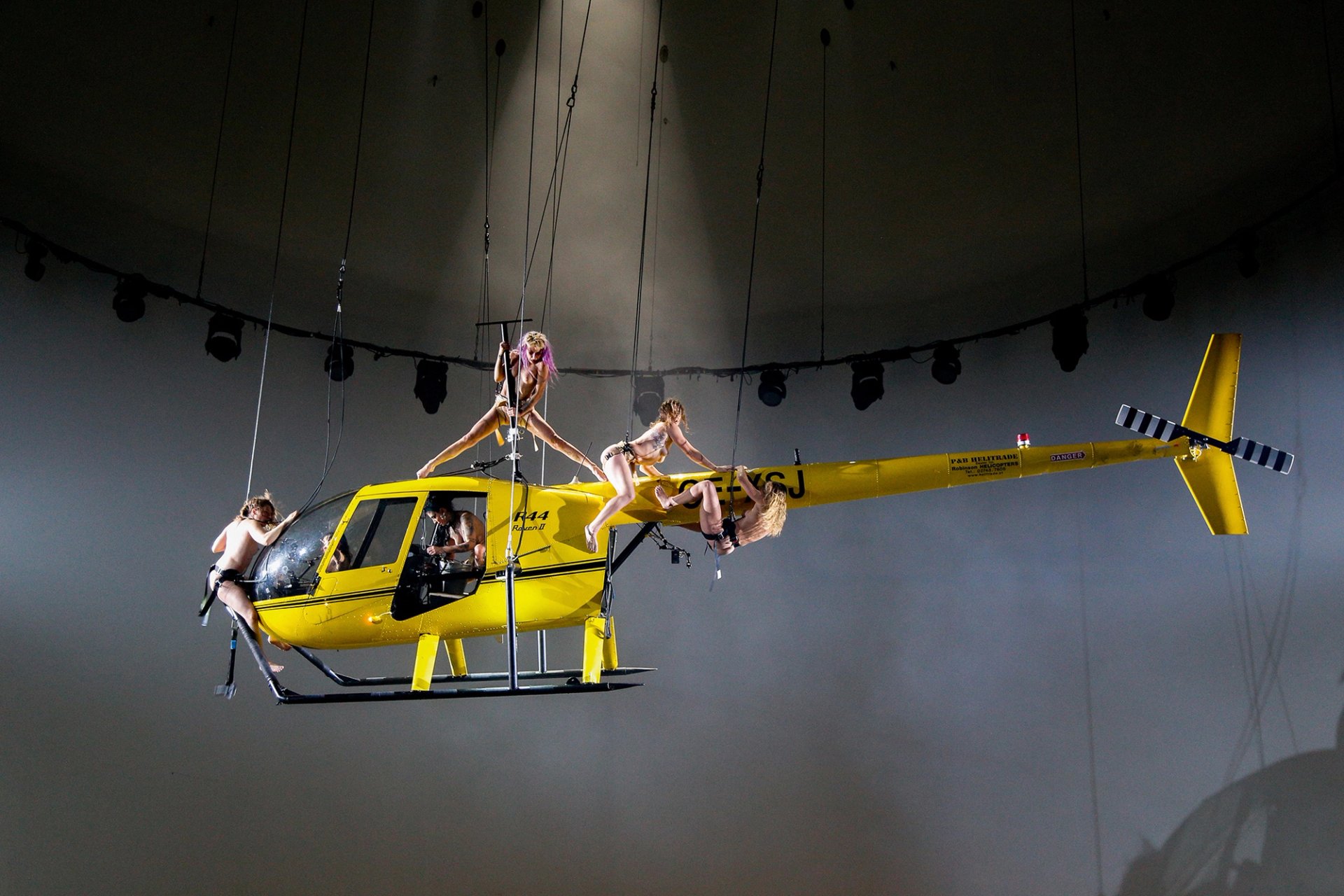
One of Holzinger’s extreme theatrical productions, Ophelia’s Got Talent (2022), which included a real helicopter and nude performers
© Bahar Kaygusuz/Florentina Holzinger
“Theatre, art, dance, even opera, they all come with certain conventions, and rules also in terms of spectatorship,” Almes says. “But all these categories are made up by others. I think the most interesting artistic practices are hybrid practices. This idea of category or discipline-based thinking no longer holds in today’s contemporary art world.”
And nothing proves that fact better than Holzinger being selected for this year’s Austrian pavilion. Despite how shocking—and non-traditional in form—her work is, selectors were happy to platform such radical art. “The reaction we got from the ministry was a very positive one. Very encouraging, very supportive. It might be partly because Florentina’s work is also internationally recognised,” Almes says. But it might also partly be because Austria is relatively unique in having a strong aesthetic tradition of artists working with things like blood and bodily excreta, thanks to the performance work of the Viennese Actionists like Hermann Nitsch and Günter Brus. “Certainly, in the collective consciousness of Austria, having blood and other body fluids on stages, et cetera, is not necessarily shocking,” Almes says.
Shock as a tool
But the shock factor to Holzinger’s work is important—it is a tool she uses knowingly and intentionally. “I think of Florentina’s use of the spectacle as a kind of entry point for people,” Almes says. “The artworks have several layers, and shock is the first one—it is there to make you look. You will look at the nude performers having sex in front of you. You will look at a massive bell that has a performer hanging upside down inside of it, you will look at the big helicopter. This is the moment where Florentina’s work lures people in. And then, of course, there are way more layers underneath—there’s a lot of depth in terms of the themes that she brings out.”
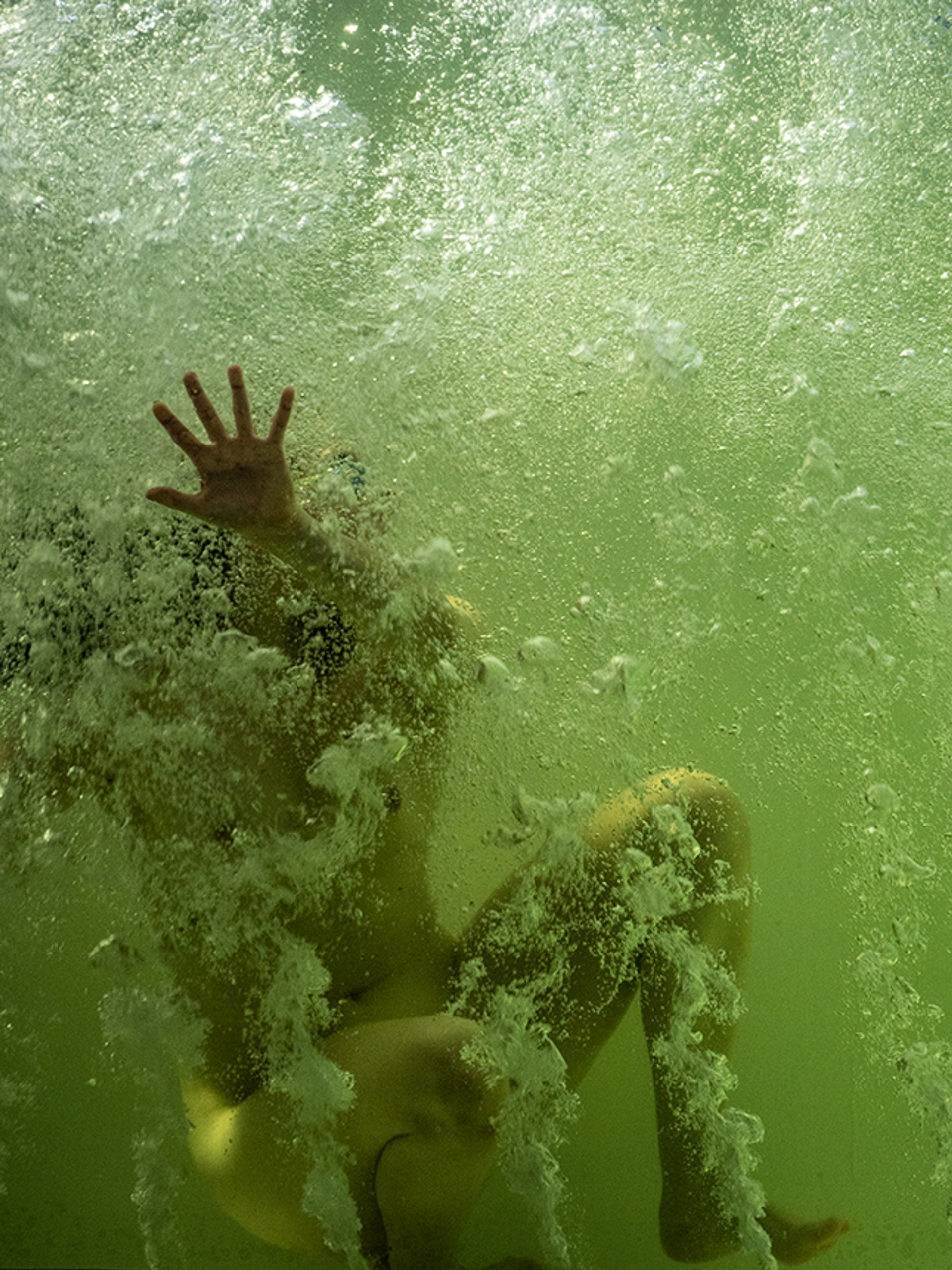
Ophelia’s Got Talent, like the artist’s Venice presentation for 2026, revolved around water
© Nicole Marianna Wytyczak/Florentina Holzinger
For Seaworld Venice, the themes are apocalyptic. The work functions as an underwater theme park, sewage treatment plant and sacred building, imagining Venice as a flooded metropolis, the water level so high that dry land disappears and sewage seeps into daily life. There will be live performers present throughout the seven-month duration of the installation, playing characters in this watery nightmare world who are totally dependent on technology for their survival. “In our scenario, the body can only be there with this technological extension,” Almes says. “So what does it mean to live seemingly in perfect symbiosis with technology?” And that relationship is not a straightforward one. “Nature and technology works perfectly until it doesn’t. Technology seems very reliable until there’s human error and the system destroys itself.”
Technological paranoia and distrust course through the work, but so does climate anxiety. “We think about Venice as a city that is particularly threatened by the climate crisis and flooding,” Almes says. “At the same time that we’re critical of it, we’re also part of it. We are complicit, as are the visitors to the Biennale.”
Water is not a new theme for Holzinger—it was a huge part of her work Ophelia’s Got Talent—but the inspiration here is a little more mundane. “We started thinking about it because we had to complete a sustainability report for the project,” Almes says. “And it made us think of how ridiculous it is to have a sustainability concept for Venice. The city lives off all the tourists that come here. It is this crazy paradox. Venice is dependent on tourism for survival, but that tourism is accelerating the damage of climate change. And I think that Florentina’s work sits often in this contradiction. You can’t say it’s this or that. It’s many things at once.”
• Giardini