
In Bitcoin news today, a bipartisan group of 16 US lawmakers introduced the American Reserve Modernization Act of 2026, the ARMA Bill, proposing that the federal government actively accumulate up to 1 million Bitcoin over five years and hold it as a formal national reserve asset.
If it passes, this would be the first time in history that the US Congress has enacted a deliberate federal policy to acquire and hold Bitcoin as a strategic store of value. That raises an obvious question for anyone new to this space: what exactly is a Strategic Bitcoin Reserve, and why should you care?
This ARMA Bill news dropped as Bitcoin fell -1% overnight, sliding back toward $77,000 after a short-lived rally that saw BTC briefly reclaim $78,000. However, alt coins are faring slightly better, with the total crypto market cap up +0.5% on the day, climbing back above $2.65 trillion.
$BTC is still holding above the $75,000-$76,000 support zone.
As long as this holds, I'm expecting a rally towards $79,500-$80,000. pic.twitter.com/k8g2E5WAHv
— Ted (@TedPillows) May 22, 2026
Bitcoin News Today: What the ARMA Bill Actually Proposes
The American Reserve Modernization Act of 2026, introduced by Representative Nick Begich and supported by 15 bipartisan co-sponsors, aims for the US Treasury to acquire about 1 million Bitcoin over five years, representing 5% of the total supply.
Under this bill, Bitcoin must be held for at least 20 years and may be sold only to reduce the national debt, which currently exceeds $39 trillion.
ARMA builds on the BITCOIN Act introduced by Senator Cynthia Lummis and is designed to be budget-neutral, funding itself by revaluing the Federal Reserve’s long-stagnant gold certificate price to current market values. This adjustment would create significant paper gains to purchase Bitcoin without increasing national debt.
DIGITAL FORT KNOX OF BITCOIN MOVES FORWARD
Rep. Nick Begich has introduced the American Reserve Modernization Act (ARMA) with 16 original cosponsors.
The bill would establish a Strategic Bitcoin Reserve, consolidate federally held digital assets, and lock them away as long term… pic.twitter.com/2ersoipGk2
— Bitcoin News (@BitcoinNewsCom) May 21, 2026
Transparency is emphasized through quarterly proof-of-reserve reports and independent audits, with Bitcoin stored in secure, geographically distributed vaults.
The bill also protects individuals’ rights to self-custody their digital assets, ensuring that personal Bitcoin holdings remain unaffected by the government reserve.
DISCOVER: 99Bitcoin’s Readers – Earn $10 USDC When You Sign Up for Binance
Bitcoin vs Gold: Why BTC, Not Something Else?
The argument for Bitcoin as a reserve asset is based on three key points. First, its supply is fixed, making it resistant to inflation, unlike fiat currencies. Second, it is easily verifiable on the public blockchain, unlike gold, which requires physical inspection.
Third, there is increasing geopolitical pressure, particularly amid US-China competition, suggesting that holding Bitcoin can enhance global competitiveness.
Representative Jared Golden noted that the US, currently holding 328,372 Bitcoin valued at over $25.5Bn from seizures, lacks a federal policy on this asset. The proposed ARMA bill would halt public auctions of these holdings.
However, critics highlight Bitcoin’s volatility, which can lead to drastic price drops, and its correlation with equities during market stress, raising concerns about the wisdom of committing national reserves to such an unstable asset.
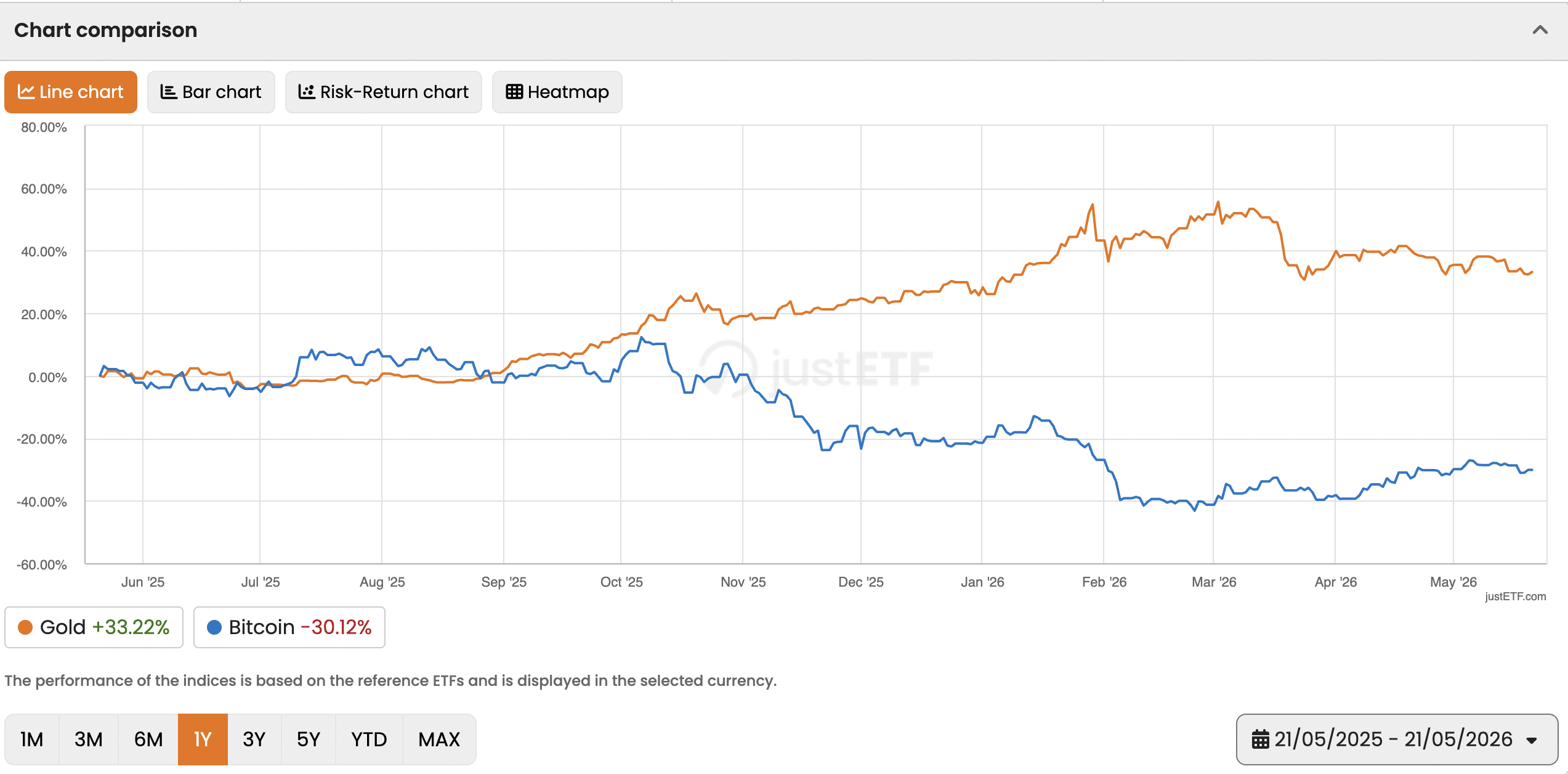
(SOURCE: JustETF.com)
What the ARMA Bill Means for Your Bitcoin Portfolio
If ARMA passes, it could lead to a significant, lasting reduction in Bitcoin supply, with the US aiming to acquire 1 million BTC in addition to its existing holdings. Matt Cole, CEO of Strive, calls ARMA the “most important crypto legislation” from Washington, as its implementation would mean that the US would absorb a large portion of newly mined Bitcoin annually.
The key factor for your portfolio is whether the bill advances. While ARMA has been introduced, it is not yet the law. The Senate’s BITCOIN Act is in the Banking Committee, and if both chambers pass compatible versions, Bitcoin purchases could begin around Q4 2026.
Trends in institutional adoption, such as Morgan Stanley’s move into spot Bitcoin ETFs, indicate that the overall policy direction will likely remain steadfast, regardless of ARMA’s outcome.
Keep an eye on the Banking Committee markup in the Senate; a successful committee vote would indicate significant progress towards a US Bitcoin policy that could influence global perceptions of Bitcoin as a reserve asset.
EXPLORE: Best Crypto Presales Gaining Traction Right Now
Follow 99Bitcoins on X, YouTube, and Telegram for more crypto news and analysis.
The post Bitcoin News Today: What is the ARMA Bill and What Does it Mean for BTC? appeared first on 99Bitcoins.