
Steven Ladd tells The Art Newspaper that he and his brother William want people to understand the intricate, often self-referential details in their collaborations. “We love communicating that,” Steven says during an hour-long video call. “‘Beauty’ was kind of a dirty word back in the day.” William cuts in. “Steve is a big communicator,” he says as his brother laughs. “Steve would talk for hours, and I’d be like, ‘I’m just making things that are beautiful.’”
William, who did beadwork, weaving and macramé growing up, does not mind that he and Steven, who has made all of his own clothing for 30 years, have been called “craft” artists. “We have a very crafty mind,” William says.
Collaborators for more than 25 years and based in New York, they are making the final preparations for a monumental work in monument-rich Washington, DC, where National Scrollathon, which they call “America’s cultural project”, will preach unity and understanding at the John F. Kennedy Center for the Performing Arts, which the current president has taken to calling the “Trump Kennedy Center”.
10,000 scrolls
Like the Second World War memorial a mile away, the project will have freestanding pillars labelled by state. One side will contain rolled up “scrolls” that 10,000 people across the country created, and the other will have photos of participants.
The brothers visited all 50 US states, five territories and the District of Columbia, where they gathered 25 to 35 people for each hour-long Scrollathon session. Participants rolled fabric trimmings to make a “scroll” and added a message or symbol. They shared stories ranging from surviving cancer to children talking about sushi. “You can be crying in a session, you can be laughing in a session,” William says.
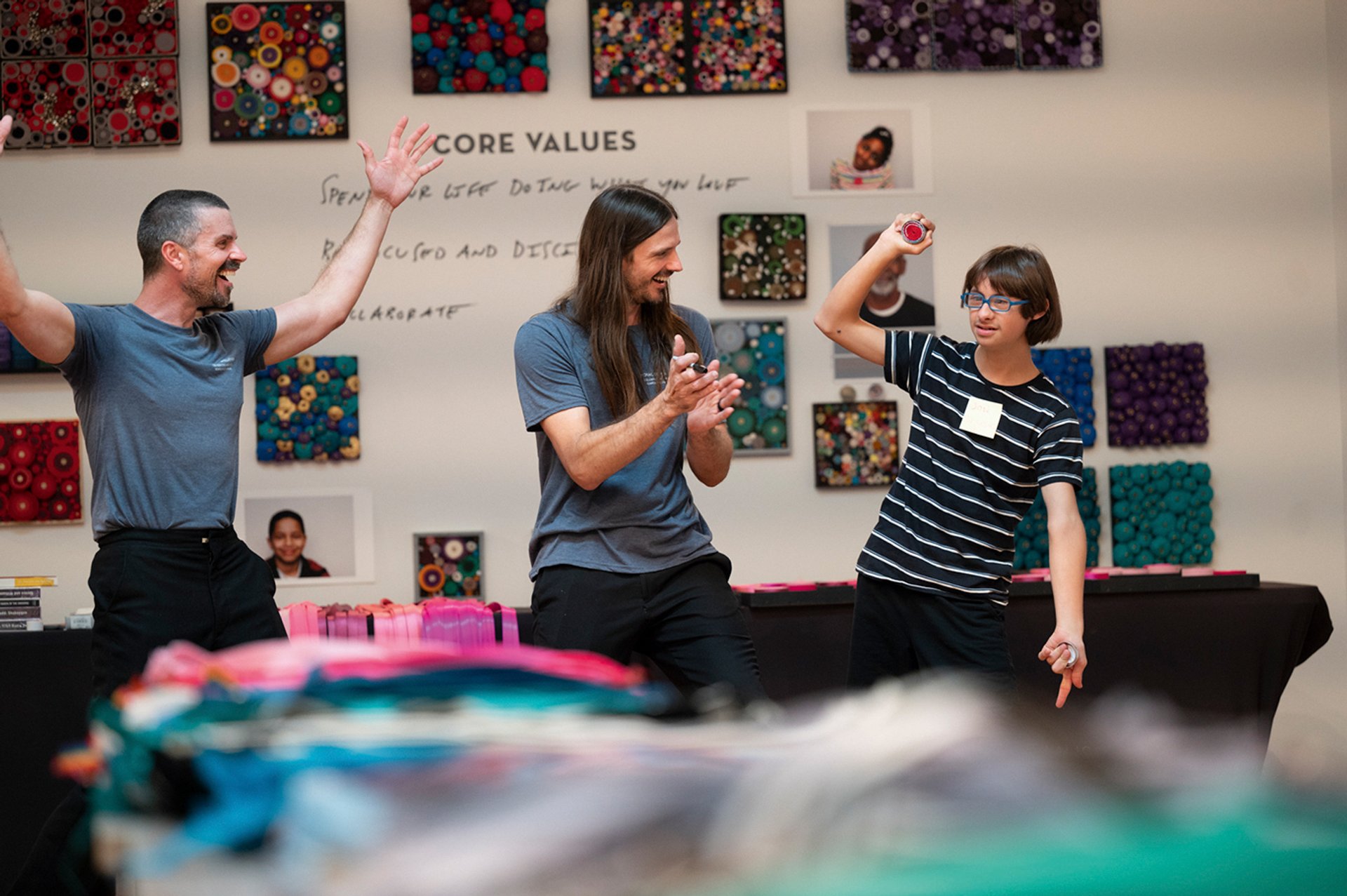
Scrollathon workshop with Steven and William Ladd at the Sarasota Art Museum, Florida, 2022
Photo: Daniel Perales for the Sarasota Art Museum
Part of the project is recording videos of participants. In one, a man who titled his scroll “appreciation” said he has lived in a house for a year after five years of being homeless and lonely. Another, a Black man, said that he attended segregated schools in Sarasota, Florida, until tenth grade, and Scrollathon was the “perfect subject matter” to return to one of the schools.
Steven says the brothers love how scrolls are ancient and universal storytelling devices that hold “so much symbolism and meaning throughout humanity”. The abstract patterns of scrolls variously evoke cells under a microphone or complex iron-on bead designs.
When they first lived in New York City, “broke basically for ten years”, William says, the brothers recycled fabrics that they were loath to throw away and wrapped them into scrolls. They worked with inmates at the Rikers Island prison, special needs communities and others. Around 20 years ago, they made scrolls with students of their longtime friend Angela Veninga, near their home town of St Louis, and students of their sister, who teaches in Brooklyn.
A Kennedy Center board member, who heard a talk connected to the brothers’ show at the Parrish Art Museum in Water Mill (2014-15), told them that they had to do a project at the centre’s new building, the Reach. “That’s when all of a sudden our mind kind of exploded on a national level,” William says.
In 2017, Steven says, someone from the Kennedy Center asked them what they wanted to do. They said they wanted to work with 1,000 Washingtonians on a permanent piece for the centre. When they visited, centre staff asked if they would make a national work for the 250th anniversary of the signing of the US Declaration of Independence.
Love for each other
“We were like, ‘It’s our dream to work all over America,” Steven says. “We are patriots. We love America. We love our family. We love this country.’ This was before all of everything in the current political climate.” When they began convening rooms of people for Scrollathon, the brothers found that Americans love one another and want to listen to others’ stories and tell their own, Steven says.
Traversing the country for the sessions, including during the pandemic, they created a network of relationships, which William calls the “hardest part”. They believe they have forged a model for a national cultural project that they can continue and that others could emulate.
“People love people,” William says. “People love America. Whether or not you’re protesting, or whether or not you’re waking up and believing in what’s happening, you still love where you are. You might disagree. You still love being here, being able to disagree.”
The brothers were never worried that the project would be cancelled, even as some artists severed ties with the Kennedy Center in protest of President Donald Trump’s policies and interventions at the centre. The centre will now soon close for two years of renovations, truncating the run of the Ladds’ project. Originally scheduled from 26 May to 7 September, National Scrollathon will now be on view from 29 May to 29 June.
“We had so many powerful people at the Kennedy Center that are still employed there that were always, from 2017 until today, advocating for the presentation of our project,” Steven says.
William thinks it is important to discuss politics. “We have Republicans in our family; we have Democrats in our family,” he says. “We know people that support Trump; we know people that hate Trump. We know people that didn’t like Obama; we know people that love Obama. It’s America.”
Walking away from the venue they told 10,000 people they would be showing their work at over Trump’s capture of the Kennedy Center “would just be wrong”, William says. “It was destined to be where it’s going to be. That’s the way we played it from the beginning and until this day, unless they cancel in the next month, it’s going to be there.” He adds that they signed a contract three years ago and plan to honour it.
Diversity’s dream
“When you walk into the Kennedy Center, you’re going to see 10,000 Americans represented in that space, every age, every background, every political affiliation, every orientation, every race, Indigenous communities, Chamorro, Carolinians from Northern Mariana Islands and American Samoa,” Steven says. “That’s like the dream to have that kind of representation in that kind of space, and that’s happening now in this political climate.”
William hopes someone sees the work and offers to fund it for the rest of the brothers’ lives. He adds that he does not think there has been a US cultural project of this scope before. “That’s a lot to take on,” he says, “but I think that the Ladds are willing to take it on and change the world into a better place.”