

At the back of the exhibition Edvard Munch and the Chocolate Factory, which opened at the artist’s eponymous museum in Oslo this month (until 11 October) is a gigantic pair of beige canvases—on which enigmatic images of workers appear at various stages of completion. The work is a preparatory sketch for a decoration of Oslo City Hall, which was never realised. The draft was, instead, discovered outside Munch’s studio in Ekely after his death, allegedly scrunched up in a ball of ice and snow, nearly forgotten to the ages.
Workers on the Building Site (1931–33) may have fallen out of favour with the man who made it, but it tells an important story about him, which is fundamental to the exhibition as a whole. It shows Munch not as an isolated, anxious painter, as he is often perceived, but as a public artist, a civic artist who wished to connect with people and pursue the idea that, in the words of the Chocolate Factory curator Ana Maria Basciani, “art should be for everybody”.
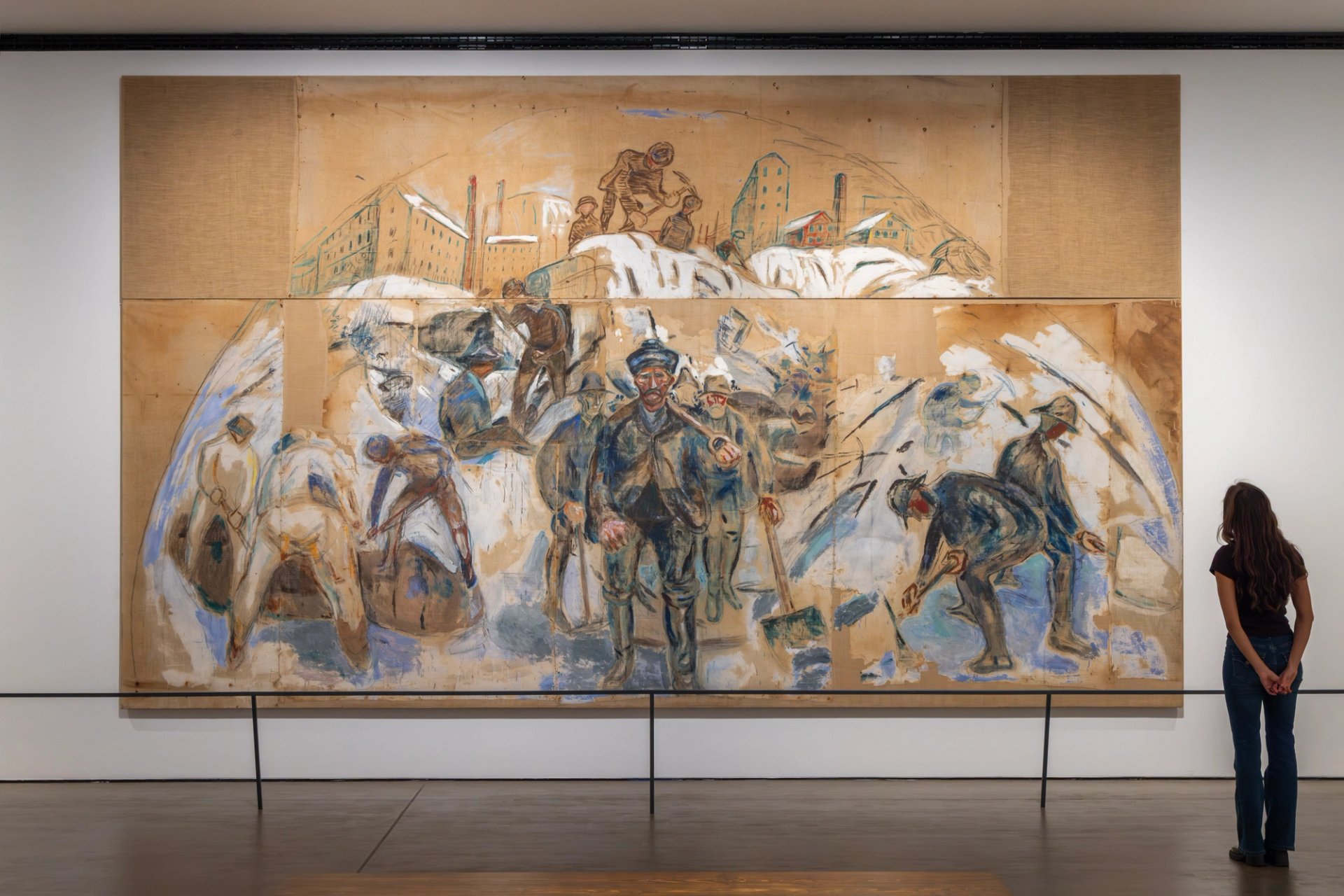
Edvard Munch’s Workers on the Building Site (1931–33) on view in the exhibition Edvard Munch and the Chocolate Factory
Perhaps the most potent symbols of this side of Munch are his decorations for the University of Oslo’s ceremonial hall, or Aula, which he completed in 1916. This frieze of 11 monumental paintings, which is not in the Chocolate Factory show, includes The Sun, depicting the large radiant star rising up over the sea, a rocky landscape in the foreground. Another piece is titled The History, and depicts an old man sitting under a tree, passing knowledge on to a young boy. With these works, Munch said he wished to “form a complete and independent world of ideas, and I wanted their visual expression to be both distinctively Norwegian and universally human”.
Munch was not initially invited to participate in the competition to create the Aula decorations, but expressed his interest and was eventually allowed to take part. He had entered an important chapter in his career, finding a new lease of life after eight months spent at the psychiatrist Daniel Jacobson’s clinic in Copenhagen in 1908-9, following a mental breakdown. Working in outdoor studios in Kragerø, on Norway’s southern coast, and Ramme, further north, he created hundreds of sketches and drafts for the murals. It was a crucial project, Basciani explains, not only for Munch as a public-serving artist but for Munch as a man seeking to grow his own image.
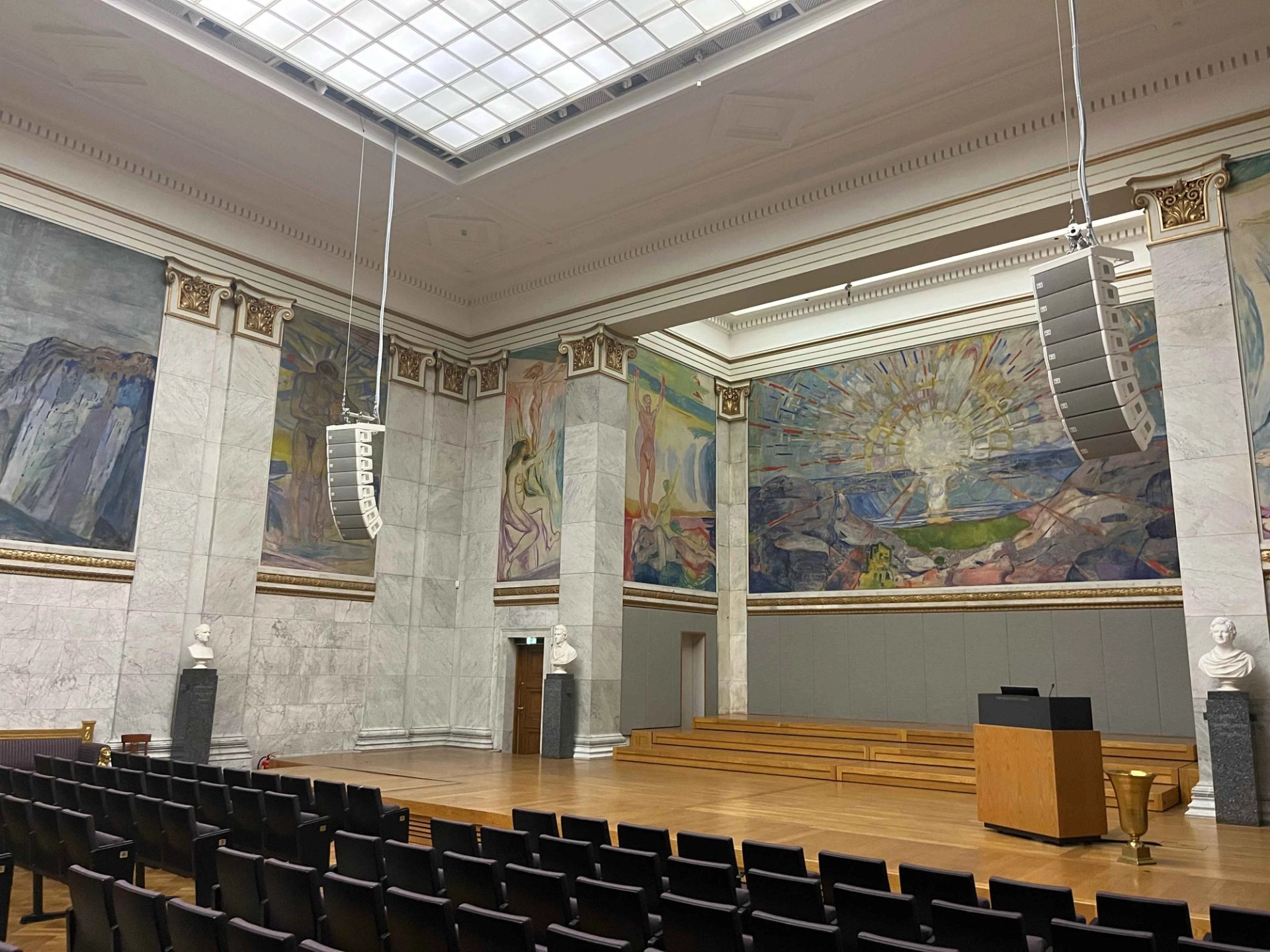
The Aula, The University of Oslo. Alma Mater is on the right hand and the Sun in the centre. Photo: The Art Newspaper
“He was a strategist,” Basciani says. “He knows that if he gets this commission, that is going to be the real recognition that he wants. And that maybe in that period, he would regenerate.” The competition was hit by delays, but eventually the murals were purchased by a group of loyal supporters and donated to the University of Kristiania (the former historical name of Oslo), and have been on permanent display ever since—serving as a backdrop for ceremonies, classical music concerts and more.
If the Aula decorations acted as Munch’s first, critical step into public space, his decorations for the Freia Chocolate Factory—which are his only other completed public works, and sit at the heart of the Munch Museum’s show—brought further depth and nuance to this relationship. On 6 April 1922, Munch received a letter from the factory’s director, Johan Throne Hols, officially inviting him to create works for the building’s women’s canteen. In the space of what he claimed was just two months, the artist created a series of 12 paintings, depicting life in a coastal town in summer. There are women harvesting fruit, children gathered on a street, and men hoisting goods down to boats, all rendered in loose brushstrokes and a medley of vibrant yellows, greens, blues and reds. In 1934, the paintings for the women’s space were moved into a new modern, all-gender canteen designed by the architect Ole Sverre. Plans had also been made for further paintings for the men’s canteen, but they were never realised.
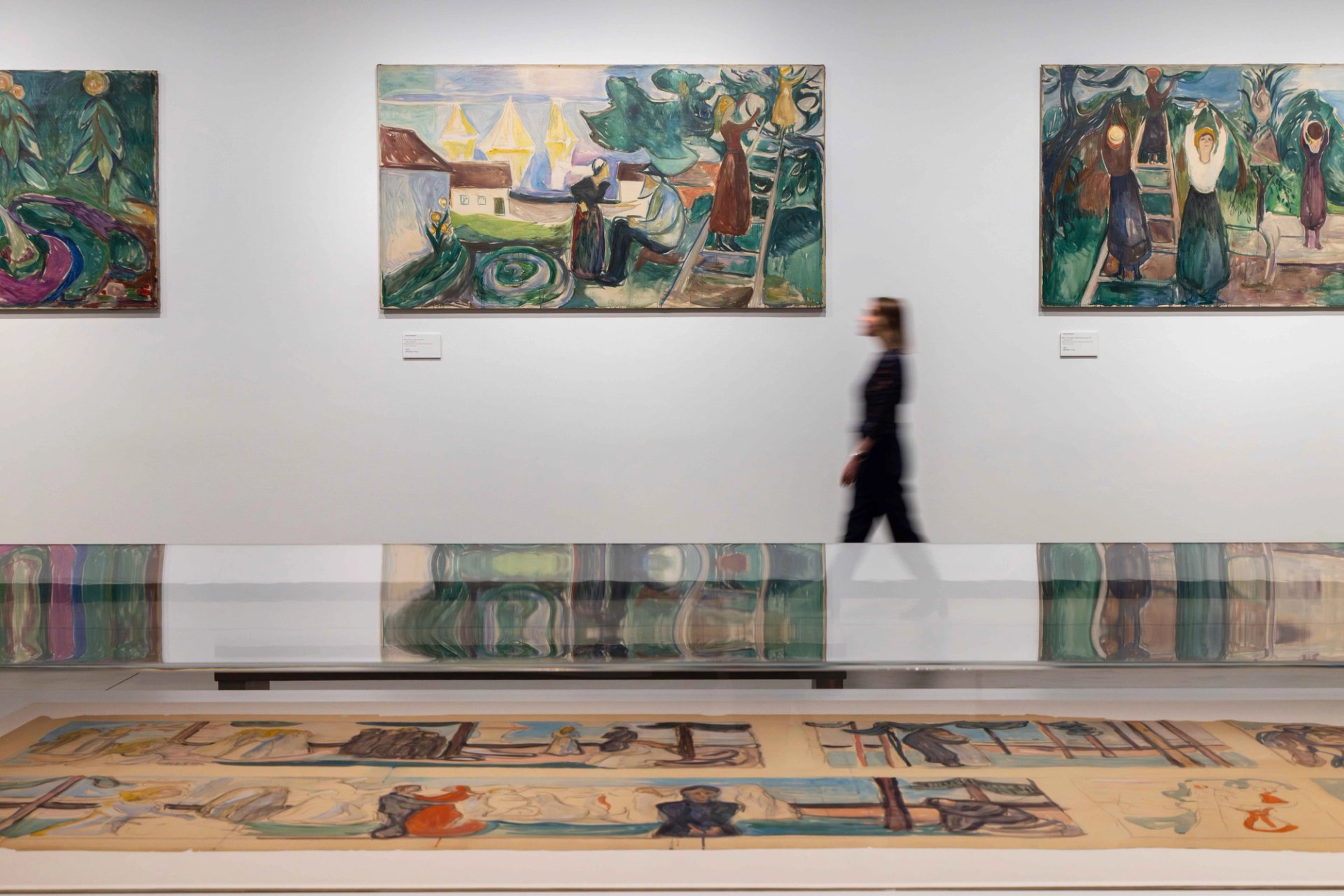
While many of the works in the women’s canteen draw on motifs Munch had used previously—Fertility, depicting an Adam and Eve-like pair under a tree, and Dance on the Beach among those that first appeared at the end of the 19th century—they also relate to developments that were very specific to the time, that Munch was tapping into. The early 20th century was a period “of incredible industrial growth in Norway”, Basciani says. It was also one in which issues around workers rights, public health and gender equality were being widely discussed—as is made clear by the Chocolate and Confectionery Workers’ Union banners that hang in the Munch Museum exhibition’s main space.
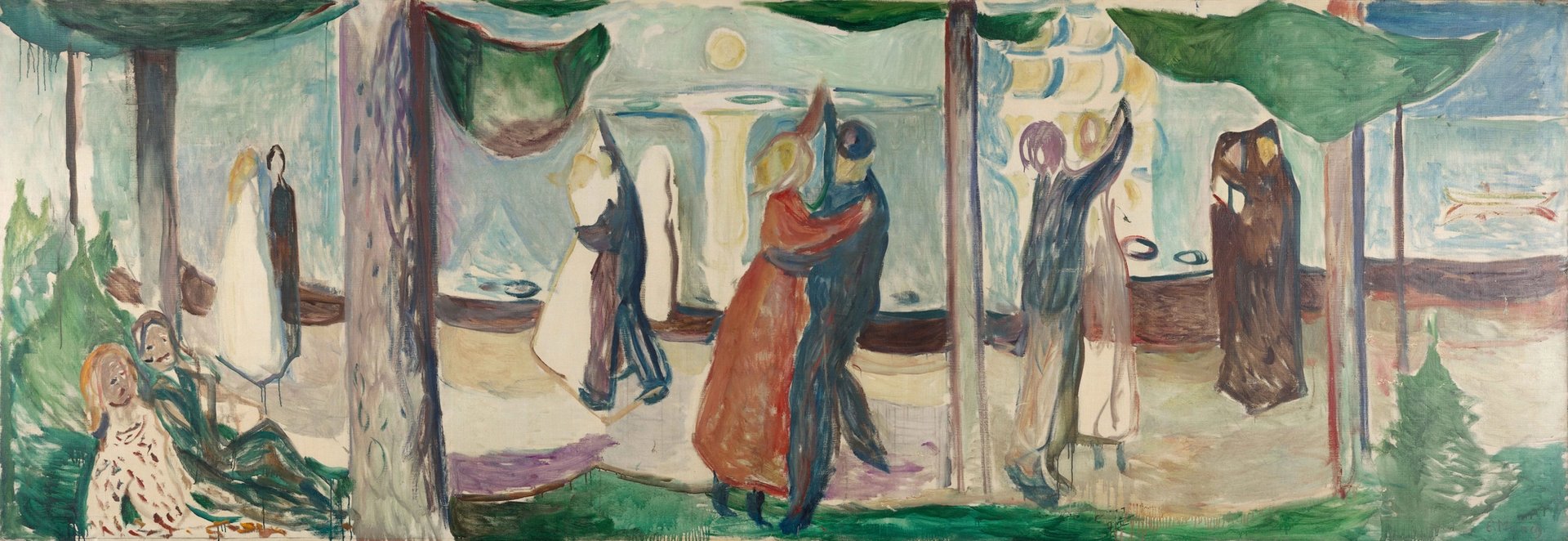
Edvard Munch, Dance on the Beach (The Freia Frieze VII), 1922. Photo Ove Kvavik. © Munchmuseet
Munch had begun to express an interest in the lives of the everyday person, in particular the worker, from around 1909, with images of farmers, fisherman and more appearing in his paintings. He saw in these figures symbols of the future, both for Norway and for art. He said in a 1929 letter: “Now it is the time of the worker. I wonder whether art will again belong to everyone?—and resume its rightful place on the spacious walls of public buildings.”
While the images in the women’s canteen paintings would likely have been a far cry from the real-life experiences of the workers, it’s likely they were made with the interests of the public in mind. The art critic and painter Pola Gauguin, is quoted in the catalogue as saying in 1923: “I believe Munch’s main idea was that the people working here every day have more need for, and derive more joy from, seeing the phenomena of general life, from childhood, through adolescence, to old age, than they would from symbols of the work they do every day.” Reflecting on why he took on the commission in an undated letter, Munch himself suggested he had hoped the frieze would represent a concise, complete version of his series exploring the human condition.
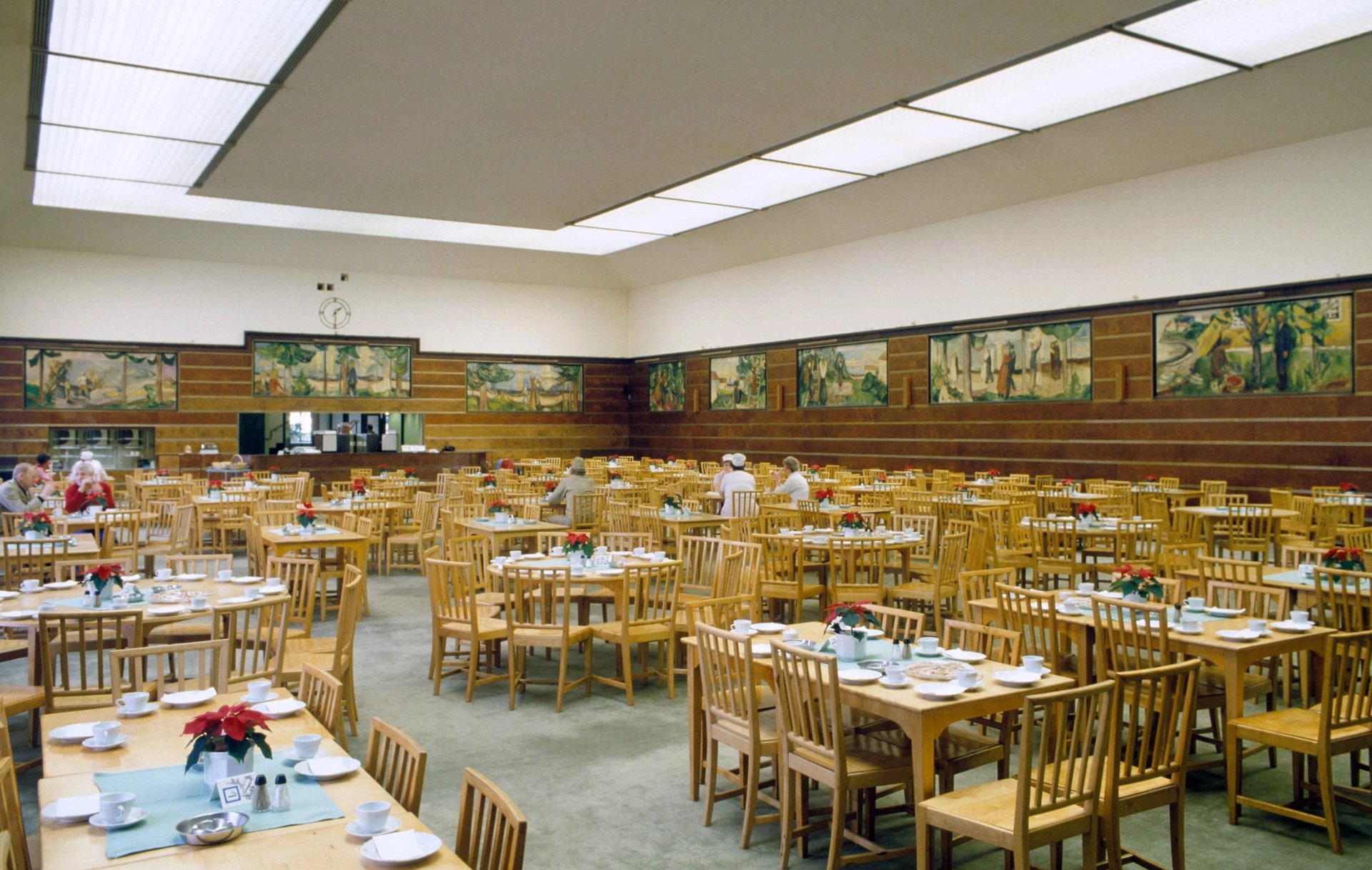
The Freia dining canteen
Photo: Svein Andersen. © Munchmuseet
“When I think about it, it was to finally see my idea of the Frieze of Life in one place and with my idea of letting a shoreline tie all the images together into a whole,” he said.
Any altruistic intent was almost certainly shared by the frieze’s commissioner. In their colour and harmonious atmosphere, these paintings tie into wider conversations around vitality, hygiene and enjoyment that were prevalent in society at the time. The Freia chocolate factory, under the then director Johan Throne Holst, was at the forefront of new thinking about workers’ wellbeing, with Holst publishing a manifesto in 1914 in which he stressed the importance of happiness at both home and one’s working place. A video from the opening of the modern canteen—an orchestra playing, while workers sit happily chatting, surrounded by Munch’s paintings—shows that this space was perceived as being symbolic of that.
The reception of the chocolate factory works was complex. In an undated letter Munch wrote, perhaps somewhat patronisingly, about how “the little chocolate girls, sat there eating, understanding the pictures better and better”. Yet staff appreciation was apparently not without its limits: according to a biography of Munch by Rolf Stenersen, the artist was called back to paint doors and windows onto buildings in the paintings, a task he allegedly abandoned after the driver he had requested be on call failed to turn up one day.
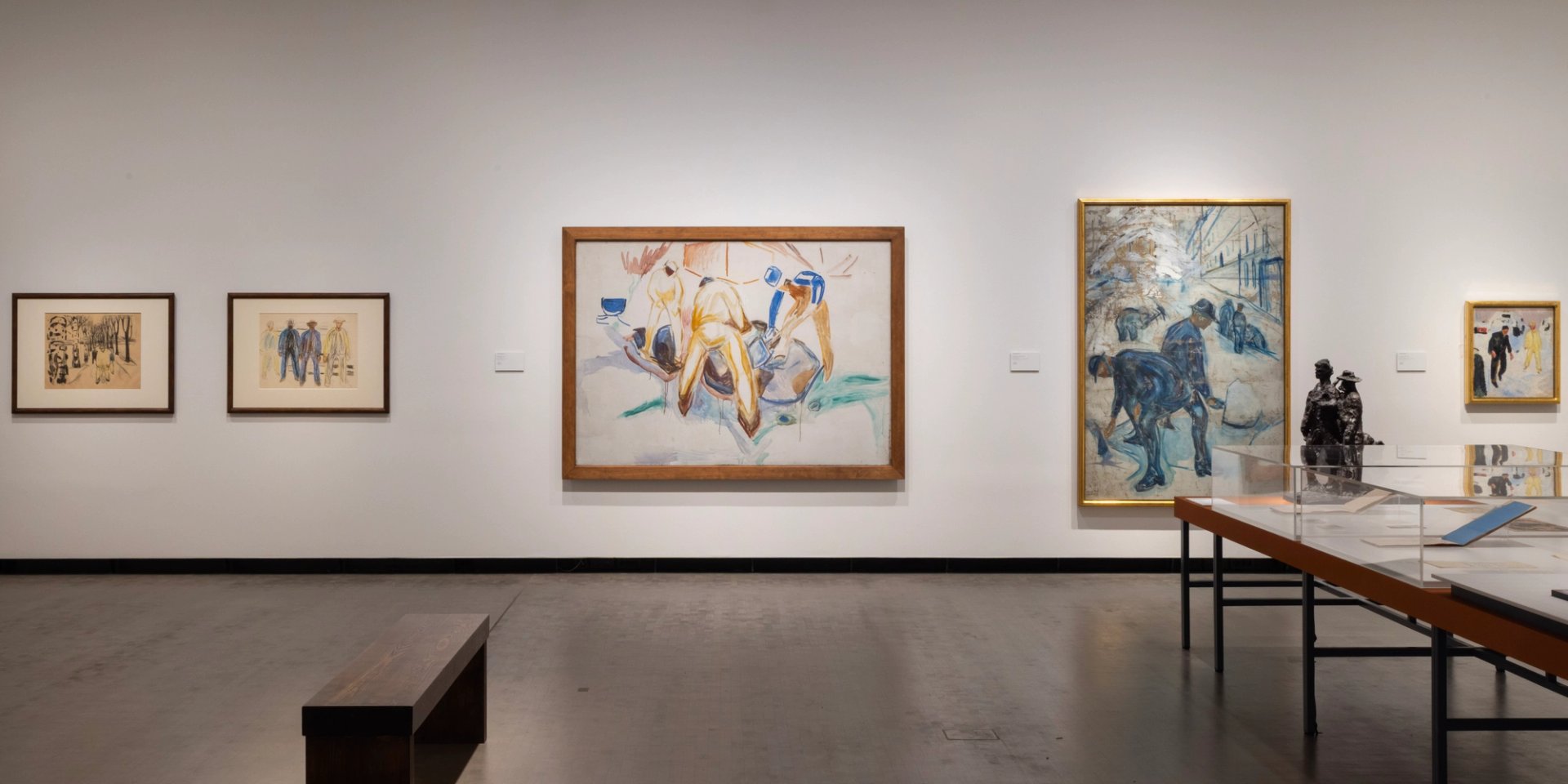
The exhibition features other works Munch made depicting working people
Courtesy of Munch Museum
However the works themselves were perceived, though, the canteen as a whole certainly made an impact: more than 10,000 visitors attended in the first three weeks. They have since—apart from the present show and one other more than 50 years ago—remained in place, gathering stains from smoke and dust, for more than a century.
Munch’s drafts for unrealised projects, also on view in the exhibition, show how he had intended to strengthen his dialogue with the working public yet further. There are his drawings for the men’s canteen, which include scenes such as a man greeting his daughter, a family relaxing on a picnic basket, groups of people pouring down a street. These images show Munch connected, in a multi-dimensional way, to the new world people were entering: a world in which, Basciani explains, “workers had just earned the right to summer holiday, for example, and to the ten-hour working day.”
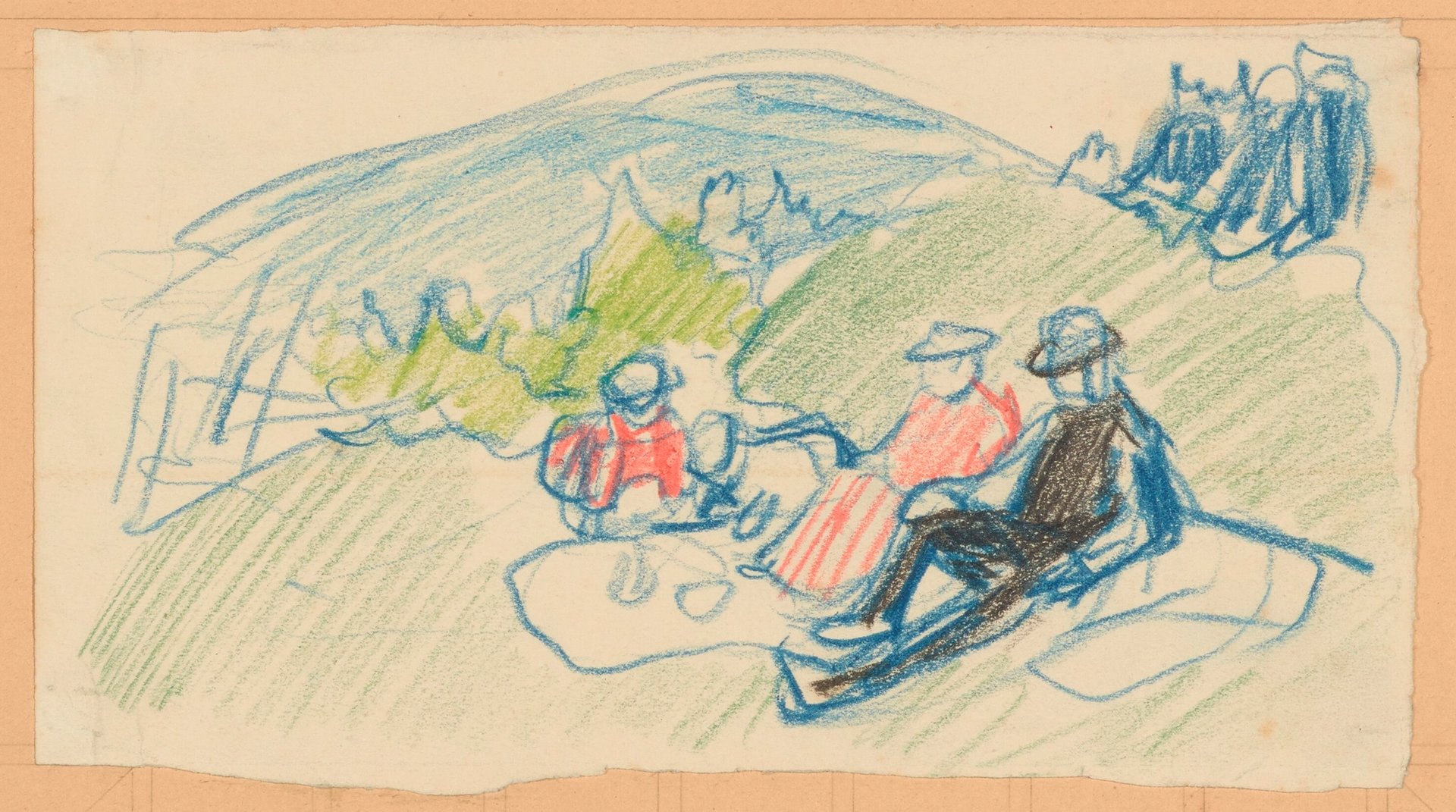
Edvard Munch, Worker and Child (1907), drawing in preparation for his proposed decoration of the men’s canteen. The decorations were never realised
© Munchmuseet
Then there are Munch’s sketches for Oslo City Hall, which the artist had begun without a commission, and which show the full extent of his civic ambitions. One, Horse Team on a Building Site, (1928–29), bursts with activity and colour, hinting at Munch’s excitement at a new era for Kristiania and his part in forming it. Similarly, in Workers on the Building Site, the monumental, two-canvas piece that has undergone meticulous conservation—including by the conservators Lina Wulff Flogstad and Mie Mustad at the Munch Museum—men clear paths in the snow, “demonstrating their strength”, Basciani notes in the catalogue, “and participating in the demolition of the city to shape its future”.
Despite a public campaign in support of him, Munch’s dream for the city hall never came to pass—the building opening years after his death. But it was a project he clearly thought deeply about. In an 1928 interview with the Norwegian newspaper Dagbladet, the artist floated the idea of taking a flight over the land, to think through his plans for it. “How does one go about creating decorations for castles in the air?,” he said. “One must take a plane to see the room one intends to decorate”.
To Basciani’s knowledge, such a flight never happened. Munch’s grandest plans, instead, got buried in the snow.
- Edvard Munch and the Chocolate Factory, Munch Musuem, Oslo, until 11 October