

For the past few years, visitors who arrived at Hobart’s Museum of Old and New Art (Mona) by car were greeted by a construction sign that read “Yep, David’s building something new… at this point we’ve given up trying to stop him”.
Designed to keep people out of harm’s way during construction of the museum’s latest extension, the signage also suggested that David Walsh, the multi-millionaire professional gambler behind Australia’s largest privately owned museum, may not be able to control his art obsession.
A new wing called Phrontisterion, the largest construction project in Mona’s 15-year history, opens this weekend. Breaking new ground presented an opportunity to reflect on the original motives behind the museum—at least one of which was to “actively re-educate people about how to use a museum”, Walsh tells The Art Newspaper. At the time there was a “very significant chance that no one cared” if he failed, he says.
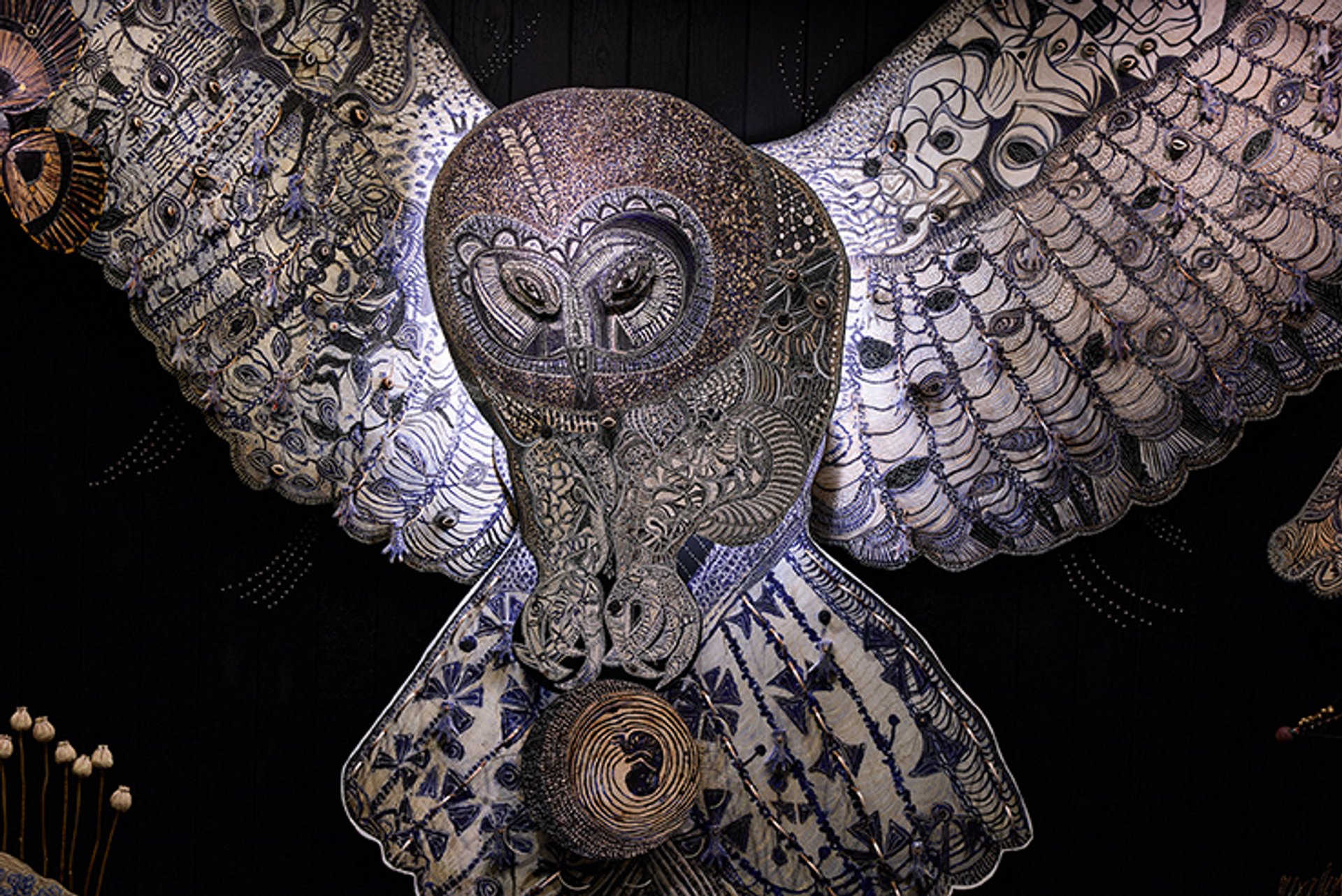
Joshua Yeldham’s installation Surrender Room (detail, 2025-26) is a new addition to the museum
Photo: Mona/Jesse Hunniford, courtesy of the artist and Mona
But with its eclectic mix of contemporary art, antiquities and an ever-increasing list of permanent installations from the likes of James Turrell, Alfredo Jaar and Anselm Kiefer, Mona has prevailed against its critics, becoming a must-visit global art destination over the past 15 years. On its website, Mona invites visitors to “Come along, catch the ferry, drink wine, eat oysters. Talk crap about the art.” And many artists and curators have done that. “The art community is on the whole fairly supportive of Mona,” Walsh says. “So I get celebrity treatment.”
With an estimated price tag of A$100m ($70m), Phrontisterion cost significantly more than the A$75m Walsh stumped up for the original museum, which is largely underground. It has increased Mona’s display space from 8,440 sq. m to roughly 12,640 sq. m.
Cartography and contemporary art
In 2023 Walsh revealed that the extension would include his “dream library” as well as works by Kiefer, the 17th-century cartographer Willem Blaeu, and the contemporary French-Swiss artist Julian Charrière. That list now includes Matthew Barney, Joshua Yeldham, Lucas Grogan, Rachel Marks and Ben Jakober, whose work is on show in the redeveloped library space.
The new wing also houses Charrière’s Breathe, a new permanent installation that gives visitors the chance to inhale oxygen molecules previously trapped inside pieces of iron ore that formed 2.4 billion years ago during the Great Oxidation Event. According to Walsh, Australia is one of the only places Breathe could be realised, as “anywhere else you’d have to import rocks”. Located adjacent to the new wing, on the edge of the River Derwent, is In Absence (2019), a collaboration between the Kokatha/Nukunu artist Yhonnie Scarce and the architecture studio Edition Office. The design of this 9m-high timber pavilion, adorned with more than 1,400 hand-blown glass daisy yams, was inspired by the eel traps used for thousands of years by many of the first peoples of South-Eastern Australia.
Phrontisterion also encompasses Elektra (2025), an inverted concrete pyramid designed by Kiefer that went on display last December, built to resemble the artist’s outdoor studio near Barjac in southern France. Walsh says he has visited the studio “many times” and each time was “mesmerised, thrilled, excited, stupefied” by the scale of it. “It’s like one man building the Great Pyramids,” he says. Walsh’s deep affection for Kiefer’s structures at Barjac resulted in Mona’s international curator, Geneva-based Olivier Varenne, approaching Kiefer with a “speculative idea” to reconstruct one in Hobart, “not really expecting it to come to anything”, Walsh says. But it did.
A place of deep thinking
Elektra is a “restrictive artwork”, Walsh says. “It leaves a lot of negative space.” While the negative space at Barjac is in the ground, at Mona it provided Walsh with “a good place to build a library”.
In Ancient Greece the playwright Aristophanes employed the word phrontisterion, which refers to a place of deep thinking or meditation, to take a swipe at the popularity of Socrates’ open-air philosophical debates. In the context of Mona, phrontisterion refers to the centrepiece of the new wing, Mona’s new library.
Mona is all about the “efficient use of space”, Walsh says. When it first opened it was “an A$75m museum with the floor space of museums that cost hundreds of millions of dollars”. But that economy of space did not apply to the library, which had “super fancy elegant walls” that meant the books sat on bookshelves in the centre of the room, Walsh says. I made “no attempt to raise [the library] to the level of the objects that were contained within Mona”, he says. It is a decision he has always regretted.
Death of Dewey
The new library boasts over 50,000 books, maps and documents housed in custom-built cabinetry and underpinned by a state-of-the-art proprietary cataloguing technology that Walsh hopes will one day end the stranglehold the Dewey Decimal System has over the world’s libraries. With the Dewey Decimal System a “book has to be in a single place always”, Walsh says. With new assisted technology, Mona’s librarians can identify books “immediately, accurately” and “do cataloging far cheaper, aesthetically and make associations between books far more apparent”.
But perhaps most pleasing to Walsh is the fact that the library will showcase the foundational philosophy of Mona, and the “conceptual space” the museum inhabits, much of which is concerned with exploring the biological and evolutionary drivers behind why humans create and appreciate art. Walsh says he is interested in “the motives of artists rather than the art itself”.
According to Walsh, the sort of money he spent on Mona could have bought him “a jet and an island or a big boat or those things that some really rich people do”. But instead he went all-in on art—and what did he get? Buying “elite art is targeted status acquisition”, he says.