Key Takeaways
- Saylor says corporate adoption is essential to Bitcoin’s global monetary role.
- Public companies hold 1.263 million BTC, with Strategy controlling about two-thirds.
- Strategy’s financing model and 32% banking adoption score show how corporate and institutional bitcoin infrastructure is developing.
Saylor’s Corporate Bitcoin Thesis Meets a Concentrated Market
Corporate adoption could help bitcoin develop into a broader monetary network, but the outcome depends on whether companies can hold the asset while meeting ordinary financing obligations. Strategy Inc. (Nasdaq: MSTR) Executive Chairman Michael Saylor argues corporations provide the legal structure, scale and continuity bitcoin needs.
Public-company holdings support that thesis, but Strategy’s dominance means the market still depends heavily on one company’s capital structure.
In his July 18 post on X, Saylor said companies allow people to organize under law around a shared mission with greater “efficiency, transparency, creditworthiness, scale, resilience, and continuity.” He added that corporate adoption is “necessary, inevitable, and welcome” for bitcoin to succeed as a global monetary network.

Strategy Controls Two-Thirds of Public-Company Bitcoin Holdings
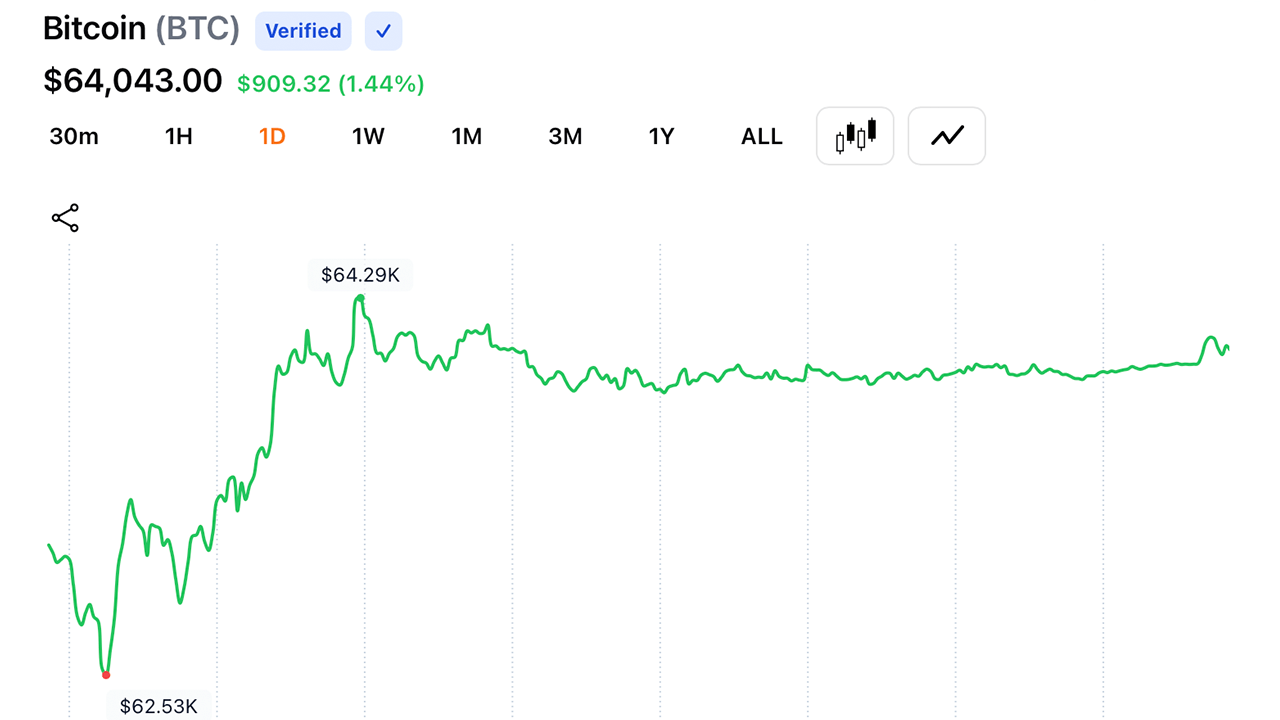
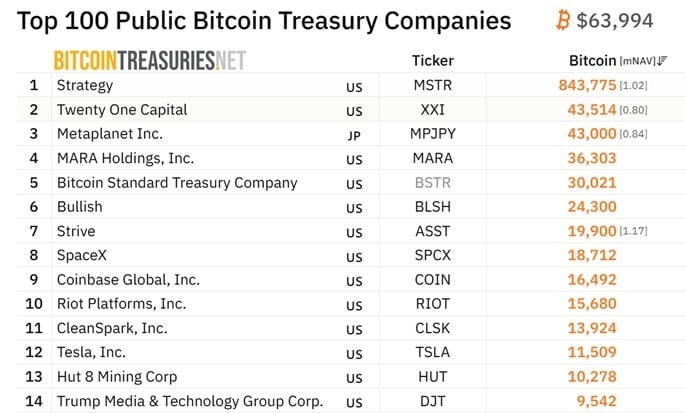
BitcoinTreasuries data showed that 197 public companies held approximately 1.263 million BTC worth $80.82 billion, with bitcoin trading near $64K. BTC accounted for 94.5% of the digital assets held by the tracked companies, while the number of public-company holders had declined by one during the preceding 30 days.
Strategy held 843,775 BTC, equal to about 66.8% of the public-company total. Twenty One Capital ranked second with 43,514 BTC, followed by Metaplanet with 43,000 BTC, MARA Holdings with 36,303 BTC and Bitcoin Standard Treasury with 30,021 BTC. That concentration makes Strategy’s financing decisions more consequential to the corporate bitcoin market than those of any other listed holder.
Strategy’s Balance Sheet Shows the Scale of Its Bitcoin-Credit Model
Strategy’s dashboard valued its bitcoin reserve at approximately $54.03 billion, based on a BTC price of $64,032. The company also reported $3 billion in cash reserves, $6.75 billion in debt and $15.46 billion in preferred securities.
Annual preferred dividends totaled $1.763 billion. Strategy estimated that its cash reserve provided 20.4 months of dividend coverage, while its bitcoin reserve represented 30.6 years of coverage at the displayed values. Those figures place bitcoin at the center of both Strategy’s treasury position and the financing structure supporting its preferred securities.
Dividend Payments Have Turned Bitcoin Into a Funding Source
Strategy sold 32 BTC for approximately $2.5 million in May at an average price of $77,135. The company said the proceeds would help fund preferred-stock dividends, while it also raised $128.3 million through common-stock sales during the same period. The transaction was its first disclosed bitcoin sale since a tax-related disposal in 2022.
The company later sold another 3,588 BTC for about $216 million to support preferred dividend payments. Combined, the two sales totaled 3,620 BTC, or about 0.43% of Strategy’s current 843,775 BTC position. The disposals were small relative to the total reserve, but they confirmed that bitcoin can be converted into cash when the preferred-stock structure creates recurring payment needs.
The sales do not show that Strategy is abandoning its accumulation strategy. They do show that its bitcoin reserve now performs two functions: long-term asset exposure and liquidity support for securities issued to finance that exposure. With annual dividends of $1.763 billion, the company must continue funding those payments through cash, capital raising, bitcoin sales or a combination of the three.
Geoffrey Kendrick, global head of digital assets research at Standard Chartered Bank, offered a more constructive interpretation, arguing that wider acceptance of Strategy’s bitcoin-backed preferred securities could reduce pressure for further BTC sales and eventually support renewed accumulation. He maintained a $100,000 bitcoin target for the end of 2026, implying roughly 56% upside from bitcoin’s price near $64,000.
Strategy’s Banking Index Puts Institutional Adoption at 32%
Strategy’s Bitcoin Banking Adoption Index gave the financial sector an overall score of 32%, based on activity across trading, custody, ETFs, tokenization, lending, underwriting and corporate allocation.
Fidelity led with 71%, followed by BNY at 46% and Goldman Sachs at 45%. JPMorgan, Morgan Stanley and Citigroup each scored 43%, while Royal Bank of Canada and SMBC ranked lowest at 13%. Fidelity was the only institution above 50%.
The index tracks the presence of bitcoin products and activity, not customer adoption, transaction volume, assets or revenue. Strategy also had not published full category weights or detailed scoring standards, limiting independent assessment of the 32% result.
The next catalyst will be Strategy’s next treasury and financing disclosure. The concrete questions are whether the company sells more BTC, relies on its $3 billion cash reserve, raises additional capital or resumes purchases while maintaining $1.763 billion in annual preferred dividends.

Fidelity, BNY, Goldman Sachs, JPMorgan, Morgan Stanley, Citi Lead Strategy’s Bitcoin Banking Adoption
Fidelity, BNY, Goldman Sachs, JPMorgan, Morgan Stanley, and Citigroup topped the newly launched Strategy Bitcoin Banking Adoption Index, which assessed…


Fidelity, BNY, Goldman Sachs, JPMorgan, Morgan Stanley, Citi Lead Strategy’s Bitcoin Banking Adoption
Fidelity, BNY, Goldman Sachs, JPMorgan, Morgan Stanley, and Citigroup topped the newly launched Strategy Bitcoin Banking Adoption Index, which assessed…
Fidelity, BNY, Goldman Sachs, JPMorgan, Morgan Stanley, Citi Lead Strategy’s Bitcoin Banking Adoption
Fidelity, BNY, Goldman Sachs, JPMorgan, Morgan Stanley, and Citigroup topped the newly launched Strategy Bitcoin Banking Adoption Index, which assessed…