
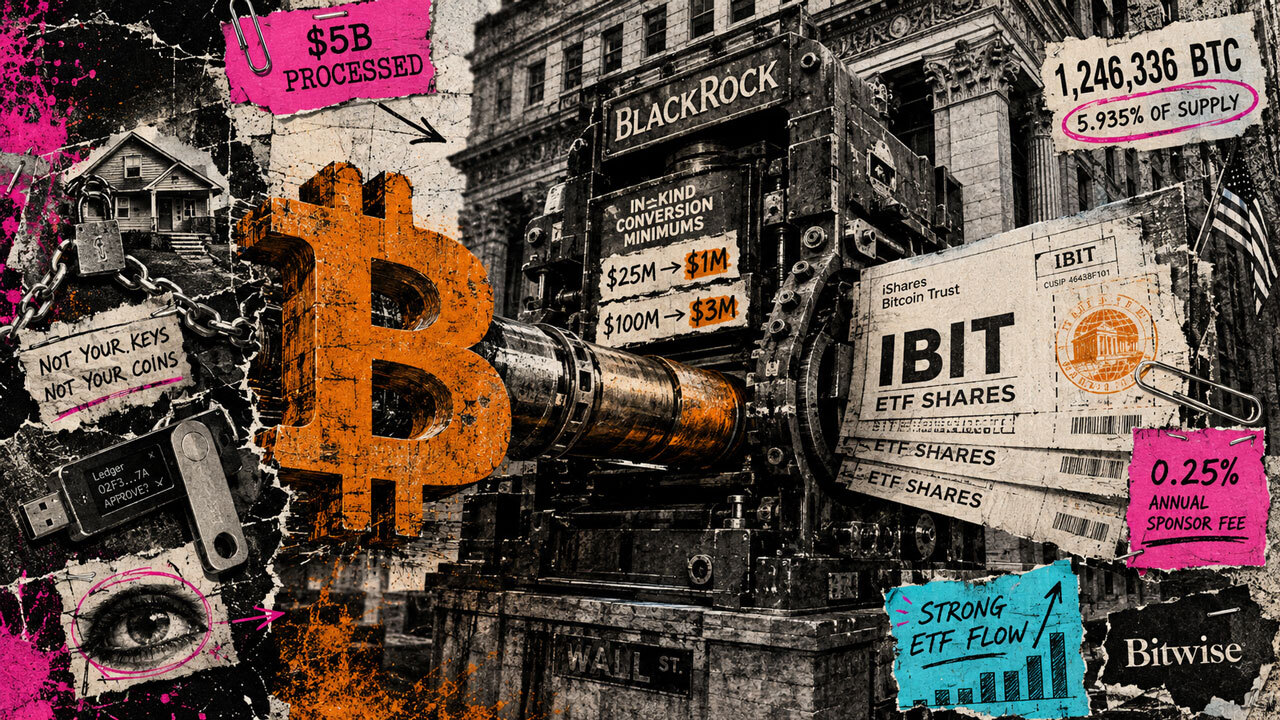
BlackRock cut the minimum for converting privately held Bitcoin into IBIT shares from $25 million to $1 million, while Bitwise lowered its floor from $100 million to $3 million. While this might sound like a niche development for a small number of institutional users, it signals that custody is no longer just a slogan for Wall Street.
BlackRock cut the minimum transaction size for a qualifying Bitcoin holder to convert coins directly into shares of its iShares Bitcoin Trust ETF from $25 million to $1 million in July, the company told Bloomberg. The 96% reduction now brings a service once reserved for the richest whales within reach of a much larger class of family offices and wealthy clients, and BlackRock says the program has processed more than $5 billion to date.
Bitwise made an even steeper cut, taking its minimum from $100 million for its first such transaction to $50 million and now $3 million. The cut reduced Bitwise’s threshold by 97%, and each conversion preserves exposure to Bitcoin price while placing the coins inside the fund’s custody structure.

The cheaper entry point is an important rethink of a decision once shaped by the execution costs and possible tax bill of selling coins, wiring dollars, and repurchasing exposure through an ETF. An in-kind conversion compresses those steps into one institutional transaction, giving the holder ETF shares that fit inside a brokerage account and the familiar systems that surround it.
A $1 million floor still excludes almost everyone, although it reaches far beyond the population able to commit $25 million or $100 million of Bitcoin to a single transaction. The lower threshold turns self-custody from a permanent identity into a service choice whose costs can be measured against an institutional alternative.
| Provider and product | Published conversion size | Reduction | One-time conversion charge | Annual ETF fee | Estimated annual fee at cited size | Evidence of use |
|---|---|---|---|---|---|---|
| BlackRock IBIT | $1 million minimum, down from $25 million | 96% | Undisclosed to the end client | 0.25% | $2,500 on $1 million | More than $5 billion processed |
| Bitwise BITB | $3 million minimum, down from $100 million through an interim $50 million floor | 97% | Undisclosed to the end client | 0.20% | $6,000 on $3 million | Aggregate conversion volume undisclosed |
| Morgan Stanley and Galaxy | $5 million lending minimum for referred clients, down from $25 million | 80% | Undisclosed and dependent on the client arrangement | Varies by chosen ETP; MSBT charges 0.14% | $7,000 on $5 million if converted into MSBT | Onboarding can be shortened by as much as 75% |
| Grayscale GBTC or BTC | No minimum published | N/A | Undisclosed to the end client | 1.50% for GBTC; 0.15% for BTC | $15,000 or $1,500 per $1 million | In-kind transactions represented 62% of gross Bitcoin creations in June, versus 28% in March |
| ARK 21Shares ARKB | No minimum published; completed transactions averaged about $5 million | N/A | Undisclosed to the end client | 0.21% | About $10,500 on a $5 million position | Average completed transaction was about $5 million over three months |
A whale service becomes a wealth-management product
In-kind creation is an institutional process reserved for authorized participants and eligible clients. A holder transfers Bitcoin through an authorized participant, the trust issues ETF shares at settlement, and the intermediary credits those shares to the holder’s account. Ordinary brokerage clients continue buying and selling IBIT shares for cash.
The SEC approved in-kind creations and redemptions for crypto exchange-traded products (ETPs) in July 2025, ending the original cash-only restriction that CryptoSlate examined through its effects on spreads, taxes, and flows.
IBIT’s operating documents allow an authorized participant or its client to deposit Bitcoin into the trust’s trading account for a creation order, with the trust issuing shares to the authorized participant at settlement.
That route removes a lot of friction for a wealthy holder who already owns BTC. Selling Bitcoin, wiring dollars, and repurchasing exposure through an ETF adds execution costs and can realize a taxable gain, while in-kind transactions may defer that gain for some holders. Because the tax result depends on the holder and legal structure, each conversion requires individual tax advice.
So what was once a bespoke transaction is becoming a repeatable service, and a Morgan Stanley and Galaxy referral program announced in June shows how the process is spreading into wealth management. Under the arrangement, an eligible client lends crypto to Galaxy, which coordinates an in-kind creation with an authorized participant before ETF shares arrive in the client’s chosen account. Galaxy cut its minimum for referred clients from $25 million to $5 million and said onboarding that can exceed four weeks may be shortened by as much as 75%.
Activity elsewhere shows the same process becoming routine, with Grayscale completing 62% of its gross Bitcoin creations in kind in June, up from 28% in March. Completed transactions at 21Shares averaged about $5 million over the three months through July, according to Bloomberg.
US spot ETFs already hold a large share of Bitcoin’s total supply, with Bitbo counting 1,246,336 BTC across 13 funds on Aug. 25, equal to 5.935% of the 21 million supply. IBIT alone held 765,389.9 BTC, or 3.645% of the supply, while BlackRock listed its net assets at $60.65 billion on the same date.
Self-custody now carries a physical price
BlackRock’s head of digital assets, Robbie Mitchnick, told Bloomberg that kidnappings, ransom demands, and custody failures can motivate holders to move some or all of their coins into an ETF. The company hasn’t broken the $5 billion down by motive, so the crime data provides context for the environment around the conversions and doesn’t establish their cause.
The physical threat has become easier to quantify, with Chainalysis documenting 46 violent crypto incidents through late June and estimating that attackers successfully stole more than $30 million during the first half of 2026. That total was already more than half of the record $58 million taken during 2025, while only 12 of the 46 attempts produced a payment.
CertiK counted 52 verified incidents during the first half, up 33.3% from a year earlier, with $124.1 million in recorded exposure. The broader number includes losses and ransom demands, making it a different measure from Chainalysis’s stolen-funds estimate; CertiK also found that home invasions jumped from one to 20 incidents year over year, while kidnappings rose from 12 to 16.
Self-custody removes an exchange or bank from the authorization chain, leaving the holder as the final signer. A properly secured wallet can resist remote theft, while a criminal inside the home can target the person who knows where the seed phrase, hardware device, or second multisig signer lives.
The true cost of self-custody therefore extends far beyond a hardware wallet, because multisig coordination, inheritance planning, private security, reporting, and recovery all consume money or attention. The burden expands when family members can become targets, which is why BlackRock describes IBIT as a way to simplify the operating and custody complexity of direct ownership.
However, IBIT’s 0.25% annual sponsor fee and its dependence on brokerage and market infrastructure impose their own costs. The owner holds a security whose value tracks Bitcoin while the fund’s custodians retain the coins, and direct custody preserves the ability to withdraw, transfer on-chain, and verify assets in a personal wallet.
Safer Bitcoin owners can feed a concentrated system
Moving coins into an ETF can reduce one person’s exposure to key loss and physical coercion while placing more Bitcoin inside a smaller set of institutional firms. CryptoSlate calculated in April that funds naming Coinbase as a custodian or primary custodian represented 84.1% of US Bitcoin ETF assets under a broad method, while a stricter count excluding multi-custodian funds with undisclosed allocations still reached 80.8%, or about $74.06 billion.
Those percentages describe funds connected to Coinbase in some custody capacity and leave the exact allocation of coins among providers undisclosed. The stricter estimate still captures a structural trade: thousands of people can reduce individual key risk by moving into products whose operating dependencies converge in a handful of companies.
The custody map can spread across more companies because BlackRock’s documents name Anchorage as an available additional custodian, ARK has listed Coinbase alongside BitGo and Anchorage, Fidelity uses its own digital-asset subsidiary, and VanEck uses Gemini. The market can therefore move more coins into institutional custody while distributing those coins among more providers.
The conversion program is widening right as we’ve seen a fresh burst of demand for ETFs. Farside data show that US spot Bitcoin ETFs absorbed $2.57 billion across seven positive sessions from Aug. 17 through Aug. 25, with IBIT taking $1.82 billion, or 71% of the total. CryptoSlate covered the first six sessions as a rebound in ETF demand, while the seventh added another $314.3 million across the category.
Daily net inflows and direct Bitcoin conversions measure different activity, so their totals belong in separate datasets and aren’t directly comparable. However, it still shows two routes operating together: investors are sending fresh capital into ETF shares while existing coin holders gain a cheaper way to place Bitcoin they already own inside the same funds.
Bitcoin still lets holders control an asset that can move anywhere the network reaches, and wealthy owners can keep paying for the security, coordination, and recovery systems that direct control requires. Wall Street now sells Bitcoin price exposure in a conventional account and assumes much of that operational burden for qualifying clients.
The protocol’s self-custody option stays available as the fund industry cuts the entry price for its package by 96% at BlackRock and 97% at Bitwise. More than $5 billion has already passed through IBIT, showing how institutional adoption can advance through coins leaving private wallets alongside dollars arriving from buyers who never held Bitcoin.