

Ethereum validators rely on independently built consensus clients to agree on the chain, and that diversity is a safety feature. If a defect affects a client used by too much of the network, Ethereum can stop finalizing blocks or, under more extreme conditions, finalize the wrong chain.
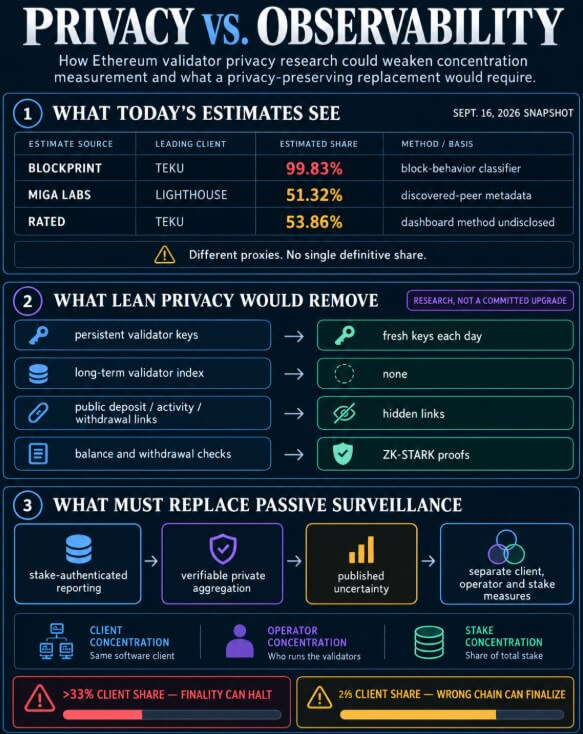
Yet a Sept. 16 snapshot of one client-diversity dashboard offered three incompatible answers about which client had the largest share. Clientdiversity.org showed Blockprint estimating Teku at 99.83%, Miga Labs estimating Lighthouse at 51.32%, and Rated estimating Teku at 53.86%.
Those are readings coming from different proxies, and one is attached to a tool its developer now calls defunct. Ethereum researchers are exploring stronger validator privacy.
A Lean-chain research proposal would use fresh validator keys each day and hide links between deposits, validator activity and withdrawals, weakening some of the traces used to measure operator and stake concentration.
The central question is whether Ethereum can replace imperfect surveillance with authenticated aggregate reporting before those persistent identifiers disappear.
Why the disputed numbers matter
Ethereum.org’s client-diversity guidance describes two distinct failure levels.
A bug in a consensus client used by more than 33% of nodes could prevent finality, a liveness failure that leaves users unable to rely on transactions as irreversible.
A critical bug in a client with a two-thirds majority could cause an incorrect split chain to finalize, a safety failure that could leave validators facing slashing or an expensive exit-and-re-entry process.
The public guidance uses node share as shorthand. Researchers seeking a consensus-risk measure care about the distribution across validators and their voting weight, because a simple count of visible machines does not show how much stake backs each client.
The Sept. 16 snapshot did not provide that clean, stake-weighted answer.
| Estimate | Largest displayed client | Displayed share | Underlying signal |
|---|---|---|---|
| Blockprint | Teku | 99.83% | Machine-learning classification from block behavior |
| Miga Labs | Lighthouse | 51.32% | Client metadata from discovered peers |
| Rated | Teku | 53.86% | Method not disclosed on clientdiversity.org |
Sigma Prime’s archived repository says the classifier is no longer accurate after Ethereum’s Electra upgrade and considers the project defunct. Clientdiversity.org nevertheless labeled the Blockprint panel as updated daily.
Miga measures a different signal. Its Ant crawler discovers peers and requests client metadata. Firewalls, refused connections, discovery gaps, and rotating peer IDs can limit coverage. One node can serve many validators, so a node sample does not reveal how much stake is behind each observation.
Rated’s documentation shows a separate attribution problem. For operator-level analysis, Rated groups validator keys by deposit address, then maps those groups to entities using transaction research, block graffiti and voluntary disclosure.
Rated says there is no standard method for that higher-order mapping. Its operator attribution is not an explanation of the client estimate displayed on clientdiversity.org, but it shows how much concentration analysis can depend on persistent public links.
Client concentration, operator concentration and stake concentration are related but not interchangeable. A large operator can diversify across clients, while nominally separate validators can share one operator, hosting provider, or software stack.
Ethereum Lean privacy would change what observers can measure
Buterin’s July research post proposes moving much of Ethereum’s per-validator accounting into zero-knowledge proofs. Under its privacy phase, the active validator registry would be rebuilt each day, validators would register fresh keys, and no long-term validator index would remain.
Balance updates and withdrawal conditions would be proven with ZK-STARKs. Deposits would use hiding commitments so a withdrawal address is not publicly linked to earlier validator activity.
Buterin described the result as strong validator anonymity. In the discussion, he also acknowledged that privacy can hide centralization, while suggesting that large operations may still leak enough aggregate data to be identifiable.
Ethereum’s broader privacy roadmap describes several protocol changes as active work or candidates under consideration, and says the roadmap is unfinished and subject to change.
Daily key changes would disrupt methods that assume a validator can be followed over time. Hiding deposit and withdrawal links would also erode deposit-address grouping used in some operator attribution.
Miga’s crawler observes network peers rather than relying on long-lived validator keys. A block classifier looks for behavior rather than identity. Neither method would automatically disappear because keys rotate, although new protocol and client behavior could make their signals less reliable.
Blockprint’s failure after Electra already shows how a protocol change can invalidate a fingerprint.
A 2025 USENIX study reported that four observer nodes located more than 15% of Ethereum validators in the peer-to-peer network during a three-day measurement. That experiment shows how network traces can reveal hosting concentration, but also why preserving those traces creates privacy and targeting risks.
A research path exists for publishing aggregate client shares without revealing each validator’s choice, but it does not yet solve authentication.
A Nethermind research project explored private voting for client reporting. Validators could encrypt their client choices, prove their ballots are structurally valid, and allow a set of authorities to recover only the aggregate. The design considered homomorphic encryption, distributed key generation, and zero-knowledge proofs.
An IETF research draft on verifiable distributed aggregation describes related cryptographic tools for private sums, histograms, groupings, and heavy hitters. These primitives can validate the form of a submitted measurement while hiding the individual input.
Multiplexed setups and distributed validators may also use more than one consensus or execution client, making an honest report more complex than a single label. Nethermind’s post identifies sampling, fake data, software attestation, decryption authorities, and performance as unresolved design questions.
Private client aggregate reporting could show whether a client crossed a warning threshold without revealing individual validators, yet still miss that one company controlled many unrelated keys. Client share and operator share need separate authenticated measurements. Neither the Lean post nor the private-reporting research specifies a complete operator-concentration system.
Ethereum can make validators more private without abandoning its client-diversity safety discipline, but measurement must become an explicit part of the privacy design. That means stake-authenticated reporting, verifiable aggregation, published uncertainty, and separate treatment of client, operator, and stake concentration.
Daily re-anonymization would expose how much the current picture already depends on incompatible estimates and public traces that privacy research is meant to remove.