

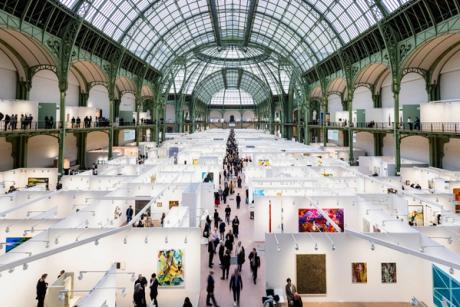
Art Basel will compensate dealers for the early closure of its Paris fair, held from 20-23 October in the Grand Palais, the fair company announced today (11th November), on a French national holiday.
The fair was forced to shut down its Parisian outing two days early because of violent rioting in the French capital. Since then, dealers have been demanding compensation for their lost sales and stand fees. Indeed, soon after the closure the French Comité Professionnel des Galeries d’Art (CPGA) sent a strongly worded letter to the fair director, Karim Crippa. It accused the firm of not consulting with dealers—the CPGA represents 57 of the fair’s 211 exhibitors—and of showing “disrespect, even contempt” for them.
The closure hit the smaller dealers particularly hard, since the biggest galleries tended to make sales on the opening days, whereas the smaller dealers, mainly sited on the upper floor of the Grand Palais, depended on the two weekend days for business. The letter said it expected “concrete proposals” for this compensation.
Crippa has responded to the letter with an offer of a reduction across the board of 20% of stand fees to all participants. He said: “We believe this approach offers a fair and considered way forward, reflecting our appreciation of the partnership we share and our commitment to strengthening it further.”
Philippe Charpentier of Mor Charpentier gallery, who is the president of the CPGA, tells The Art Newspaper that the compensation rate is what the committee expected.
Nonetheless, if one calculates in percentages, the fair was open for three-and-a-half days—its ultra-VIP Avant-Première timeslot began at 3pm on Tuesday 20 October, and the fair closed on Friday—instead of the projected five-and-a-half. The fair was therefore shortened by about 36%.
Speaking about the decision to close the fair early, Noah Horowitz, the chief executive of Art Basel, tells The Art Newspaper: “We stand by the decision to close. We feel it was in the right interest of all the parties involved. It was a very difficult decision, but we stand by it.”
Asked about the decision to close for the two days—when unrest was only expected on the Saturday—he says: “Given the uncertainty surrounding the impact and the duration of the planned demonstrations and access to the Grand Palais, we simply couldn’t be confident that conditions would allow us to reopen safely on Sunday. An event of this size and scale is incredibly complex, and some exhibitors had also expressed serious concerns about leaving artworks unattended in the Grand Palais on the weekend. We concluded that closing the fair early was in the best interests of the art, the staff and ultimately the visitors.”
Horowitz is not prepared to comment on other aspects of the closure—for example, questions of insurance or the firm’s relationship with the Grand Palais, for which MCH paid €10.6m to rent the space for seven years in 2022. Horowitz says that MCH, the parent company of the Basel group of art fairs, is “fully committed to delivering the 2027 edition of the fair”.