

The latest BMNR earnings report puts a hard number on what a year of falling ether prices did to the world’s largest ETH treasury: a net loss of $6.31 billion.
Bitmine Immersion Technologies filed its annual report on Form 10-K with the SEC late on Nov. 10, covering the fiscal year that ended Aug. 31, 2026.
Almost the entire loss, $6.23 billion, came from unrealized fair value declines on digital assets the company still holds.
For Bitcoin investors, one detail stands out: the same filing shows Bitmine’s small BTC position lost far less of its value than its ether stack over the same 12 months.
The bigger question now is whether a treasury model built on one volatile asset can keep raising capital when its book value sits below what it paid.
What Do the BMNR Earnings Actually Show?
Total revenue reached $124.8 million, up from $6.1 million a year earlier, when Bitmine was still mostly a Bitcoin mining and hosting business.
Staking and validation revenue made up $121.4 million of that, about 97% of the total, according to the 10-K.
The top line, however, was dwarfed by the mark-to-market hit.
Under the ASC 350-60 fair value rules, Bitmine booked a $6,229.1 million unrealized loss on its digital assets, against a $805 million unrealized gain the prior year.

ADVERTISEMENT
It also recorded a $143.7 million net loss on ETH-referenced derivative contracts, partly offset by a $257.9 million gain from changes in the fair value of warrant liabilities.
The bottom line was a $6,313.4 million net loss, compared with net income of $348.6 million in fiscal 2025. The company ended the year with an accumulated deficit of about $5.99 billion.
Cash is the other part of the story. Net cash used in operating activities rose to $305.1 million from $4.1 million, while investing outflows, mostly ETH purchases, totaled $12.86 billion.
How Big Is the Gap Between Cost and Value?
Note 4 of the filing lays out the treasury in plain numbers.
On Aug. 31, 2026, Bitmine held 5,901,837 ETH with a cost basis of $19.95 billion and a fair value of $14.56 billion.
That works out to an average cost of about $3,380 per ether against a year-end mark near $2,467, a gap of roughly $5.39 billion.
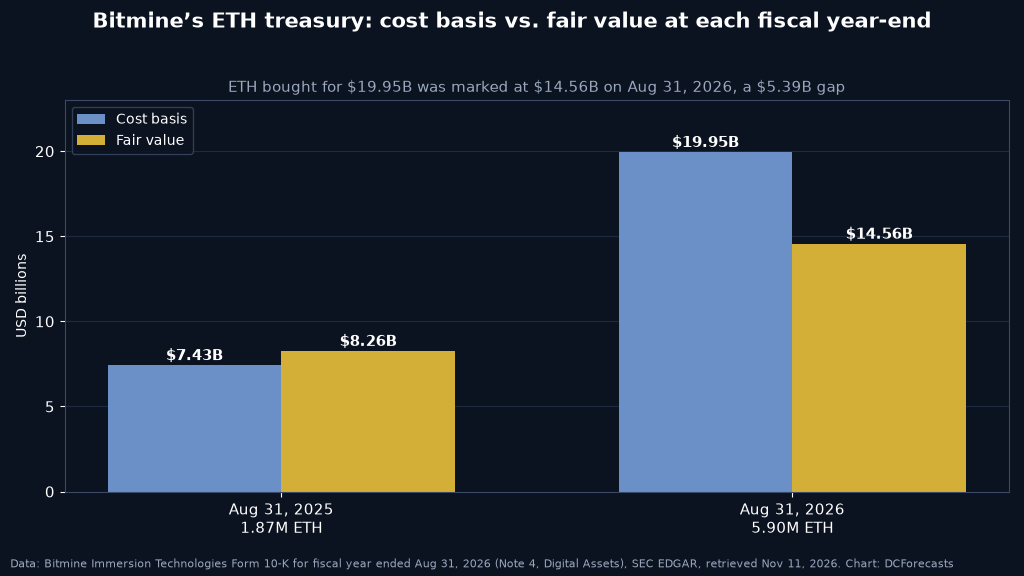
A year earlier, the picture was the reverse. The company held 1,874,927 ETH valued at $8.26 billion, about $834 million above cost.
Bitmine has kept buying since the fiscal year closed. Its Nov. 9 update, filed as an 8-K exhibit, listed 6,070,092 ETH, or 4.97% of supply, with 5,227,037 ETH staked. We tracked that push toward its 5% goal in our earlier coverage.
With ether near $2,081 on Nov. 11, according to CoinGecko data, those 6.07 million tokens are worth roughly $12.6 billion.
Why Bitcoin Held Up Better on the Same Balance Sheet
Bitmine started life as a Bitcoin miner, and it still keeps a small BTC reserve.
The 10-K lists 211 BTC with a fair value of $16.6 million on Aug. 31, 2026, up from 192 BTC a year earlier.
Dividing fair value by units gives a clean comparison of how each asset was marked over the fiscal year.
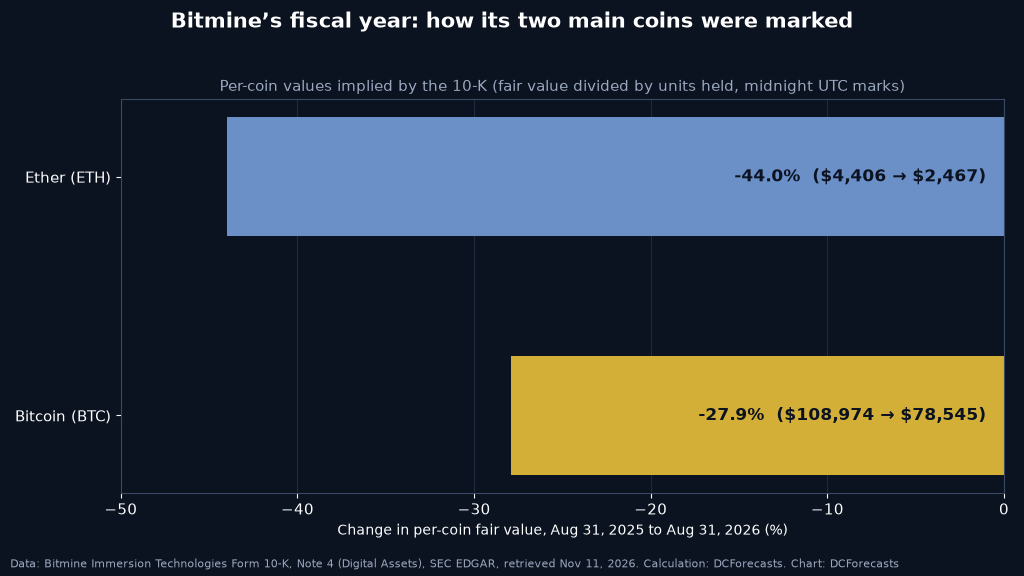
Ether’s implied price dropped 44% to about $2,467, while bitcoin’s fell 27.9% to about $78,545.
Both declines are real, and we do not want to understate them.
Still, the comparison matters. Bitcoin absorbed a tough macro year with a drawdown roughly 16 percentage points smaller than ether’s, on the same company’s own accounting.
That resilience fits a pattern we flagged when the ETH/BTC ratio slid to its weakest level since July.
We believe that is the quiet lesson for treasury companies: the asset with the deepest liquidity and the simplest monetary story tends to hold its value better when markets tighten.
Can the Treasury Model Keep Funding Itself?
Bitmine’s own risk factors are candid about the pressure points.
The company warns that large reported losses “may adversely affect investor confidence, analyst coverage, index inclusion, and the willingness of counterparties to transact with us.”
It also flags a possible “premium collapse,” since the strategy relies on its shares trading at a premium to the assets behind them.
During the year, Bitmine bought back 20,819,071 shares at an average of $17, about $354 million, and still had $3.6 billion of authorized repurchase capacity at year-end.
It raised preferred capital too, pricing 3.5 million shares of 9.50% Series A Preferred Stock in June, which adds a fixed dividend to fund.
Management also disclosed material weaknesses in internal control over financial reporting that it is working to remediate.
On the positive side, staking gives Bitmine an income stream a pure holding company lacks, with the filing citing a gross annual rate of about 2.5% to 4.0% on staked ETH.
A similar paper-gain dynamic, running in the other direction, drove SharpLink’s quarterly profit earlier this month.
What Should Investors Watch After the 10-K?
We would watch three things in the coming weeks.
- Whether ether can recover toward Bitmine’s roughly $3,380 average cost, which would need a gain of about 62% from $2,081.
- Whether BMNR shares keep a premium to the value of its holdings, which governs how cheaply it can issue new stock.
- The company’s 10-QT transition report for the three months ended Nov. 30, which it plans to file as it moves its fiscal year-end to Dec. 31.
Bitcoin, meanwhile, traded near $74,500 on Nov. 11, according to CoinGecko data, up about 1.2% over 24 hours.
Its fixed 21 million supply, deep spot ETF market and growing list of corporate holders give it a sturdier base than any single-company treasury bet.
The coming weeks will show whether Bitmine’s paper loss turns out to be a low-water mark, and whether more treasuries decide that the most durable reserve asset is the one Bitmine started with.
DC Forecasts is a leader in many crypto news categories, striving for the highest journalistic standards and abiding by a strict set of editorial policies. If you are interested to offer your expertise or contribute to our news website, feel free to contact us at [email protected]