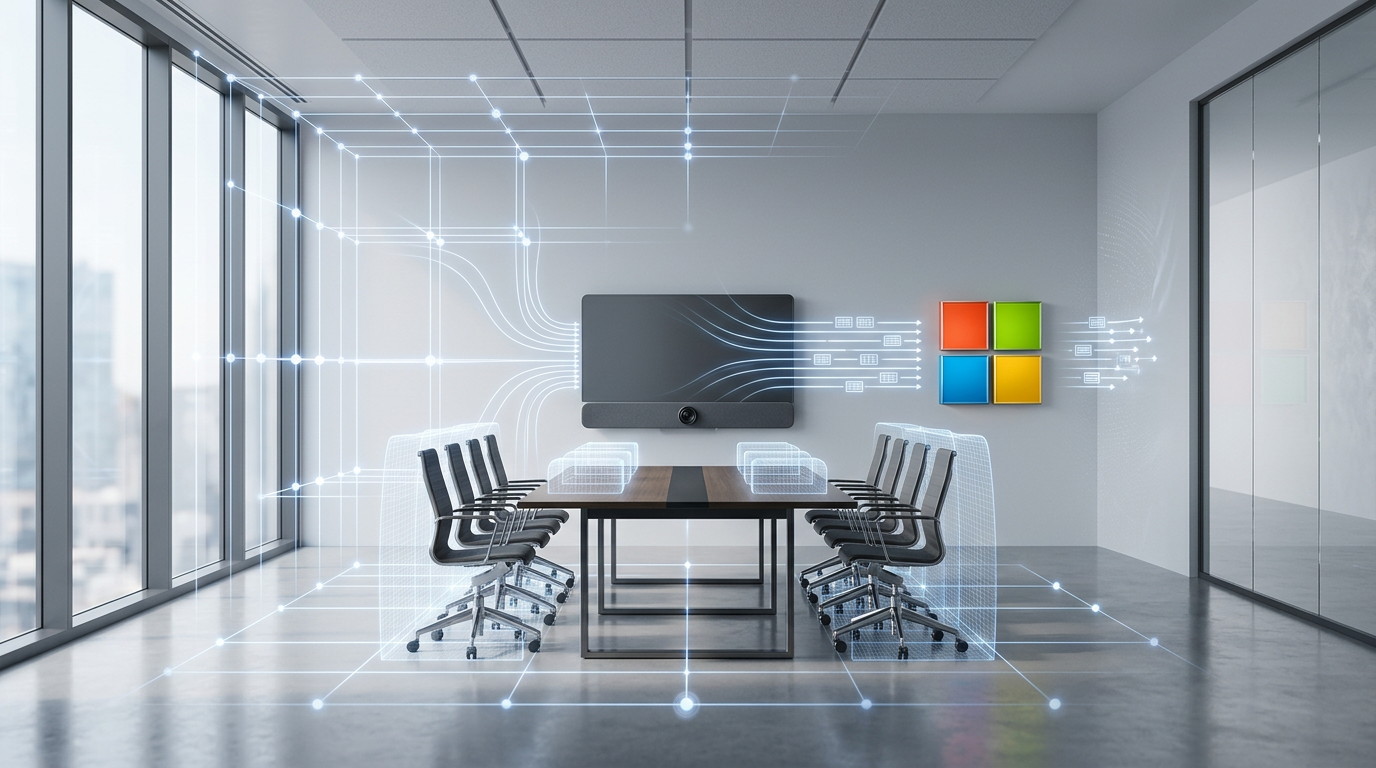


Office utilization vs productivity has become one of the most misunderstood equations in workplace management and analytics. Many organizations see rising badge swipes, fuller floors, and higher desk usage, and then assume productivity should rise with it. But occupancy data only proves one thing: people were in the building. It does not prove they collaborated effectively, made faster decisions, reduced friction, or produced better outcomes.
That is why so many workplaces look ‘busy’ again while leaders still report slow execution, meeting overload, and inconsistent cross-team delivery. The office can fill up without getting better at work. For workplace experience and real estate leaders, this is not a culture failure. It is often a measurement failure.
‘If you only track occupancy, you will optimize for presence. If you track outcomes, you will design for performance.’
In early consideration, the priority is not to defend hybrid work or push a return-to-office narrative. The priority is to separate signal from noise in workplace occupancy analytics. The strongest workplace programs treat utilization as one input, not the success metric. They connect space data to outcomes like decision velocity, collaboration quality, employee experience, and the cost of work.
Related Articles
Why Does Office Utilization Fail to Improve Productivity?
Direct answer: Office utilization fails to improve productivity because occupancy measures ‘attendance’, not ‘effectiveness’, and busy spaces can still produce fragmented work and high coordination overhead.
A full office can still be a low-performance environment if the work happening inside it lacks structure. Employees can spend the day in meetings that do not resolve decisions. They can sit near colleagues but still work asynchronously on different priorities. They can come in for visibility rather than value, then compensate by working later to finish deep tasks.
This is why office effectiveness strategy cannot start with utilization targets alone. A utilization-first approach rewards behavior that looks good on dashboards, while leaving the real blockers untouched: unclear ownership, slow approvals, duplicated work, and poor coordination across teams.
What Disconnect Exists Between Occupancy and Performance?
Direct answer: The disconnect exists because occupancy is a ‘volume’ metric, while performance is an ‘outcome’ metric, and the path from one to the other is not automatic.
Occupancy answers ‘how many’ and ‘how often’. Performance answers ‘so what’. Many organizations treat presence as a proxy for collaboration. They assume that if people are together, collaboration must be happening. But proximity does not guarantee coordination. It can even increase interruption costs, reduce focus time, and inflate meeting load.
This is where employee productivity measurement workplace efforts often fail. Teams try to infer output from inputs because outputs feel complex, political, or hard to instrument. The result is a reporting model that overvalues footfall and undervalues flow.
How Do Hybrid Work Patterns Distort Workplace Metrics?
Direct answer: Hybrid work distorts metrics because attendance clusters on the same days, which inflates utilization without proving sustained performance gains.
Hybrid patterns often create ‘busy days’ rather than ‘effective weeks’. Office utilization spikes midweek, while Mondays and Fridays remain quiet. That pattern can produce the illusion of a recovered workplace. In reality, it can create a schedule where teams pack collaboration into a narrow window, then push deep work into the edges of the week.
In analytics terms, this is a distribution problem. Average utilization can hide volatility. Peak occupancy can mask underused space. Most importantly, none of these signals explain whether work improved. That is why hybrid workplace performance requires more than counting bodies. It requires connecting patterns of presence to patterns of output.
Where Does Presence Fail to Translate into Outcomes?
Direct answer: Presence fails to translate into outcomes when the workplace does not reduce friction in the work system, including decision-making, coordination, and execution.
Workplace leaders often focus on the environment: desks, zones, rooms, amenities, and policies. Those matter, but they do not automatically fix the mechanics of collaboration. If teams still lack clear decision rights, if dependencies remain hidden, and if approvals remain slow, the office becomes a more expensive backdrop for the same friction.
This is where ‘busy’ becomes deceptive. You can see activity everywhere, but progress does not accelerate. People interact more, but decisions still stall. Meetings increase, but output does not. In that scenario, the office becomes a stage for coordination overhead.
How Should Organizations Measure Workplace Effectiveness?
Direct answer: Organizations should measure workplace effectiveness by linking space and behavior signals to outcomes, not by using occupancy as the headline KPI.
A more useful measurement model treats workplace occupancy analytics as a diagnostic tool. It helps leaders ask better questions, not claim success. The goal is to create a balanced scorecard that includes utilization, but also shows whether the workplace improves the way work moves.
In practice, that means building a measurement approach that can answer five operational questions:
- Did time-to-decision improve for cross-functional work?
- Did collaboration become more intentional, or just more frequent?
- Did meeting volume rise, fall, or shift toward higher quality interactions?
- Did deep work time increase or decrease on office days?
- Did teams report lower friction in coordination, handoffs, and approvals?
This is the core of office utilization vs productivity. Utilization tells you whether space is used. Effectiveness tells you whether space is useful. The second question is the one your stakeholders actually care about.
A final note for early consideration: leaders do not need perfect measurement on day one. They need better measurement than ‘busy equals better’. Start by separating presence metrics from outcome metrics. Then build a feedback loop where workplace changes can be tested, measured, and refined. That is how workplace management and analytics becomes a performance function, not just a facilities report.
FAQs
Why does office utilization fail to improve productivity?
Because utilization measures attendance, not effectiveness. A busy office can still produce high meeting load, fragmented work, and slow decisions if coordination friction remains.
What disconnect exists between occupancy and performance?
Occupancy is a volume metric. Performance is an outcome metric. Without measuring decisions, delivery, and collaboration impact, occupancy cannot prove productivity gains.
How do hybrid work patterns distort workplace metrics?
Hybrid schedules cluster attendance on specific days. This inflates utilization and peaks, but it does not prove sustained improvements in output or collaboration quality.
Where does presence fail to translate into outcomes?
Presence fails when the workplace does not reduce friction in decision-making, approvals, coordination, and execution. Activity increases, but progress does not.
How should organizations measure workplace effectiveness?
Use a balanced scorecard. Combine workplace occupancy analytics with outcome metrics such as time-to-decision, meeting quality signals, deep work time, and reported coordination friction.