


For decades, the Blaquier-Arrieta collection was reportedly kept “under lock and key” at the family estate outside of Buenos Aires, Argentina. Today, five of its paintings are being unveiled at Sotheby’s in London, as the auction house begins an international tour of Impressionist and Modern masterpieces assembled by the Argentine sugar industry heiress Nelly Arrieta de Blaquier and her husband, Carlos Pedro Blaquier.
Twelve paintings from the collection, one of the great remaining private holdings of its kind, are expected to fetch around $450m when they go under the hammer in New York in November.
The decision to show these works in London is not incidental. Seven of the 12 paintings Sotheby’s is offering were bought from the Lefevre Gallery on Bruton Street in the 1970s, when the Argentine couple would come to London almost every year in search of art. “It’s a time capsule of that golden moment,” says Helena Newman, Sotheby’s chairman of Impressionist and Modern art.
Of the London highlights, there is a late Harlequin painting by Paul Cezanne, not exhibited in London since 1954. No comparable portrait has appeared at auction since 1988. “At public auction, there hasn’t been anything at this level,” Newman says. Sotheby’s expects it to make “around $120m”, which would be a record for the artist at auction, although in 2012 the Qatari state reportedly paid more than $250m for Cezanne’s The Card Players (around 1890) in a private sale.
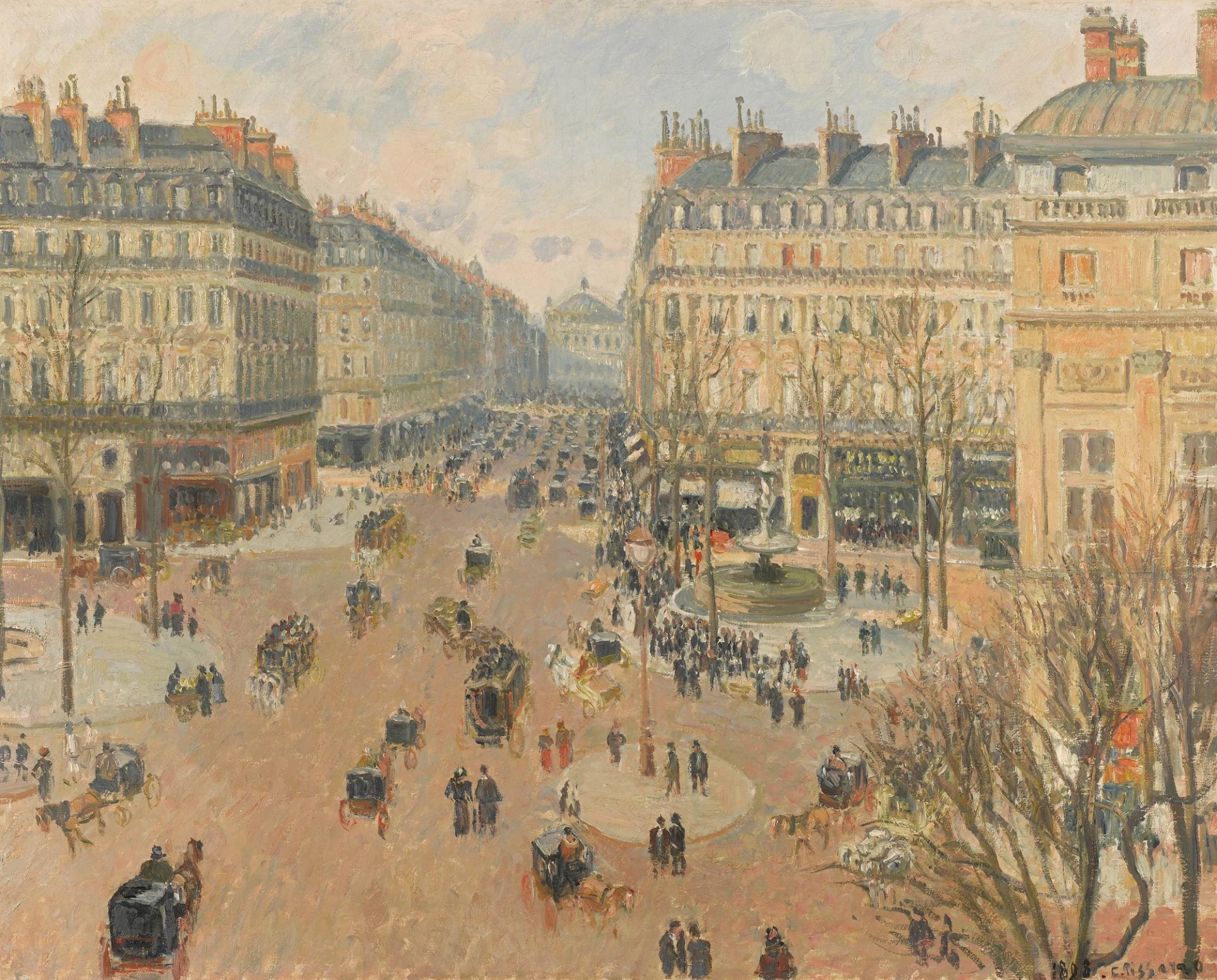
Camille Pissarro’s grand Parisian streetscape La Place du Théâtre-Français, soleil d’après-midi en hiver (1898) is estimated to sell for $30m-$40m Courtesy of Sotheby’s
Camille Pissarro’s grand Parisian streetscape La Place du Théâtre-Français, soleil d’après-midi en hiver (1898) (est $30m-$40m) was last seen in London in 1942-43; Claude Monet’s Le Jardin des Tuileries (1876) (est $15m-$20m) in 1957; and Maurice de Vlaminck’s fiery Nature morte à la cruche bleue (1906–07) (est $2m-$3m) in 1969. Pierre-Auguste Renoir’s En Canot (Jeune fille à la barque) (est $25m-$35m), painted in 1877, the year the Impressionists took their name, has never been shown in London.
The arrival of these works in London comes as two new exhibitions turn their attention to Impressionism: the Royal Academy’s Painting the French Riviera, featuring works by Picasso, Cezanne and Renoir among others, opens next week (2 October-31 January 2027) followed by the National Gallery’s Renoir and Love the following day (3 October-31 January 2027).
Absent from the Sotheby’s presentation is Vincent Van Gogh’s Châtaignier en fleurs roses et blanches, painted at Auvers-sur-Oise, a town just outside of Paris, in May 1890, in the final months of the artist’s life. It was last shown publicly at New York’s Guggenheim in 1964. Estimated at $180m, Sotheby’s expects it to beat Van Gogh’s existing auction record, currently $117m for Orchard with Cypresses (April 1888), which sold at Christie’s, New York in 2022 and came from the collection of Microsoft co-founder, the late Paul Allen. Newman believes Châtaignier en fleurs roses et blanches could reach $200m or more. “It’s a market-defining moment to have an 1890 Van Gogh come through,” she says. “It’s incredibly rare.”
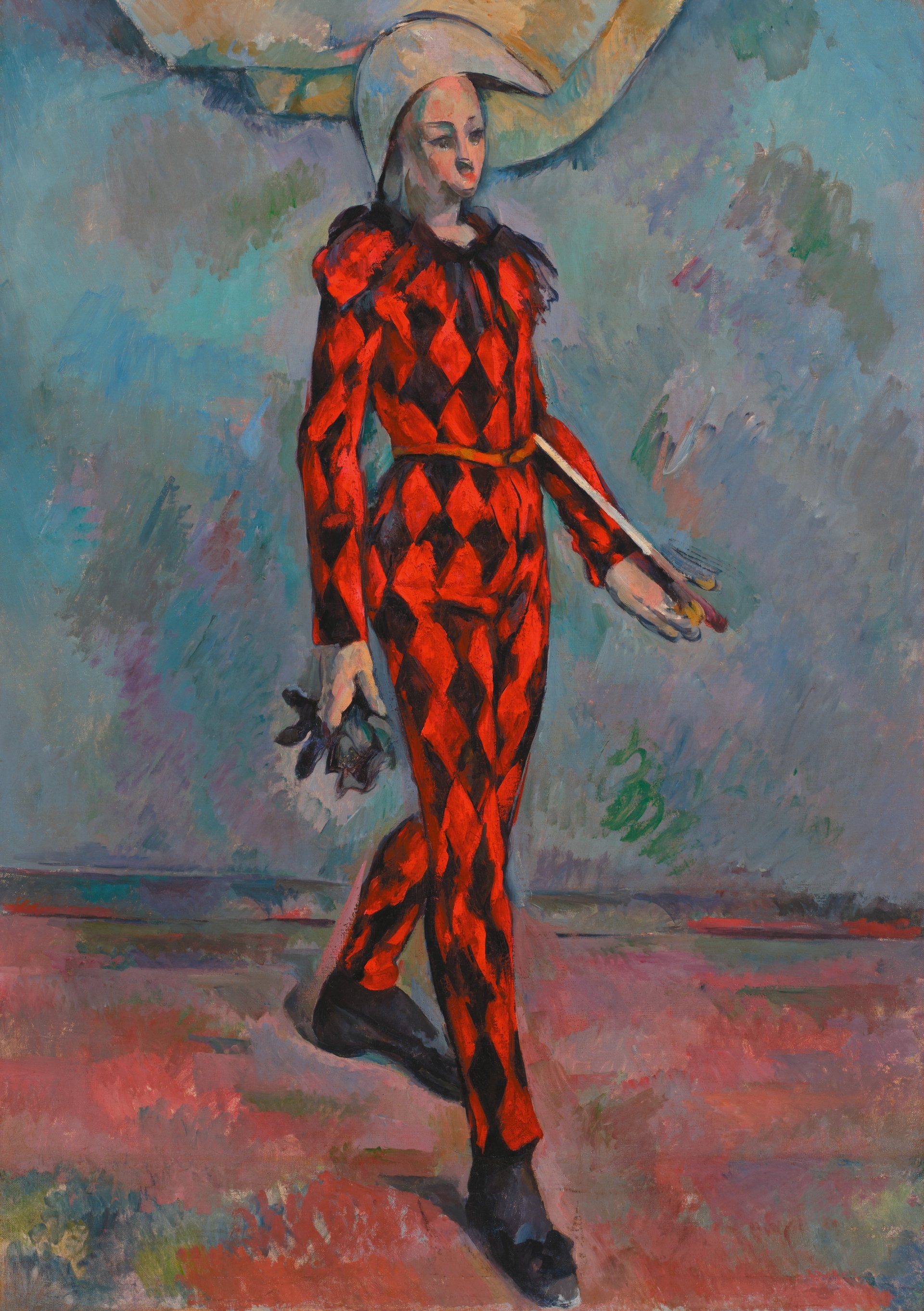
Arlequin (1888–90) by Paul Cezanne, is estimated in the region of $120m Courtesy of Sotheby’s
Of the works Van Gogh produced during his final months at Auvers, Châtaignier en fleurs is one of the few major examples still in private hands. Its heavily worked surface—the flowering chestnut tree built up in vigorous strokes of green, blue and yellow—belongs to the intense burst of creativity that followed Van Gogh’s arrival at Auvers.
Newman says “scheduling issues” meant the painting could not be shown in London, but there are plans for it to be exhibited as part of the tour. After London, the collection travels to Taipei, Hong Kong and Paris before the New York sale. Taiwan is a particularly important stop, Newman says, because of its “deeply embedded, established collectors of masterpieces of Impressionist art”.
A dispute with Argentinian customs officials over the export of about a dozen paintings from the collection to Luxembourg in 2023 was resolved earlier this year, according to Sotheby’s.
The great wealth transfer
In 1995, the New York Times described María Elena “Nelly” Arrieta de Blaquier as the owner of “Argentina’s largest private art collection”. She was reportedly the sole heir to Ledesma, Argentina’s sugar giant, and married Carlos Pedro Blaquier in 1951. He became president of the company in 1970, a position he held until 2013.
Blaquier was charged in 2012 with allegedly participating in kidnappings during Argentina’s military dictatorship in 1976. He denied the allegations and died without standing trial.
According to reports, the couple separated several decades ago. Nelly died in 2020 and Carlos in 2023.
For decades, the Blaquier-Arrieta collection itself was something of a closed book in Argentina: a vast holding of European and Latin American art assembled and kept at the family estate, La Biznaga. Nelly was a major cultural patron and chaired the Friends of Argentina’s National Museum of Fine Arts, very occasionally showing selected treasures to visiting collectors and museum directors.
Unsurprisingly the major auction houses have been vying for the contents. Christie’s had previously handled works from the collection, including Van Gogh’s The Zouave (1888), reportedly sold privately for around $190m, as well as two Signac paintings.
Newman confirmed that Sotheby’s guranteed the 12-piece collection is, though declined to disclose the amount. The guarantee, she says, was one factor in Sotheby’s pitch, alongside its relationship with the family, proven track record with single-owner collections and expertise. “What I can say is that we’re expecting the collection to reach in the region of $450m,” Newman says, adding: “Plus, maybe plus.”
The timing is also significant. After years in which contemporary art dominated the top end of the auction market, there is a renewed appetite for established Impressionist and Modern names. “What we’re seeing is a return of interest in the very top blue-chip quality,” Newman says, describing the current market moment as “almost like a return to order”.
It is also a moment when vast sums of wealth—and art collections—are being passed down the generations. “Like a lot of these big collections, it’s part of a generational change that is being worked through by the family,” Newman says, noting that the Blaquier family is retaining important Argentine and Latin American holdings while releasing the Impressionist core.
The question now is whether there is the depth of demand for the next generation to take up the baton. Recent auction results for older material would suggest they are.