

Since the US military, under the direction of President Donald Trump, captured and extradited the Venezuelan president Nicolás Maduro and his wife Cilia Flores on 3 January, international attention has focused on political turmoil in the country and American designs on its vast oil resources. Venezuela also has natural, architectural and archaeological riches—including three Unesco World Heritage Sites—but with the country currently locked in geopolitical limbo, their future is uncertain.
The city of Coro and its port, located in the state of Falcón in the country’s north-west, dates from 1527 and was the first community in South America to achieve independence from Spain. According to Unesco, the site is unique on the Caribbean coast, and has outstanding universal value, as its buildings are constructed with earthen architecture and traditional mud building techniques including bahareque (a system using mud, timber and bamboo), adobe and tapia (rammed-earth) that are still in use today.
Coro’s historical value, according to Unesco’s listing, derives from its hybrid of colonial-era Spanish and Mudéjar architectural styles with Indigenous bulding traditions. From the middle of the 17th century, the city’s built character was further influenced by Dutch architectural practices on the neighbouring islands of Curaçao and Aruba. The city’s unique cultural mélange also includes a historic Jewish cemetery.
But Coro and its port, first inscribed as a World Heritage Site in 1993, were added to Unesco’s list of World Heritage in Danger in 2005 due to a host of challenges. These include environmental risks and the historic architecture’s material fragility, concerns that were driven home in 2004 and 2005, when heavy rains damaged several buildings and public spaces. Another threat has been what Unesco calls “inappropriate development” within the city due to a lack of planning oversight and formal preservation controls.
Around 450km east of Coro, in the capital Caracas, sits Venezuela’s newest Unesco World Heritage Site. The Ciudad Universitaria de Caracas was designed by the London-born Venezuelan architect Carlos Raúl Villanueva (1900-75) and built between 1940 and 1960. It is considered an outstanding example of Modernism in architecture. The campus includes an extensive urban plan and a large number of buildings, many made of reinforced concrete; among them is the Aula Magna auditorium, housing the Alexander Calder sculpture Floating Clouds (1953), which doubles as an acoustic calibration system.
The campus also includes Villanueva’s Olympic Stadium and distinctive Plaza Cubierta, an open-air space crisscrossed by concrete-covered walkways. In addition to Calder’s acoustic clouds, the campus features site-specific works by leading artists including Jean Arp, Fernand Léger, Jesús Rafael Soto, Victor Vasarely and Gego. While not on the list of endangered heritage sites, the Ciudad Universitaria faces challenges, too, including from the growth of residential and commercial areas at its south and west boundaries, which Unesco says requires the creation of a buffer zone.
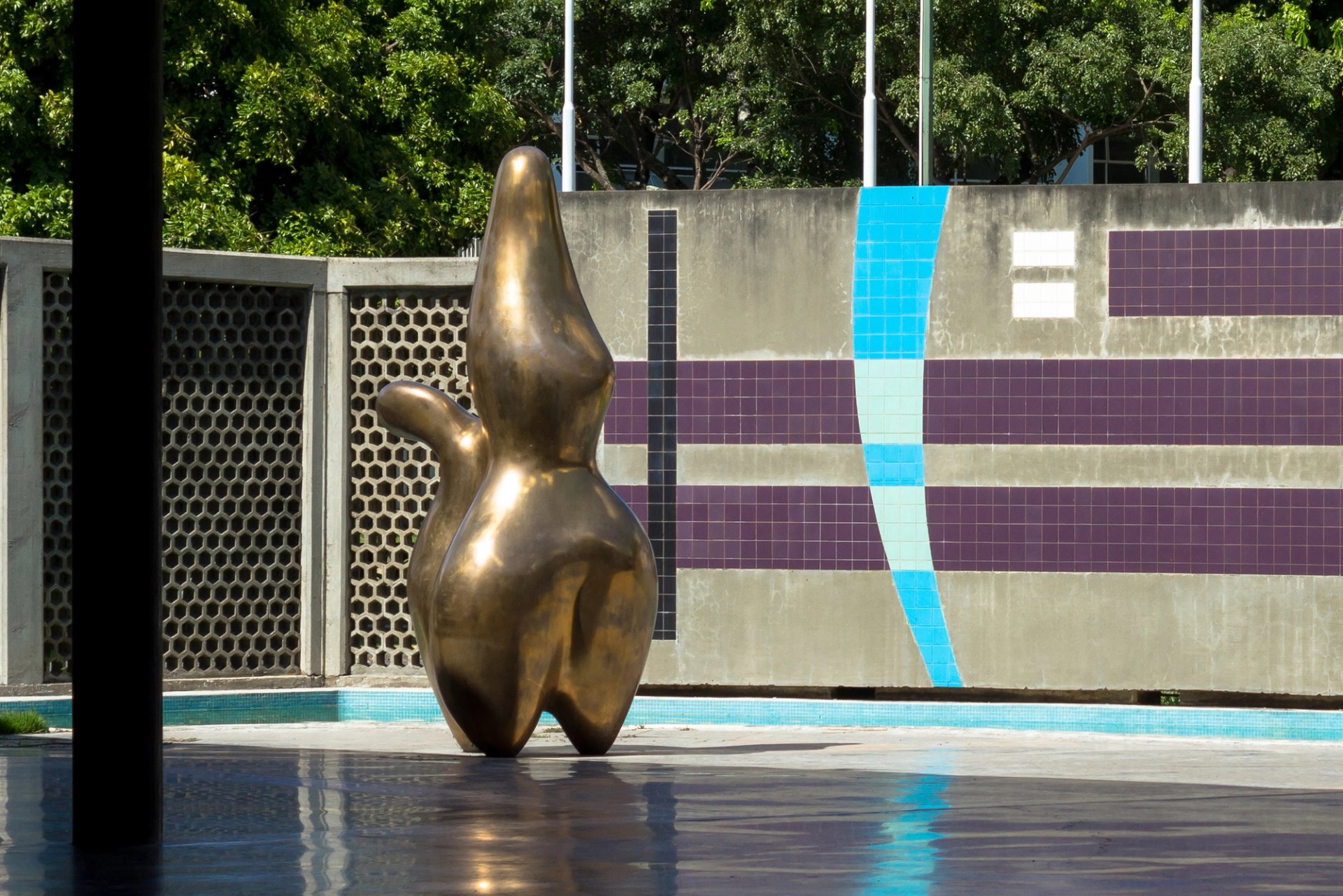
El Pastor de Nubes (1953) by Jean Arp at Ciudad Universitaria de Caracas, a World Heritage Site © Davisuals
Venezuela’s third Unesco World Heritage Site and its biggest tourist attraction is Canaima National Park, in the state of Bolívar in the country’s south-east. It is known for its stunning landscapes, distinctive tepuis (table-top mountains), rich biodiversity and Angel Falls—the world’s tallest uninterrupted waterfall. The foundational myth of the region’s native Pemón people is that the tallest tepuis, Mount Roraima, is the stump of the divine tree that once bore all the world’s fruits and vegetables. Tales of its grandeur by the British explorer Everard im Thurn are said to have inspired Arthur Conan Doyle to write his novel The Lost World (1912).
But according to Unesco, the three-million-hectare park is also at risk. According to a 2025 report, threats to the park include wildfires, legal and illegal mining, and conflicts between Venezuela’s national guard and the region’s Pemón communities.
The campaigning group SOSOrinoco—comprised of a “group of experts” working anonymously due to the risk of retaliation—has published damning allegations about the effects of illegal mining on Venezuela’s natural heritage, including in Canaima National Park.
But mining activities have since spilled beyond the designated areas and into protected spaces
According to SOSOrinoco, Maduro designated a large area in southern Venezuela as the so-called Mining Arc of the Orinoco in 2016—which the group claims “has no formal structure or geographic boundaries”—opening up the territory to mining operations (mainly gold and coltan). But mining activities have since spilled beyond the designated areas and into protected spaces including Canaima National Park, Yapacana National Park and the Upper Orinoco-Casiquiare Biosphere Reserve. The organisation attributed the expansion of mining activities to “shell companies” and “irregular actors that are being shielded by the government”, including organised criminal syndicates and Venezuelan military officers.
Venezuela’s political crisis has made it difficult to contact heritage professionals in the country or assess the risks posed to heritage sites. A Unesco spokesperson tells The Art Newspaper: “Based on the information currently available to Unesco, the situation does not point to any specific or immediate threat to the World Heritage Sites in Venezuela. Unesco continues to monitor developments closely and stands ready to react as needed.”
A history of neglect
The vulnerability of Venezuela’s historic and cultural sites predates the current political crisis by several decades and is rooted in longstanding structural weaknesses in heritage governance, land-use planning and cultural policy.
“Venezuela preserves an exceptionally rich and diverse precolonial heritage, shaped by multiple cultural traditions such as Arawakan- and Cariban-speaking societies, as well as earlier populations whose material and symbolic traces remain visible across the territory,” says Adine Gavazzi, an architect specialising in anthropology who is the Unesco chair of the University of Genoa and Università della Svizzera Italiana. She has studied the region’s heritage and last year curated a book of archaeological research on the wider Amazonian region.
“Despite its importance, much of Venezuela’s pre-Hispanic heritage needs to be documented more for it to become internationally visible,” she says. “While legal protection exists through the [government’s] Instituto del Patrimonio Cultural, conservation and research face structural and logistical limitations.”
Due to Venezuela’s accelerated modernisation, oil-driven urban expansion and infrastructure development between the 1920s and 80s—which often proceeded without systematic heritage impact assessments—many archaeological sites were destroyed or left exposed during road construction, mining and agricultural expansion. Historic urban centres were altered through poorly regulated redevelopment. Rock art sites, caves and open-air archaeological vestiges were left minimal legal protection, monitoring or interpretation.
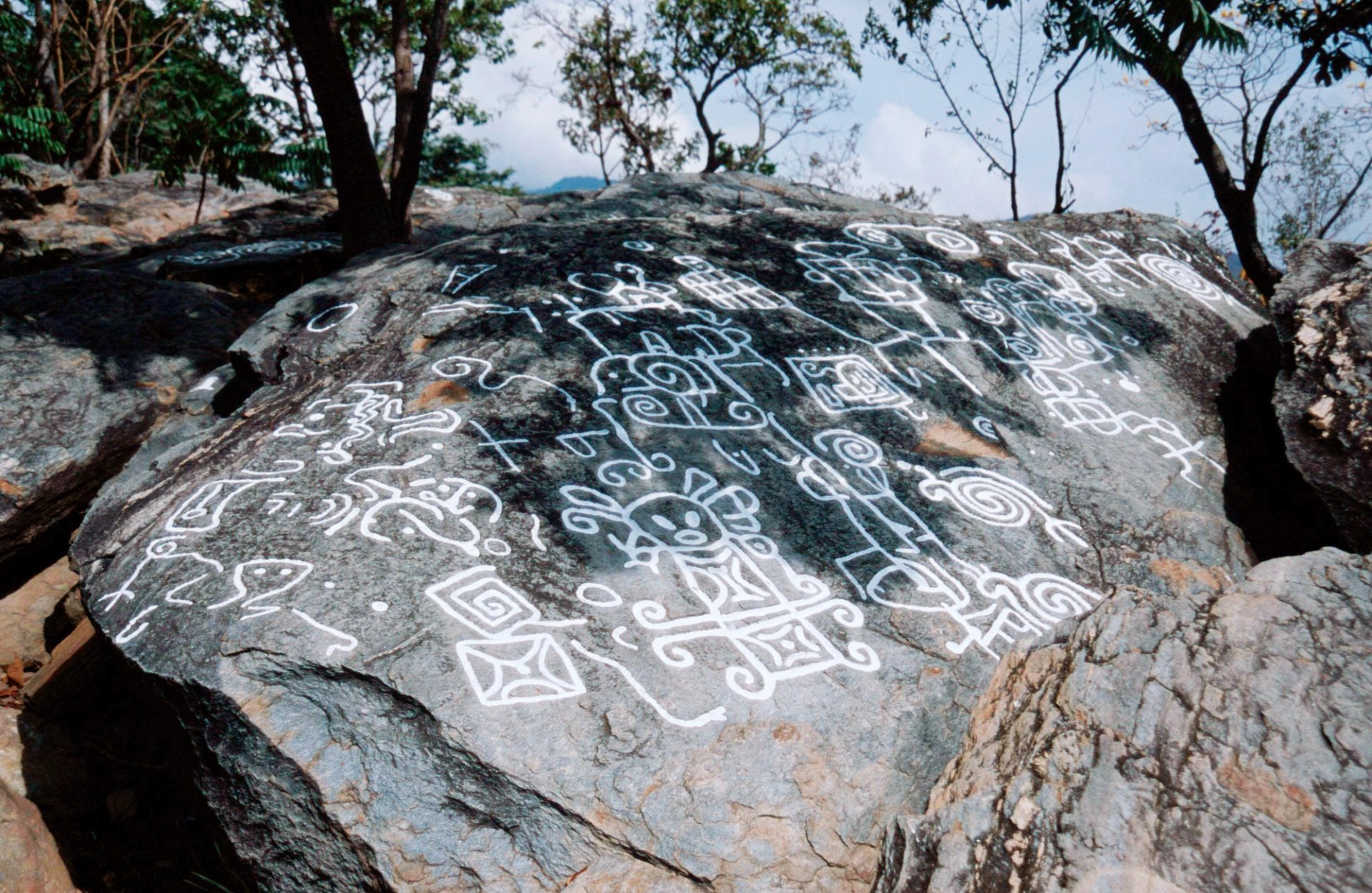
Petroglyphs at Venezuela’s Vigirima site, part of the country’s rich heritage in need of protection ImageBROKER.com/Alamy Stock Photo
By the beginning of the 21st century, international assessments—such as the conservation organisation Icomos’s Heritage at Risk reports—had identified Venezuelan fortifications, historic towns, vernacular settlements and archaeological landscapes as being under threat due to abandonment, inappropriate interventions and environmental degradation. Numerous rock art sites including Taima-Taima in the north near Coro, and Vigirima near Valencia, Venezuela’s third-largest city, were already experiencing physical decay, vandalism and looting long before Maduro’s ousting last month.
When it comes to heritage protection, the current crisis is not the problem—it goes way back
José Miguel Pérez-Gómez, archaeologist
“When it comes to heritage protection, the current crisis is not the problem—it goes way back,” José Miguel Pérez-Gómez, an archaeologist at Universidad Simón Bolívar in Caracas and contributor to Gavazzi’s book, tells The Art Newspaper. Lack of information and education, he says, are the greatest culprits. “You can’t protect sites if you don’t educate the people about their own heritage.”
To that end, Pérez-Gómez and a team of colleagues have been working in Canaima National Park for 15 years and are turning recent discoveries into opportunities for public education. The group’s 2009 discovery of unusual red-and-yellow pictograms on the wall of a rock shelter at the foot of a mountain called Upuigma-tepui, apparently unknown to even local Pemón communities, led to further discoveries of advanced ceramics and tools. The team’s working hypothesis is that these images and objects belonged to an ancient, 10,000-year-old culture and that Cainama was their “ground zero”.
Pérez-Gómez says that, due to similar motifs found in neighbouring Brazil, Guayana and Colombia, his team believes that this ancient culture may have spread beyond modern Venezuelan territory. The team hopes to do more research to determine exact dating of the pictograms and artefacts, though that is impossible under the present circumstances. Eventually, Pérez-Gómez hopes that Unesco will name Canaima National Park as an important “cultural landscape”, recognising its importance beyond its natural heritage.
“If Unesco declares this place a cultural landscape, then, after the proper environmental assessments, guided archaeological tours can be developed,” Pérez-Gómez says. And when Venezuela is able to rebuild its economy, he adds, this kind of cultural tourism could become “a new opportunity for the Pemón community”.